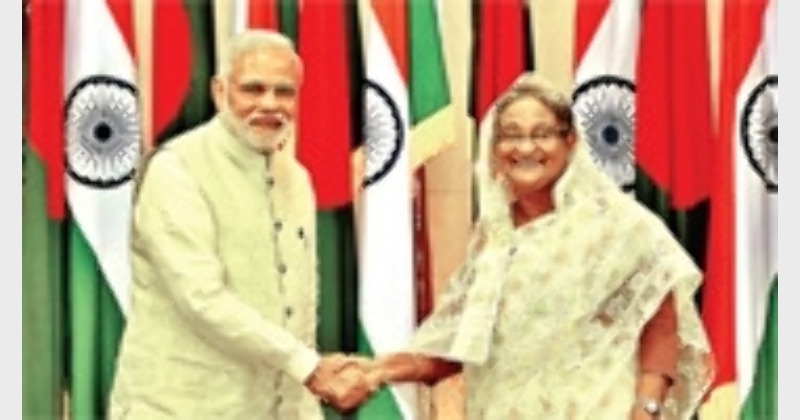
Intro: Prime Minister Narendra Modi’s visit to Bangladesh has set the tone for future cooperation between the two counries.
Undoubtedly, one of the hallmarks of the present Prime Minister Narendra Modi led Government has been the discernible transformation in the foreign policy front. India has admirably transformed from pursuing a hesitant foreign policy for over 6 decades to a proactive and purposeful foreign policy in positioning herself as an emerging global superpower. Special emphasis has been witnessed in the form of the ‘Neighbourhood First Policy’, which has been armed with the goal of regional co-operation.
Subject experts debating and discussing the growth chart of South Asian countries have always argued and reasoned that South Asian countries have increasingly acknowledged that the regional approaches and common actions are essential to accomplish their development goals. This is the very purpose for SAARC to come into being. There are several benefits for regional cooperation, namely, a country’s economic system becomes regionally interconnected, speeds up economic growth, enables the fight to eliminate poverty and ensures in generating employment opportunities. Position papers have always focussed on the fact that countries like Nepal, Afghanistan and Bhutan often find it difficult to fund the large infrastructural projects making a regional approach more attractive. Study has also pointed out that South Asian governments have recently given greater attention to regional and global linkages. Countries like Bangladesh, Nepal and Bhutan have emphasised on regional connectivity in their respective policy decisions.
It is in this context that PM Narendra Modi elucidated his vision in his first ever address at the SAARC summit, wherein he stressed on the need to integrate the SAARC countries on four vital pillars namely rail, road, power and transit :
“Today goods travel from one Punjab to another Punjab through Delhi, Mumbai, Dubai and Karachi – making the travel eleven times longer and the cost four times more. India too has her share of her responsibility – because of our size and location. I know that many of your goods have to do a Parikrama of India to reach their destinations. Just think of what we are doing to our consumers and to the environment. We must shrink the distance between our producers and consumers and resort to using the direct routes of trade. I know India has to lead, we will do our part, I hope each of you will too.”
True to these words at the previous SAARC summit, efforts on behalf of PM Modi and the Government of India have never ceased; the Prime Minister’s recent visit to Bangladesh gave birth to the much needed SAARC sub-regional development plan, which has been in the offing since the 2010 SAARC Summit. In specific, the recent signing of the Coastal Shipping agreement between India and Bangladesh integrates Nepal and Bhutan and eventually leads to boosting economic co-operation, bilateral trade and most significantly people-to-people contacts. The agreement which was actually forged between India and Bangladesh in 2010 but signed now, serves as a critical stepping stone for opening connectivity, not only between Bangladesh and India, but also with Bhutan and Nepal, helping identify the most efficient regional and international transport routes. Yes, the successful forward movement of the sub regional grouping of Bangladesh, Bhutan, India and Nepal (BBIN) has made connectivity its priority in the form of the Coastal Shipping Agreement.
Soon after the signing of the agreement, India’s Foreign Secretary S. Jaishankar outlined the importance of such a coastal agreement with Bangladesh, “We see this as really a very key understanding that would allow us to use our common bay and each other’s waterways for movement of cargo. As of now, the bulk of our trade takes place across the land border, and to the extent that we have sea trade this is done through distant ports. The goods are taken to distant ports and then they are reloaded into feeder vessels which then bring them into Chittagong. What this Coastal Shipping Agreement would do is basically enable the direct regular movement of ships between India and Bangladesh, which would bring the shipping time down from 30 to 40 days on average to 7 to 10 days,” he said.
India's trade with Bangladesh has grown rapidly during the past few years. Bangladesh is now India's largest trade partner in South Asia. As per the agreement, the opening up of the coastal route between India and Bangladesh is expected to provide an alternative route for the transportation of Exim (Export-Import) cargo between the two countries. Exim trade between India and Bangladesh would be benefited by way of reduction in freight charges. It will also improve the utilization of port capacities of Indian ports and open up new opportunity for Indian coastal vessels. It will also help in decongestion of roads especially at the Land custom stations and integrated check posts at the Indo-Bangladesh boarder.
The agreement also allows Bangladesh to engage with Nepal and Bhutan in the sphere of bilateral trade. This is one of the most vital takeaways from the BBIN agreement; improved connectivity will help increase in bilateral trade across the four countries which in turn will help the countries help reap the benefits of growth. Indian Prime Minister’s commitment of ease of doing business and speeding up of infrastructure facilities in the borders will only add to India’s consistent and continuous efforts of maximizing India’s trade ties with her immediate neighbourhood. At the 16th SAARC Summit in Thimphu, Bhutan in 2010, member countries declared 2010-2020 as the ―Decade of Intra-regional Connectivity in SAARC. They unanimously acknowledged the importance of developing transport infrastructure and transit facilities, especially for the landlocked countries as a means to promote intra-SAARC trade. This agreement is a significant achievement to achieve the objective of intra-regional connectivity.
The Coastal Shipping Agreement integrating BBIN is a meaningful step initiated by India in realising the ancient virtue of Vasudhaiva Kutumbakam – the entire world is one family. This also reiterates how by operating on the 5 pristine pillars, namely Samman – Dignity and honour, Samvad – greater engagement and dialogue, Samriddhi – Shared prosperity, Suraksha – regional and global security and Sanskriti evam Sabhyata – cultural and civilisational linkages, as outlined in the BJP’s Foreign policy resolution adopted in the party’s national executive meeting, the Government is blending foreign policy with national economic development. Finally, here is a concrete measure that has given new vigour to PM Modi’s strong belief in the shared future of our neighbourhood – together we grow.
Sudarshan Ramabadran (The writer is a Research Associate at India foundation Delhi)