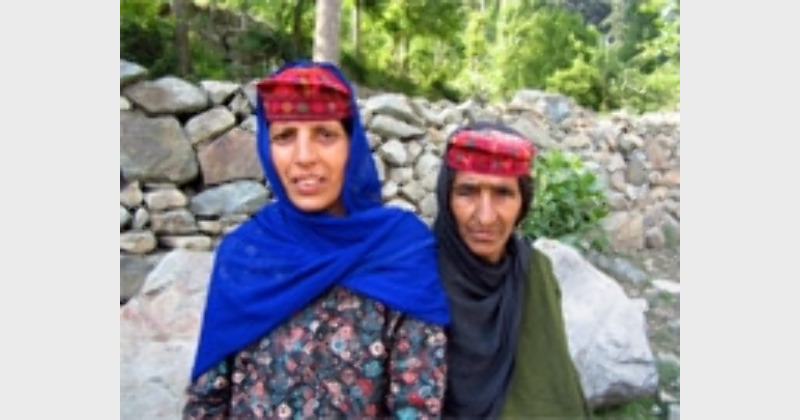
Intro : In an attempt to empower the Scheduled Tribes of Jammu and Kashmir, the state government has set up a separate ministry for STs.
The Jammu and Kashmir state government has set up a
separate ministry now for the Scheduled Tribes (STs) in the state. The Peoples’ Democratic Party (PDP) and the BJP have come together on this truly as alliance partners. There was no bickering on the issue and PDP
minister, Chowdhury Zulfikar Ali, from April 20 will head the new ministry. What was noticeable was that when the announcement for setting up the ministry was made, no Opposition party opposed it. In fact, neither the National Conference (NC) nor the Congress could find a way to oppose the move. Even the Panthers Party, a regional group in Jammu which had some legislators in the past assembly could do anything about the move. Interestingly, the separatists also, who generally have a lot to say on anything that the state government does, kept quiet. For them, opposing a move to benefit about 11 per cent of the population, according to the 2011 census figures, could have only meant further erosion in their swift dwindling base.
For a change, neither Syed Ali Shah Geelani nor Yasin Malik, or for that matter anybody of the separatist
persuasion, said a word about setting up the ministry.
By these indications, it is definitely a good start. The state government in its attempt to empower the STs of the state will hopefully do more in the days to come for the communities.
It is interesting to go back into the history of the state and find more about the STs. Believe it or not, it is said that till
1989-end, no Scheduled Tribes (STs) lived in the state. Does it mean, the STs, start living in the state only after that date? No. They lived here much before that date but were not recognised as STs because of the limited way the Indian Constitution applies in the state.
The State Constitution, which had come into force on January 26, 1957, also did not grant the status of STs to them, and acted as a barrier against the grant of ST status to some communities.
In fact, between August 1947, when our country became independent and November 1989, for over four decades, no community was recognised as ST in Jammu and Kashmir. This resulted in a situation whereby the STs were given special right throughout India, but not in Jammu and Kashmir. As if they never existed in the state! As if they were not
disadvantaged communities and needed no positive discrimination to emancipate them!
For the first time ever, no less than eight communities were recognised in J&K as STs, only in November 1989. It is another matter that their rights, as per the Indian Constitution, have not been given to them fully yet. It was only on April 19, 1991, that Gujjars and Bakerwals, besides some other communities, were recognised as STs, and the list of STs in Jammu and Kashmir was expanded from eight to 12 communities.
Under Indian Constitution, various types of reservations are defined in Chapter XV, from Article 330 to 342. These define the enabling provisions for communities like
Anglo-Indian, Scheduled Castes (SCs) and the Scheduled Tribes (STs). There are economic provisions, social
provisions, financial provisions and political provisions. These provisions mainly help the disadvantaged
communities into getting better positions. Among these
provisions is the provision for political reservation, which is considered as one of the most powerful tools.
Incidentally, before the 2008 delimitation of Parliamentary and Legislative Assembly constituencies, there were 41 Parliamentary constituencies reserved for STs. This has gone up to 47 reserved constituencies for STs presently, meaning thereby that six more parliamentary seats have been reserved for STs.
Similarly, the number of reserved Legislative Assembly constituencies for the STs has also gone up, from 532 to 554. But not a single ST reserved constituency falls in Jammu and Kashmir.
In the Jammu and Kashmir state, political reservation for the STs, which is available under the Indian Constitution, does not exist. That means the STs have not been given the political reservation at any level, neither at the Parliamentary seat level, nor at the level of the Legislative Assembly.
Obviously, this has put the various ST communities living in the state of Jammu and Kashmir at a distinct disadvantage vis-a-vis their counterparts living in India. Let us hope that establishing a new ministry for the STs in Jammu and Kashmir will go some way for helping these people.
According to an organisation representing the Gujjar and Bakerwal communities,
illiteracy is the highest among the women of these communities. Illiteracy, in turn, leads them to lead a life where they are unable to take benefit of the existing schemes.
The tribal Gujjar-Bakerwal women of Jammu and Kashmir live in utter deprivation due to poverty, illiteracy, nomadic way of life, early marriage, superstitions, traditional
neglect and lack of awareness about welfare schemes, says a new Survey conducted by Tribal Research and Cultural Foundation (TRCF is a National Organisation working on Gujjars of Indian states). The survey also highlighted that the tribal women presence in all the major institutions of the state, since 1947, is almost negligible.
The nomadic lifestyle of a good number of the ST
communities again makes teaching them difficult. Special schemes are thus needed for educating the members of the community.
After 1989 and 1991 recognition as ST communities, the members of these communities are now entitled to job
reservations. This has led to the prosperity among these communities as compared to what they were before. This means more and more among their children are now seeking education. Consequently, they are also getting the benefit of job reservations and entering into all walks of life.
In fact, one among the Gujjar community after being recognised as belonging from ST reserved category also qualified the prestigious Indian Administrative Services (IAS) examination. Hailing from Rehan, a village near the LoC in Rajouri district, veterinary doctor-turned-IAS
officer, Dr Shahid Iqbal Choudhary was the first Gujjar from Jammu and Kashmir to get into the IAS in 2009. A veterinary surgeon, he had earlier qualified for Indian Forest Service in 2005 and served as a forest officer in the Valley.
Dr Javed Rahi, a Gujjar scholar, while welcoming the establishment of a ministry for the STs, has sought political reservations for the STs. This, he believes, will be truly a way forward. We cannot agree more with Dr Rahi’s demand.
Sant Kumar Sharma (The writer is a freelance journalist based in Jammu)