Intro: Road rage is a serious act causing an emerging threat to the lives of road users and can be seen as endangerment of public safety. It is not always possible to judge intentions of the road user but to be alert and observant, can help one to get rid of it.
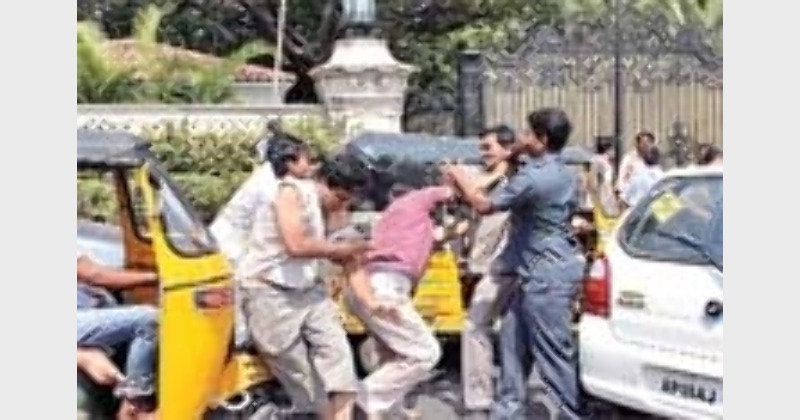
Road rage, an aggressive behaviour usually seen on the roads, which leaves a family holding torn and blood-soaked clothes of their loved ones close to their heart and weeping into grief. The recent incident of this behaviour was seen in New Delhi on April 5 in which a man, Shahnawaz was beaten to death with iron rods.
| People are losing patience and tolerance due to stressful life. They are frustrated with their own life which results into road rage. Increasing levels of congestion on the roads have undoubtedly played a role in raising tempers among drivers. They have to keep themselves calm for their health and others too. — Dr Ram Kumar, Psychiatrist |
Shahnawaz was returning home from a family wedding when his motorcycle grazed a car near Delhi's famous Turkman Gate. For 15 minutes, he was beaten with iron rods by five men who were in the car, according to his young sons who were with him. Younger brothers of the victim claim that their elder brother was beaten to death for the only reason of a scratch on the car but if this is true then aggressive driving is a matter of concern for every driver.
Aggressive driving is a major concern of the Delhi Police and a real threat to the safety of all road users these days. A survey conducted in 2013 by the AAA Foundation for Traffic Safety in Washington DC, claims that nearly 9 in 10 respondents said they believed aggressive drivers were a “somewhat” or “very serious” threat to their personal safety. This same survey found that a substantial number of drivers admitted to engaging in potentially aggressive behaviours, such as driving above the speed limit, or jumping a red light.
Unsafe driving behaviour, performed deliberately and with ill-intentions or disregard for safety can constitute aggressive driving. In fact, Foundation study found that potentially aggressive actions–such as tailgating, erratic lane changing, or illegal passing are the factors in up to 56 per cent of fatal crashes. In extreme cases, this escalates to road rage, which is a violent criminal act involving an intention to cause physical harm. When drivers explained why they became violent, the reasons were often trivial: “She wouldn’t let me pass,” “They kept tailgating me,” or “He practically ran me off the road–what was I supposed to do?”
A Delhi based businessman, Rajendra Chauhan said, “The traffic in Delhi and other parts of India is appalling. With jams everywhere, it is very irritating to see a person overtake wrongly, flout traffic norms. I daily spend more than five hours travelling for work. When someone does something stupid, I feel like getting out of my car and beating up that person.”
Considering the behaviour of aggression on roads by the drivers, Organiser spoke to people who drive across Delhi in a single day and perceived that all of them shared a common opinion behind road rage accidents and that is ego-clashes and surpassing the traffic rules. In some cases in India, it appears that incidents of road rage are caused by simple misunderstandings between the drivers also.
Road rage not only victimises the common people but also police officials when they ask the road users for the authorised papers. One such incident was that of Assistant Commissioner of Police (ACP) in the Special Cell's Anti-Terror Squad (ATS), Amit Singh and his driver were punched, kicked and hit with steel knuckles, stones and helmet by three persons, including a woman, after a car bumped into the cop's vehicle from behind on October 17, 2014 and he asked for the license as the minor was driving.
Similar incident was noticed by Ashish Kumar, a resident of Nizamuddin while passing Indraprastha Park, a truck driver was rebuking and beating a Delhi Police official when he discarded his entry in banned zone and asked for papers. Kumar helped the cop to get rid of the unwanted conflict.
Depicting the ways people make others frustrate on the roads, Satyendra Kumar, Beat Constable Traffic Police at India Gate Circle said that, “Sad to say, many drivers nowadays forget the fundamental of lane-changing and over-taking. Whether the other driver wants to give way to you is immaterial. On April 7, an over-speeding Alto car hit a motorcycle from behind which had stopped at the traffic light before zebra-crossing. In this case, the car driver deserves to be punished by the law and should apologise to the motorcyclist but he came out and started scolding him. We ran to avoid the chaos but in spite of his mistake he was telling us the laws. This unwanted behaviour sometimes causes major accidents.” In a number of cases it is seen that in stead of apologising, the victim as well as the police is often threatened by the offender saying, ‘I know such and such person’, he said.
Is Road Rage a ‘Disease’? Road rage has become a rule of the day. People are losing patience and tolerance. There will be a discussion about culprits for few days in the media. Have we ever thought why there is a sharp rise in such cases? Why people have lost Godly forgiving nature and a scuffle on small issue may take somebody’s life. Magnanimity is taken over by narrow-mindedness. You can see agitated children and people more than peaceful and serene faces around. Have we ever thought that why sons of Rishis (Our gotras are named after Rishis) have become demons? We must introspect why we have forgotten the h purpose of life, Moksha. What are the reasons of this downfall? We have also seen a sharp rise in destructive diseases like Cancer, Diabetes Mellitus, Organ failures, suicides etc. This is a socio-medical problem. We have ignored our literature like Bhagwad Gita. Doctors have become managers instead of healers. They do not believe in restoring the sick to true and holistic health or at least putting them back to true path of recovery. Instead of learning from Dr Hahnemann or incorporating his teachings we have totally ignored his methodology of treating the sick. Government and Health managers of today need a thorough shake to rethink. We must find out other reasons for these defiant behaviours. —Dr BS Johri |
Thrashing out the factors which makes a person frustrated on the roads, Dr Prashant Goyal, MD (Psychiatrist) AIIMS said that, “Contributory variables to road rage include environmental variables, such as crowded roads and high levels of traffic density; psychological factors, such as displaced anger, illogical attributions, and high life stress and psychiatric disorders. Intermittent Explosive Disorders (IED) and Borderline Personality Disorder (BPD) are four times encountered by the general population and possible anti-social features. Hence individuals involved in road rage come from a variety of psychological substrates, all of them may culminate in an event that not only places the victim at risk, but also the perpetrator.”
Discussing the behavioural pattern of the drivers, Dr Amitabh Saha, Senior Consultant, Psychiatry, Pushpanjali Crosslay Hospital, Vaishali, Ghaziabad said, “In most of the cases it has seen that it is drivers’ stress or tension from their home and work places which gets projected in the form of road rage.”
Conflicts between drivers have also arisen because of unclear road priorities, where drivers have disagreed as to who has the right to way. At times the drivers fail to adhere to the rules of the road and ignore signs, cause irritation among the drivers.
Now, how can you avoid being the victim of an aggressive driver? It is simple; you can protect yourself by avoiding them or report the matter to the concerned authorities so that
proper action can be taken against the culprits. Courts while punishing the
culprits should also instruct authorities to take appropriate actions against such persons so that they holistically improve. Monica Sangwan