






 Intro: One thing seems clear: unless the border dispute is amicably resolved, a sense of restraint will continue to prevail in the relationship between the two countries despite a genuine desire to live in harmony. ?
After all the brouhaha and sloganeering like Hindi Chini bhai bhai the 3-day visit of China’s President Xi Jinping turned out to be a damp squib. The boundary dispute persists, even when both sides want peace and tranquillity along the border. True, both Narendra Modi and Xi Jinping are more than anxious to correct the situation and be accommodative. Xi Jinping did his level best to sound friendly, calling India “an ancient and magic land, an enchanting and beautiful land” and Modi lavished unheard of hospitality in more than ample measure. Prior to his visit word was going round that China was willing to invest over USD 100 billion in India but in the end it turned out that the amount would not exceed USD 20 billion – chicken feed as critics called it, and to be spent over the course of five years.
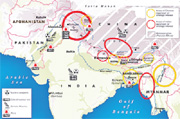
According to Narendra Modi China and India are “two bodies, one spirit”. Wise words. But what is the reality? While India has been working on Confidence Building Measures (CRMs), the border dispute remains unsolved. There are some 14 places on the LAC where India and China’s perceptive of where it lies differ, giving rise to so-called ‘transgressions’ and ‘incursions’. The Joint Statement issued at the end of Xi’s visit has taken note of this. The statement further re-affirmed “the utility and significance of the mechanism of Special Representatives for seeking a political settlement”.
The SR level talks were instituted under former Prime Minister Atal Behari Vajpayee’s regime in 2003 and the two sides have already held 17 rounds of negotiations. One can only take satisfaction that arrangements for discussion at least are there for the time being, and have not been scrapped.
There are other positive developments to be noted in the Joint Statement. One is that the two sides have taken a positive view on defence cooperation and there will be “regular exchange of visits between the Defence Ministries to expand ‘pragmatic cooperation’. It may be remembered that Xi Jinping is, apart from being President, also the chairman of the country’s Central Military Commission and head of China’s armed forces. Yet another positive development is that both sides have decided to launch “working level consultations” between the Department of Atomic Energy on the Indian side and the China Atomic Energy Authority, a year-and-a-half after they first decided to engage in civil nuclear cooperation. But perhaps a more cheering issue is the one dealing with terrorism. According to the Joint Statement “both sides reiterated their resolute opposition to terrorism in all its forms and manifestations with ‘zero tolerance’, commiting themselves to cooperate on counter-terrorism. One presumes that Beijing is fully aware of Pakistani terrorism and jihad.
Again, just as China’s closeness with Pakistan is a matter of concern for India, India’s growing closeness with Vietnam must be a matter of concern for China.
Both Vietnam and India have asserted that the freedom of navigation in the disputed waters of the resource-rich South China Sea should not be impeded, calling all the parties ‘concerned’ to exercise restraint in this context. It is no secret that China has been exerting its influence in these waters which is not taken well by Vietnam and other bordering countries like the Philippines and Indonesia. Among the seven pacts signed, a Letter of Intent (LoI) was signed between the ONGC Videsh Ltd. and Vietnam Oil and Gas Group.
Beijing has objected to India’s exploration projects in the Vietnamese Oil Blocks. India is right in making friends with China’s neighbour Vietnam, just as China has been making eyes at Colombo. This is part of the political game which China should be aware of and accept graciously. What China should be happy with is the fact that India has accepted Tibet to be part of the Peoples’ Republic of China in the Joint Statement, while thanking Lhasa for opening a new route to Manasarovar through Nathu La Pass.
(The writer is a senior journalist and former editor of Illustrated Weekly)
?








Comments