





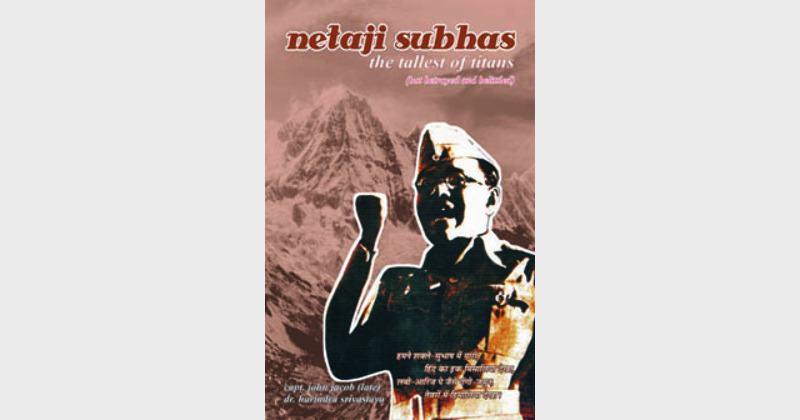
Netaji Subhas: The Tallest of the Titans (but betrayed and belittled) by John Jacob and Dr Harindra Srivastava, Publisher: Graphic Centre, Mangalwada, Bhopal, Pp 397, Rs 1,101 (HB)
Tej N Dhar
 Subhas Bose is one of the most colourful and controversial figures in the history of Indian freedom struggle against the British, and made more so by the mystery surrounding his death. The book under review has been written by the late Captain Jacob, who was part of the Subhas’s INA, and Dr Harindra Srivastava, who has been working tirelessly for nearly two decades to write and speak extensively on political figures who have been sidelined in the most known narratives of India’s freedom struggle. The prologue to the book clearly states the pronounced revisionary impulse behind its writing, which defines the nature of its content and its strident tone.
The authors tell us that their book not only reflects the “ever increasing interest in Subhas Bose” but also “seeks to rectify deficiencies” found in many existing books on him, which “seldom attempt to put his life in true perspective.” They also believe that most of the historians have not been able to understand his true personality, and have projected him as a frenzied individual who had a “bubbling frothy attitude towards patriotism, for which he was willing to do anything.” To rectify this, they act like true historians, to “offer a critical analysis of the factors which lead to a person’s success or failure.” For this, they weave an analytical narrative of Subhas’s life in eleven chapters, and follow these up with ten appendices, which contain selected documents and writings related to his association with the Congress party and the INA, an epilogue, which contains a brief text of the Mukherjee Commission Report, and a bibliography of 275 works on Subhas’s life and political career in English, Hindi, German, Japanese, and French.
The book provides all the important details about Subhas’s life, from the time of his birth to the time of his mysterious death. Born in 1897 into an illustrious family, the ninth of the fourteen children of his parents, Subhas studied in the Baptist Mission School in Cuttack, where he excelled in English and displayed extraordinary love for nature. He joined the Presidency College of Calcutta at the age of sixteen, where he overcame the contrary pulls of spirituality and nationalism by opting to be with Aurobindo and Bankim Chandra than with Ramakrishna and Vivekananda. For siding with his fellow students against Professor Oaten, he was rusticated from the college. After his readmission, he passed his final exam with first class honours and went to Cambridge for further studies.
After eight months of his stay in Cambridge, Subhas stood fourth in the ICS examination, but, because of his strong nationalist moorings, he decided not to be a part of the useless machinery of power and heartlessness and not to make any kind of compromise with the colonial regime, because it “degrades the man and injures his cause”. So he returned to serve his motherland in 1921.
The first thing he did upon arrival was to meet Mahatma Gandhi, to know his plan for getting swaraj within a year, a claim that he had been making at that time. He was disappointed by its “deplorable lack of clarity”. The only good thing that resulted from the meeting was Gandhi’s suggestion that he should meet CR Das, who became his mentor and guide. CR Das and Subhas organised a hartal against the visit of the Prince of Wales, they were imprisoned. Later, when Das had problems with the Congress Party, he created the Swaraj Party, and Subhas joined him. CR died in 1925 and Subhas showed signs of broncho-pneumonia around the same time.
Subhas’s disappointment with Gandhi’s method of working soon turned into a confrontational course with him, which took a serious turn because of several reasons. Gandhi neither mentioned nor commented on the activities of the revolutionaries like Sukhdev and Jatin Das in his Young India. He caused a big surprise to everybody by making Nehru the president of the Lahore Session of the Congress Party in 1929. Immediately after that Subhas and Srinivasa Iyenger were removed from the Congress Working Committee. Subhas also disapproved of the Gandhi Irwin Pact, and criticised Gandhi for not speaking for Bhagat Singh and his associates and for his clumsy handling of the Second Round Table talks. Subhas was arrested by the British in 1932, but let off on the condition that he would go to Europe to take care of his deteriorating health. He went to a sanitarium in Vienna, met Vithal Bhai Patel, and both felt that Gandhi had failed in his mission. He went to Poland and Germany and met Hitler, because he wanted his support to fight the British. He also met Emile Schenkle, his future wife.
Back in India, Subhas was arrested again, but released because of his ill health, which forced him to go to Dalhousie. Then he was made president of the Haripua Session of the Congress. When he stood for re-election, he was advised to withdraw, but he did not. Gandhi put up his candidate against him, who was defeated. Jacob and Srivastava firmly believe that Gandhi behaved vindictively after this. Because his candidate had been defeated, he made sure that Subhas was not allowed to function. The members of the Congress Working Committee were pressurised to resign. Nehru too resigned later. Disgusted with the authoritarian ways of Gandhi, Subhas resigned, and launched a new party Forward Block, for which he was expelled from the Congress for three years. This proved a turning point in his career, for he chose to follow his own path to liberate his motherland.
After yet another prison term, Subhas planned his escape from India to fight for its freedom by seeking the help of other countries. The authors have used multiple narrators, the people who helped Subhas to move from one place to the other, to provide us the sensational account of his flight from Calcutta to Berlin, under different names and in different disguises. There he set up a provisional free India government, with its own radio station, a new flag, and Azad Hind Fauz. His strategy was to attack the British forces from the outside, which would coincide with the rebellion of the people from within.
In 1942, he met Hitler and then moved to Japan and made a broadcast over radio Tokyo. The Fauz changed to INA, and a new regiment of women Rani Jhansi Regiment was added to it. The provisional government was recognised by Germany, Italy, Thailand, Burma, Philippines, and many more. He flew to Tokyo and secured the control of Andaman Islands. Unfortunately, the surrender by the Japanese adversely affected INA’s military campaign in Burma, and Subhas was advised by everybody to leave the place. What happened after that is another contentious story, which has been adequately documented by the authors. Among the appendices, Subhas’s estimate of Gandhi and his long letter to Nehru should be of special interest to the students of freedom movement of India.
The book thus presents the narrative of Subhas’s life with sympathy that borders on adulation, for the authors argue passionately that the Congress Party, under the influence of the dictatorial directions of Gandhi, betrayed and belittled him. Even after the Independence of the country, the party continued with its hostility towards him. Netaji Subhas is readable interesting, and provocative.
(The book can be purchased from ‘Vishram’, C-225, Mianwali Colony, Gurgaon: 122 001, Mob. 9582222842)
Books Received
An Uncertain Glory, by Allen Lane, Rs 699, Pp 448, Penguin Books (India) Pvt. Ltd., 11, Community Centre, Panchsheel Park, New Delhi-110 017
The Mantram Handbook by Eknath Easwaran, Rs 250, Pp 208, Jaico Publishing House, A-2, Jash Chambers , 7-A, Sir Phirozshah Mehta Road, Fort, Mumbai-400 001
Diamond Annual Horoscope 2014, Rs.225, Pp-544, Diamond Pocket Books (Pvt) Ltd, X-30, Okhla Industrial Area, Phase-II, New Delhi-110 020
The Preamble Deepa Kansra , Rs 275, Pp 222, Universal Law Publishing Co. Pvt. Ltd.
C-FF-1A, Dilkhush Industrial Estate, (near Azadpur Metro Station)
GT Karnal Road, Delhi – 110 033
End of story? by Arjun Shekhar, Rs 350, Pp 336, Hachette Book Publishing India Pvt Ltd, 4th/5th Floors, Corporate Centre; Plot no 94, Sector 44; Gurgaon-122 009
Muslim Backward Classes A Sociological Perspective by Azra Khanam, Rs 795, Pp 316, Sage Publications India Pvt Ltd, B 1/I-1 Mohan Cooperative Industrial Area, Mathura Road, New Delhi-110 044
Essentials of Human Rights by Raj Kumar Gupta, Rs 295, Pp 86, Universal Law Publishing Co. Pvt. Ltd. C-FF-1A, Dilkhush Industrial Estate, (Near Azadpur Metro Station), GT Karnal Road, Delhi -110 033






Comments