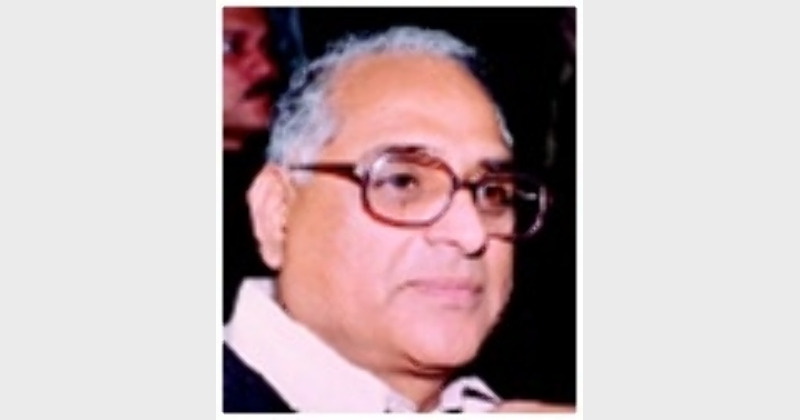
Dr JK Bajaj IN 1857, Indians put up a valiant fight to throw away the British yoke. The effort unfortunately failed. British responded by imposing brutal punishments and subjecting large numbers to torture and suffering, making the alien ruling apparatus more extensive and intrusive, and imbibing and propagating a frank contempt for Indian people and Indian civilisation. English educated Indians began to internalise that contempt for India, and soon the elite came to believe that India needed to relearn everything from Europe and undergo a long apprenticeship under the British.
Before the end of the nineteenth century, India had thus become completely supine. She had lost faith in herself, and her resourceful and educated people had begun to desert her, at least in their thinking and ideals.
But India is a blessed land. Whenever exigencies of life and history become too much, whenever her people begin to lose faith, then invariably, there appear extraordinary personages, who restore the faith and right the balance. Many such personages took birth in India in the 1860s. We have just finished celebrating the 150th year of the birth of Mahamana Madan Mohan Malaviya and Ravindranath Tagore. We are now in the midst of celebrating the 150th year of Swami Vivekananda. By the end of the decade we shall be similarly remembering Mahatma Gandhi, who was born in 1869.
It is not easy to imagine the impact that Swami Vivekananda had on the youth of India with his resounding speech at Chicago, where he reminded the world about the incomparable merit of India and her civilisation and the world listened. The event energised the youth, especially the English-educated youth, of India. Those, who had come to believe that they belonged to an illiterate and impoverished nation, suddenly had a glimpse of the learning and wealth of India, in a language they and the world understood. They learnt that being born in India was not a curse, but a blessing. They could now proudly reclaim and proclaim their Indian-ness. There was a wave of awakening among the youth from Colombo to Almora, as it were.
The mood and atmosphere of India had changed by the end of the nineteenth century. Leaders, who had come to believe in the necessity and inevitability of learning the western ways, and enduring English language and British rule for that purpose, began to look inwards. Bengal, of all places, under the leadership of Rajnarayan Bose, pioneered the movement for making Hindi the language of the nation. Swadeshi movement also began there and soon spread to the whole of the nation. All this was made possible partly because of the awakening of the youth of India that Swami Vivekananda had accomplished. Mahatma Gandhi’s forceful assertion of the superiority of Indian civilisation over the satanic ways of the west in the first decade of the twentieth century could not have been possible without the foundation laid by Vivekananda. And, it was indeed over that foundation of awakened youth that Gandhiji was able to build his unusual movement, anchored deeply in and drawing from the infinite resources of sanatana dharma.
Swami Vivekananda made sanatana dharma and Vedanta intelligible and meaningful to the modern world. And thus he made India meaningful and intelligble, because sanatana dharma and Vedanta are the essence of India. We do not often realise that Vedanta permeates ordinary life in India. The Vedantic truth that this world is the manifestation of but one reality is deeply imbibed by ordinary, often illiterate, Indians. It has been expressed in so many different ways in the diverse languages of India. There are sayings, similies, images and proverbs in every Indian language that express the same thought. In Punjabi, the language that I know, it is common for an ordinary peasant to tell you that the world is like bubbles on the ocean; or that it is like walls of sand raised in the desert; and so on. Gurubani expresses the Vedantic truth in simple, pithy phrases. There is one particularly compact phrase; in rough translation it says, He is one, He is many, and then He is one again. And there is another, which is repeated by the Sikhs almost everyday. It says, He is one and He is many, therefore, what pleases Him that alone is good.
Ordinary Indians not only have the resources in their language and tradition to express the high philosophical truth of Vedanta, but they also live by this truth. They believe in it, not merely at the level of thought, but perhaps at the level of being. It is this inborn sense of Vedanta that makes ordinary life in India possible and bearable. That is how they are able to keep a sense of immense grace, dignity and sanctity in the miserable material conditions to which life has been reduced for many of them.
Swami Vivekananda, while restoring concern for Vedanta in the modern world, also restored concern for the ordinary Indian. He was himself deeply moved by the condition of India and of her people. He was deeply concerned. It is out of that concern that he drew our attention and that of the world towards the Vedantic truth. Because, Vedanta can mean nothing, if one does not have that sense of concern, sense of empathy for the condition of the ordinary Indian. Vedanta can mean nothing if it does not make us recognise the inherent divinity resident in all beings, and make us restless to ensure that the dignity of that divine presence is maintained in all forms. And Vedanta can mean nothing if we are unable to recognise the Vedantic truth being daily lived, expressed and manifested by ordinary Indians.
India, of course, also is the land of the great philosophical texts that give rigorous and detailed expression to Vedantic thought. Those expressions are important. They are the bedrock on which the whole edifice of Indian civilisation has been built. But, the important thing is that India has been able to convey the complex truth of those classical texts to the ordinary people of India in a manner that they can also understand, speak and live it. To learn Vedanta therefore is to learn about India, to begin to have a feeling of oneness with the people and land of India.
In this year, when we recall and remember the coming of Swami Vivekananda and his awakening of India to herself, we must also attempt to awaken ourselves to the India he revered. Because we, Indians, seem to have once again reverted to a condition of forgetfulness. We seem to have once again lost faith in ourselves. Like the educated Indians of the period before Swami Vivekananda, we have once again begun to believe that India needs apprenticeship of the west; that all of us need to learn the English language and the western ways; that we need to not only import western technologies and systems, but also invite the foreigners to come and implement these for us in India. Our lack of faith in ourselves has reached such proportions that we have come to believe that we need foreign money, systems and enterprise for even the simple task of retail selling that ordinary Indians have performed so efficiently for so long. In this land of abundant agriculture, we have begun to seek foreign interventions and support to teach us agriclture and even carry out agricultural operations for us. We have forgotten about Swadeshi, Swabhasha and Swaraj that Indians so tenaciously fought for in the late nineteenth and early twentieth century on the foundations laid by Swami Vivekananda. Educated Indian youth of the time before Swami Vivekananda had begun to desert India at the level of thinking and ideals; the educated youth of today have begun to desert India even physically. We have come to a state where nearly every educated young man or woman aspires to find a job away from India, and the aspiration is shared by both the graduates of high institutes like the IITs and those of the mushrooming colleges of engineering or management, etc., in the larger and smaller towns of India. It seems the elite of India no more have a stake in India, and the youth of India no more believe that they can live a happy fulfilling life here.
It is perhaps fortunate that the occasion to celebrate the 150th anniversary of Swami Vivekananda’s birth has come at this critical time. The celebrations may help us awaken the youth of India to his message of the importance and greatness of India, to his sense of concern for the condition of India and her people, and to the duty of serving the people and the nation that he cast especially on the youth. Let us hope that in this 150th year of Swami Vivekananda’s birth, another strong wave of Indian awakening and reassertion shall sweep through India, from Colombo to Almora. Let all of us who are associated with the celebrations dedicate ourselves to this task.
(The writer is in Centre for Policy Studies, and Joint Secretary, Vivekananda Sardha Shatabdi Samaroh Samiti.)