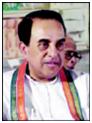
 Dr Subramanian Swamy
ON June 19, 1991 the newly chosen Prime Minister P.V. Narasimha Rao invited me to his then Motilal Nehru Marg residence and asked me to join his government for implementing my Economic Reforms draft—already adopted on March 11, 1991 by the Cabinet of the outgoing Chandrashekhar government [in which I was a Cabinet Minister with two portfolios—Commerce and Law&Justice].
Two eminent economists chosen by me in the Chandrashekhar government had helped me draft the reforms package with special focus on trade—our Economic Adviser Dr. Manmohan Singh and my Commerce Secretary Montek Singh Ahluwalia. Rao said both of them would also be in his government.
But there was a catch in Rao’s invitation—I would have to join the Congress which I did not want to because of spiritual advice of a sage. In view of this advice I later joined with Cabinet rank as Chairman of what became popularly known as “The GATT Commission” while being Janata Party President.
Rao’s sagacity and political wily nature helped tremendously in pushing through sweeping de-regulatory reforms which were however not systemic or of governance.
Governance is the art of resolving the conflict between the norm of minimal government with the multi-dimensional obligations of the state and implementing the necessary policies of the state within democratically determined law. In the old days it was just law & order and stability.
Thus good governance implies transparent governing principles adopted by consent of the people and a modus of impartial enforcement of those principles and its moral underpinnings. It means the creation of an enabling environment in which the vulnerable citizens have their preferences represented in policy. Thus add accountability and empowerment to old days.
Democracy provides such an environment. A minimal state must be sufficiently empowered and right sized to ensure that rules are observed, market failures are corrected, and level playing field provided.
Hence, the tough task of governance and reforms is to achieve devolution, decentralization, and privatization that has to be attained within the stringent monitoring of globalization. India has a three tiered devolution of governance powers, and a Constitution that defines decentralization [central, state, and concurrent powers].
My first advice to Rao was that he be careful on how he designed and packaged the reforms. I said to him that the outgoing Soviet economic model of growth and planning had bred a huge interlocking network of cronies who bought&sold licences, peddled quotas, and obtained governmental favours and operated in a flourishing black market to become very rich. Moreover they were embedded in the Congress power structure. Hence, de-regulating reforms would deprive them of the easy “rent” they we getting instantly, while the benefits from reforms would take time to reach the common man. I warned Rao that these cronies would first defame him in the media then undermine him in the party, and ultimately get him defeated in the polls and discredited too.
Governance requires design of policies that can bring reforms within a democracy-which means neutering the crony vested interests and awakening the masses to their entitlement.
Political leaders need therefore to resolve the following four conflicts: reform policies take time to reach the people, which therefore conflicts with the shorter cycle of electoral politics, and the power of established interests and invisible oligarchies which is another way to describe cronyism. Let us remember why in East Asia, the bubble burst in the booming economies of Japan and other “tiger” economies due to cronyism. In China cronyism is called Guanshi, in South Korea it is chaebol, and in Japan, keiretsu. Cronyism means ensured opacity and lack of accountability.
Reforms in the economy have to be structured so that fairly and justly the following steps can be executed:
Privatisation:
[a] How to further sequence the command economy to a free market system—to privatize, to eliminate barriers to entry/exit, and ensure near zero transaction costs.
Safety Net: [b] How to make prices reflect marginal cost without upsetting the people-e.g., reduce subsidies.
Competition Policy: [c] How to make public/pvt sector competitive long fattened on rent-seeking, high tariff and soft budget constraint, to cut costs and globally compete.
Environment: [d] How to encourage growth through new technology[fuel cells, CNG, N-power] without environmental degradation.
Labour Standards: [e] How to implement labour standards and flexible employment rules without race to bottom or scare away FDI.
Decentralisation: [f] How to delegate authority.
In India, democratic politics is complicated by the fact that bureaucracy is on the average smarter than the school drop outs and rowdies elected leaders by caste and appeasement politics.
Hence ultimately, good governance will exist only if [a] the form of the political regime makes leaders accountable and seen to be so to the people. This is what I tried to do through the judicial system since the parliamentary process today is vitiated by cronyism [b] the regulatory process under which the management of resources is exercised is made efficient and impartial[c] the capacity of leaders to design, and implement policies to meet the above six concerns of governance, and the ability of the selection process of leaders throws up such leaders.
People can have a greater say if there is e-governance, and later e-voting. The new innovations like RTI add to the information necessary to effect accountability.
Thus what can we conclude? Will reforms necessarily lead to cronyism? Obviously the answer cannot be a straight unqualified Yes. It depends on how we structure the objectives of reforms, the priorities we choose in its implementation, the strategy and tactics that we deploy to achieve the objectives, and finally the way we mobilize the resources for the projects arising from the reform package.
In my view, reform objectives must be to move the economy to a transparent system of choice that is clearly not arbitrary, unreasonable or malafide. Transparency can be ensured only if we make market determined choices where commercial interests are involved. This is what a five judge Constitutional Bench headed by the Chief Justice opined in the most recent Presidential Reference.
The priority of reforms has to be to eliminate methods where political and bureaucratic discretion in allocation of resources and projects exist. It is this discretionary power which causes cronyism.
Hence the strategy must be to use incentives for making the people conform to the rule of law, not bans and economic fatwas.
In my view resources in India are in plenty but it goes into private profiteering and corruption. Auction is therefore the only way when commercial transactions are to take place, to ensure resource mobilization and not higher taxes and levies on the common man. The ongoing auction in 2G licences will produce for example, about Rs. 7 lakh crores, when the total tax revenue in the annual Budget is Rs. 4.5 lakh crores.
Thus transparency, discretion-free market-determined decision making as a policy, incentive—driven methods can ensure reforms do not promote cronyism.
[Writer is a former Union Commerce Minister whose Draft Economic Reforms for Trade was accepted by the Chandrashekhar Cabinet in its meeting on March 11, 1991 and accepted and implemented by successor Rao-led government]
(The writer is former Union Law Minister, Harvard University Professor and President, Janata Party).