





Naval expeditions of Chola empire?
Manju Gupta?
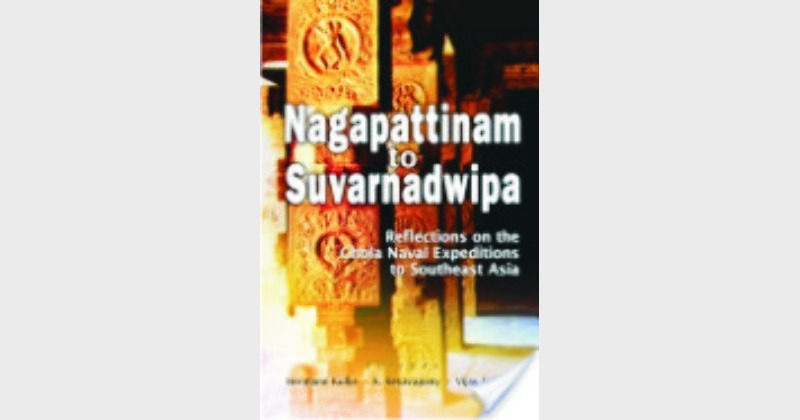
 Nagapattinam to Suvarnadwipa: Reflections on the Chola Naval Expeditions to Southeast Asia, Hermann Kulke, K Kesavapany & Vijay Sakhuja, Manohar and Institute of Southeast Asia Studies, Pp 337, Rs 995?
This volume throws light on the naval expedition of the South India’s Chola dynasty to Southeast Asia in the 11th century and its cultural impact on that part of the globe. The Chola kings had developed a sophisticated maritime enterprise centred on sea-based commerce with trading contacts in Malaya, Sumatra and China. This had produced an ocean-going fleet that was dispatched by the Chola king, Rajendra Chola I against he Srivijaya kingdom.
This book is a compilation of papers presented at a Singapore conference on ‘Early Indian Influences in Southeast Asia: Reflections on Cross-Cultural Movements’. The essays reflect on the naval expeditions which are also mentioned in the inscription dated 1030-31 at the temple of Thanjavur, in South India. King Rajendra I claims, in his inscription, to have “dispatched many ships in the midst of the rolling sea” and conquered more than a dozen harbour cities of he famous Srivijaya kingdom in Sumatra and on the Malay Peninsula in about AD 1025.
The first three papers in the book locate the naval expeditions of the Cholas in the context of contemporary Asian history and the Indian Ocean trade system. H Kulke interprets King Rajendra’s role on Srivijaya’s harbour cities as the culmination of the systematic quest of Rajraja Chola and his son Rajendra for domination of maritime South India and its surrounding islands in order to control trade between the two emerging maritime powers of the Fatimids in Egypt and the Song dynasty of China. Tansen Sen describes China’s rise to hegemony in the Indian Ocean trade system under the Song dynasty from the late 10th century.
N Karashima gives details on his survey of Chinese ceramics on South Indian and Sri Lankan coasts to shed light on Chinese trade with South India from the 9th to the 13 centuries. Another salient point is Srivijaya’s final ‘ritual policy’ to establish friendly relations with the Cholas through temple donations at Nagapattinam.
The next two chapters deal with nautical perspectives and the navy which examine the naval expeditions of the Cholas. V & S Sakhuja talk of the successful naval expeditions of the Cholas. Y Subbarayalu says that due to the predominantly donative character of the inscriptions, we get only fragmentary pieces of information about the actual mode of land-based warfare. He says that in Rajendra Chola’s inscription, only the word kalam occurs, which is the usual word for ‘ship’.
The subsequent two chapters deal with King Rajendras’ political and maritime centres at Gangaikondacholapuram and Nagapattinam. According to S Vasanthi, Gangaikondacholapuram was founded by Rajendra after the sixth regnal year and remained the imperial capital till it was razed to the ground by the Pallavas in the 13th century. G Seshadri presents a comprehensive survey of the literary sources of the history of Naagapattinam.
The following four chapters are devoted to South Indian merchant guilds, whose fame is strongly associated with the Cholas and which are often regarded as a driving force behind the naval expeditions of the Cholas against Srivijaya.
The next two papers pertain to Sri Lanka and Indonesia which were directly affected by Chola expansionism.
In the last three papers, P Shanmugam surveys the literary and archaeological evidences of increasing competition between Srivijaya and Java to control the lucrative spice trade with the new maritime powers of the Cholas and Song China. Risha Lee links the foundation of a Shiva temple, about whose consecration the Tamil-Chinese bilingual inscription reports with another important event of 1279 – Kublai Khan’s final conquest of Southern China.
The appendices at the end of the book document South Indian maritime activities in the age of the Cholas beyond Nagapattinam and Suvarnadwipa, from Cochin to Quanzhou.
(Manohar Publishers and Distributors, 4753/23, Ansari Road, Daryganj, New Delhi – 110 002; www.manoharbooks.com)
An inquiry into ethical issues of foreign aid?
Manju Gupta?
Strings Attached: Untangling the Ethics of Incentives, Ruth W. Grant, Princeton University Press, Pp 202 (HB), $ 24. 95
? USA gives aid to India because the latter signed the nuclear non-proliferation treaty. A father wills his assets to his daughter if she agrees to be a stay-at-home with mom. The government authorises tax deduction for charitable contributions. Companies pay schools to instal soda machines or televisions in their lunchroom. Schools pay students when they get good grades. In the modern world, incentives are becoming the tool for acquiring our desires to fulfil in our, education, in health care, in private life and between and within institutions of all sorts, incentives are offered to steer people’s choices in required directions and to bring about desired policy outcomes. You may wonder what is wrong in this or why should it be considered unethical?
From a certain point of view, incentives could be viewed as a form of trade. A person is offered something as a form of trade. A person if offered something he values in exchange for during something valued by the person making the offer. This can be treated as a trade and trading is free and rational.
Nonetheless we recognise bribery and blackmail as wrong even though in both cases a simple trade takes place. But viewing incentives as trades is not really correct. Examples in the realm of politics are quite controversial. Environmental policies allow companies to buy and sell pollution credits, but does treating pollution as a commodity, distort the moral claim that supports its regulation in the first place?
Considering incentives as an exercise of power raises ethical issues. At times along with coercion and persuasion, important concerns about democratic policies are brought to light. We are accustomed to thinking about incentives as an alternative to coercion – economic sanction rather than military attack, for example, and incentives seem to have a moral high ground over coercion as an alternative.
This book assesses incentives, along with the various forms of coercions and persuasion in order to articulate standards for making these judgements. When reviewed chapter-wise, we find that the first chapter present the introduction while the second gives an historical account of the use of the term ‘incentives’ and of the introduction of incentives in scientific management and behavioural psychology. The author says that the word ‘incentive’ came into use – American when the use of the language of social control and of social engineering was quite prevalent and incentives were understood to be a tool or instrument of power. They were however, criticised by several quarters as “dehumanising, manipulative, heartless and exploitative”. When viewed as an instrument of power, the controversial ethical aspects come to the fore.
Chapter 3 gives the history and the meaning of ‘incentives’ and the author tries to distinguish incentives from other forms of motivation and other forms of trade or exchange, rewards or compensation.
Chapter 4 presents three basic standards for distinguishing ethical from unethical uses of incentives and there are legitimacy of purpose, voluntariness and effect in the character of the parties involved.
Chapter 5 explores the different domains where incentives are controversial, like pleas bargaining, recruiting medical research subjects, the loan policy of International Monetary Fund (IMF); and motivating children to learn.
Chapter 7 returns to contrasting between treating incentives simply as a form of trade and trading incentives as a form of power.
Chapter 8 raises the broader question of the relation between incentives and democratic politics.
The aim of the book is to highlight the problematic ethical issues involved in the use of incentives. In daily life we encounter incentives frequently and we make our judgement which, on deeper study, make us think about psychology and ethics, democracy and expertise, power and freedom.
(Princeton University Press, 41 Winter Street, Princeton, New Jersey 08540).






Comments