





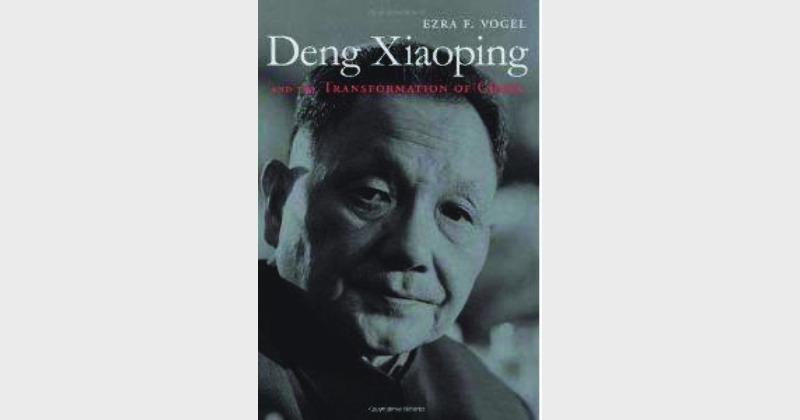
A gripping biography of Deng Xiaoping?
The maker of
modern China ?
By Dr R Balashankar?
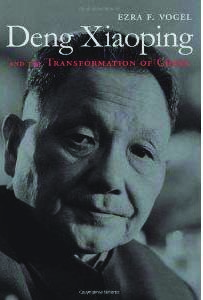 Deng Xiaoping and the Transformation of China, Ezra F Vogel, Berknap Press of Harvard University Press, Pp 876 (HB), $39.95 ?
If China’s transformation can be given a face and name, it would be Deng Xiaoping. A short man of huge stature, Deng steered the country from an abyss to the path of economic progress. Deng Xiaoping and the Transformation of China by Ezra F. Vogel captures this long march of China. Xiaoping was handpicked by Mao Zedong. And yet, he chose to move away from Maoist policies in order to achieve the economic growth he envisaged for his country.
Xiaoping’s childhood was nothing extraordinary, though he was a bright student. At sixteen, he was the youngest among eighty-four students selected to go to France to be the student-worker. His first exposure to the treatment meted out by foreigners to Asians in general and Chinese in particular came during his voyage. This early memory probably prompted him to a life-long mission to make China a great country, whose citizens would be respected world over.
“Deng’s colleagues understood that he regarded ruling China as serious business, and although he could be witty, with colleagues he was usually formal.” At the same time was accessible. While people always referred to Mao as Chairman Mao” Deng could be called by his first name ‘Xiaoping.’ “Deng was also relaxed about his vices, of which, he told visitors, he had three—smoking cigarettes, drinking alcohol, and spitting into the spittoon that was placed on the floor beside him. And he enjoyed them all.”
Deng was purged by Mao twice, though they had known each other closely since the 1930s. But Deng bid his time, for ever being the obedient soldier of the Communist Party. As long as Mao was alive, Deng kept him in good humour, attempting not to rub him the wrong way. Mao was vindictive and could demolish people on whim, which Deng had witnessed happening to several of his associates. Deng understood that while Mao had united China and laid a strong foundation, his policies were destroying China, says Vogel. Mao believed that the class revolution should be the touch-stone for all decisions, while Deng believed fast economic growth was the answer.
The Cultural Revolution took the lives of millions of people, including the top intellectuals, scientists and scholars. It was orchestrated and carried out by Mao. Anybody who so much as dared to whisper against Mao was put to death. Deng never spoke up against these mindless killings. Mao on the other hand felt that Deng was not supporting the gains of the Cultural Revolution. During Mao’s last days, his nephew Yuanxin interacted with Deng to elicit a more aggressive support for Mao’s actions. And reported back to Mao that “there had been no progress in getting Deng to budge.” Deng was sidelined and eventually removed from party positions. He made a comeback under Hua Guofeng, after Mao’s death in 1976.
Vogel takes the narration through the political developments, of which Deng was very much part and was grooming himself to take reigns one day. Vogel steers clear of making critical remarks against Deng, sticking to safer ways of expression. It seems as though he was deliberately conscious not to ruffle the feathers of the Chinese leadership.
When Deng assumed power, he faced the question of how much freedom to allow. He felt that “too much” freedom would be harmful as “protestors could organise, the country might again fall into chaos as it had during the Cultural Revolution. Tens of millions had suffered or had relatives who had suffered from political campaigns or starvation. Hostility was strong not only against local leaders who oppressed the local people, but against higher-level officials who had been part of the system that had caused such suffering.” Deng, after initially allowing open expression of opinion put the clamp down when the voices grew stronger. He had laid down four inviolable cardinal principles. They were: that nothing and no one should challenge: 1. the socialist path, 2. the dictatorship of the proletariat, 3.the leadership of the Communist Party and 4. Marxism-Leninism and Mao Zedong Thought. In fact, he went much the Mao way in putting down opposition.
Tiananmen Square massacre in June 1989 would forever remain a blot on the personality of Deng. The number of students mowed down by military tanks and bullets remains mere speculation even today. Deng ruled China with an iron hand between 1978 and 1992. During this time he set the Chinese position vis-s-vis Soviet Union, Taiwan, Vietnam, Hong Kong and other South East Asian nations.
Interestingly, India does not find mention at all in the book. Vogel glosses over the Chinese aggression of India in 1962, when Deng was in a powerful position in the party. He does not discuss the issue even while writing on Zhou Enlai. As far as Vogel is considered India is no-zone in the book. On the other hand, Japan gets a whole 14-page chapter, so do Soviet Union and the US.
Unlike Mao, Deng did not publicly humiliate his critics. He expelled them from party, allowed them to travel abroad and never allowed them to return, in short banished them.
Extremely nationalist, Deng found it his primary duty to get Taiwan back into mainland China. He hoped to achieve it before he “went to meet God.” But after a failed attempt to take Taiwan by force, Deng decided to work on it in subtler ways. He encouraged trade with and visits from Taiwan to China. He said, “If we can’t reunify China right way, we will do it in a century; if not in a century, then in a millennium.” Such was his commitment. His handling of Tibet too was bereft of human consideration. For him, it was as though it was only a territory, not the people who lived there. He was never willing to concede the leadership of Dalai Lama. Though there were several rounds of negotiations and several crackdowns, it is an issue he did not resolve.
He died on February 19, 1997 at the age of 92. His last public appearance was on New Year’s 1994. He had stepped aside in 1992. Deng’s achievement for China can be quantified. “When Deng became pre eminent leader in 1978, China’s trade with the world totaled less than $10 billion; within three decades, it had expanded a hundredfold. At the same time, China was encouraging the United States to accept a few hundred Chinese students; by a decade after Deng’s death an estimated 1.4 million students had studied abroad and some 390,000 had already returned to China.”
There is very little of personal account of Deng. For, he left no papers. Right from the beginning, Deng committed everything to memory and did not put things down on paper. Hence, very little is known in terms of his thinking and strategy except what he chose to reveal though party organs and speeches. Very few, if any, knew his mind. One of his daughters was the closest to him. But even she was not privy to party politics. Deng as a matter of rule never discussed party in the family though they were all members of the Communist Party of China. From Vogel’s narration it appears as though Deng subsumed his personality into that of the party and his personal opinion into that of his vehement drive to launch China as a world power. More than Mao or any other leader, China owes to Deng what it is today. No doubt, he was ruthless and stubborn he was devoted to his cause—that was his nation.
Vogel’s is a political biography of Deng, admirably executed given the lack of diaries and memoirs. He has largely protected Deng from censure, by fine-spreading the blame, sometimes on Mao and sometimes on the Gang of Four. It is by far the most exhaustive account of the Deng era and hence needs to be read. Ezra F Vogel is Henry Ford II, Professor of the Social Sciences Emeritus at Harvard and former Director of Harvard’s Fairbank Center for East Asian Research and the Asia Center.
(Harward University Press, HUP Publicity Detp, Publicity Dept, 79 Garden St, Cambridge MA 02138-1423 US)?



Comments