






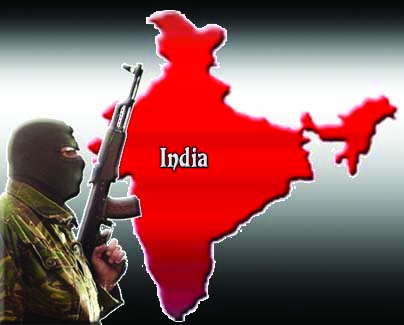
How to resolve the contradiction between combating terrorism and protecting human rights?
By Dr Subramanian Swamy?
 Human rights are the basic rights and freedoms entitled to any person. These basic rights are the right to life, freedom, equality, justice, and freedom of thought and expression.
Terrorism affects human rights in three ways. The terrorist attacks deprive citizens of their lives, limbs and properties and hence their human rights.
To combat these terrorists we place restrictions on human rights of the citizens, on privacy, freedom of travel and association, so the victims of attacks suffer both ways.
Moreover, human rights questions are raised when the terrorists are apprehended, on such issues as torture, deprivation of their “human dignity”, the right to a free trial etc., which are regularly raised in defence of the LTTE, in Kashmir under AFSPA, and for crypto Maoists.
Hence, there is a fundamental question to answer in any democratic society, even when such a society is under siege from murdering terrorists, which is: how to protect basic human rights while effectively combating terrorism.
In 1948, the UN codified these basic human rights in the Universal Declaration of Human Rights. International Human Rights Law was framed in a number of core international human rights treaties and in customary international law. These treaties include in particular the 1966 International Covenant on Economic, Social and Cultural Rights, and the International Covenant on Civil and Political Rights and its two Optional Protocols.
India has ratified these two Covenants 21 years later during the Janata Party Government tenure (1977-79) but the Protocols which establish the procedures for investigating human rights violation have not yet been adopted by subsequent governments.
In the Indian Constitution, adopted by the Constituent Assembly on November 26, 1949, human rights were codified as Fundamental Rights.
However, in the Constitution of India, all human rights including religious rights, are subject to “reasonable” restrictions. Since these restrictions are not enumerated, hence the courts under Article 32 and 226 decide it in a case to case basis. There is in India today a wealth of human rights case laws by which everyone is bound to obey.
Security of the individual, I contend, is also a basic human right and the protection of a citizen’s security is, accordingly, a fundamental obligation of Government.
States therefore have an obligation to ensure this human right, of their nationals and others, by taking positive measures to protect them against the threat of terrorist acts and to bring the perpetrators of such acts to justice. But then what is terrorism?
The UN Security Council, in its Resolution No.1566 (2004), referred to terrorism as “criminal acts, including against civilians, committed with the intent to provoke a state of terror in the general public or in a group of persons or particular persons, to intimidate a population or compel a Government or an international organization to do, or to abstain from doing, any act”.
The fundamental question is thus: Is there a trade-off between the two human rights, that is some reasonable restriction on right of freedom for the right to security, both of which being human rights.
Or whether sacrificing human rights beyond a point is in itself counterproductive to, and undermines national and international security in combating terrorism? Thus, the relationship between the two is not “linear”, but “non-linear”.
That is, it is not true that the less we protect human rights, the more we can combat terrorism. The converse is also not true.
Therefore, there is an “optimum combination” of measures to combat terrorism and the level of safeguards that ensure human rights. The law of diminishing return operates on this trade-off.
That is, after a point, the more and more we sacrifice human rights the less and less we are able to combat terrorism.
Hence, we in a democratic society are required to constantly monitor what is a reasonable sacrifice or restriction of rights for combating terrorism, and what is excessive in the measures adopted to fight terrorism.
Every nation hence is being called upon today to resolve this conflicting demand of the restriction on human rights that is reasonable and tolerable for effectively combating terrorism and while protecting basic human rights. This is a tough dilemma for any democratic nation.
India today is the most terrorism afflicted country in the world. The principal terrorist threat is however from Wahabi Islamic exhortation for jihad to establish Darul Islam in India by hook or crook.
When I wrote the DNA newspaper Op-ed “How to Wipe Out Islamic Terrorism”, the synthetic anger of the bleeding heart liberal secularist, the neo-Nehruites to be exact, was directed against my alleged painting all Muslims with one brush for combating Islamic terror.
Just as we did not paint all Germans in the Nazi regime by the same brush, I do not lump all Muslims together. Bareillvis, Sufis, Shias, Ahmediyas who are the overwhelming majority of Indian Muslims are different. For instance, they all, unlike the Wahabi driven terrorists, accept the reality that their ancestors are Hindus.
Reality? Yes, because the recent genetic studies published in India and abroad show that DNA structure of Hindus and Muslims are the same. Those who do accept this reality, that is, their lineage is Hindu cannot be terrorists. They become part of the Brihad Hindutva family. Hindus will willingly defend and protect the human rights of such Muslims, since they are family.
The Wahabi Sunni Muslims in India who are led by the fundamentalist clergy are the exception because they reject this reality. They think that they are of Arabic culture and also descendents of Ghazni and Ghori, the two original terrorists who traumatised the civilised Hindus unprepared for their brutality. This fanatic group is the breeding ground for home grown terrorists in India.
The political nature of Fundamentalist Wahabi Islam becomes apparent to all if we learn from four paradoxes in Wahabi Muslim behaviour.
First paradox is—what these Muslims demand as rights when in a minority in any society, they nevertheless vehemently deny to other minorities when they are in majority, e.g., freedom to practice religion. Can Hindu minority in such Muslim majority countries, as Saudi Arabia, build temples, celebrate Deepavali, or carry a picture of Sri Ram in their pockets?
Second paradox is—what these Wahabi Muslims permit when in majority, they vociferously refuse to permit when in minority. Thus, in majority they permit demolition of mosques stating that Masjids are buildings to facilitate reading of namaz, and hence can be subject to demolition to construct a road, for example.
Third paradox is—what such Muslims accept while as a minority in a society where the majority is united, they refuse when that majority is not united. For example, in Australia where the Christian majority is united the Muslims willingly accept Uniform Civil Code. This is termed as Al Taqqiya, while in flabby, wobbly, amorphous Hindu majority India, they refuse it, because India is Darul Harab.
Fourth paradox is—what methods Muslims in majority use to debunk, brutalise, or to convert non-believers to embrace Islam or reduce them to “Dhimmitude”, or to religiously cleanse them out as in Kashmir and Bangladesh, they protest violently in a jihad when the same method is used by a non-Muslim majority against them.
Thus, we in India need to keep these four paradoxes in mind when formulating the trade-off between necessary measures to combat Islamic terror and protecting human rights. Accordingly our security forces in the field must be given clear guidelines on how to deal with Islamic terrorism.
(The writer is former Union Law Minister and also the Convenor of the Legal and Parliamentary Cells of the Hindu Dharma Acharya Sabha)?








Comments