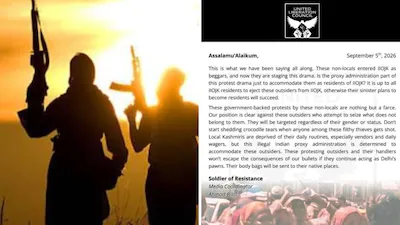
Security agencies have stepped up vigilance in Kashmir after the circulation of a purported threat letter issued in the name of the United Liberation Council (ULC), an online group that intelligence sources describe as a proxy or shadow front of Lashkar-e-Taiba (LeT).
The letter targets non-local employees and Kashmiri Hindus returning to the Valley. It accuses non-local workers of acting as “pawns” of Delhi and of trying to settle as residents of Jammu and Kashmir. The communication threatens violent action against those involved in what it calls government-backed protests or attempts at settlement, and says the warning applies irrespective of gender or status. It also allegedly warns of the use of firearms and of sending victims’ bodies back to their native places, and calls on local residents to reject and “eject” non-locals from the region.
According to senior intelligence sources, the ULC has been used as an online front for digital intimidation and psychological-warfare campaigns. Officials suspect such messages are meant to create panic, force heavier security deployments and disrupt government-backed rehabilitation and resettlement in the Valley.
Multiple agencies are examining the digital footprint of the latest communication, its origin, how it was circulated, and possible handlers. Authorities are also weighing the credibility of the threat and watching online channels for further messages or attempts to incite violence.
This is not the group’s first such message this year.
On August 7, 2026, a ULC letter named six Kashmiri Pandit employees working in a government department under the Prime Minister’s Special Package, leaked their phone numbers and family details, claimed they were being tracked even outside Kashmir, and warned the Jammu and Kashmir Police.
On August 23, a fresh poster on social media widened the campaign by publishing more personal data, including residential addresses in Jammu and vehicle numbers of specific minority employees. By late August, agencies had identified at least four distinct online warnings from the group. The letters were signed by a person using the alias Ahmad Bilal, described as the ULC’s media coordinator.
On September 2-3, the letters became a political flashpoint after former Jammu and Kashmir chief minister Farooq Abdullah questioned their origin. Opposition leaders accused him of playing down Islamist terror threats.
An investigation into the latest letter is continuing.