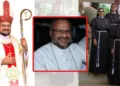

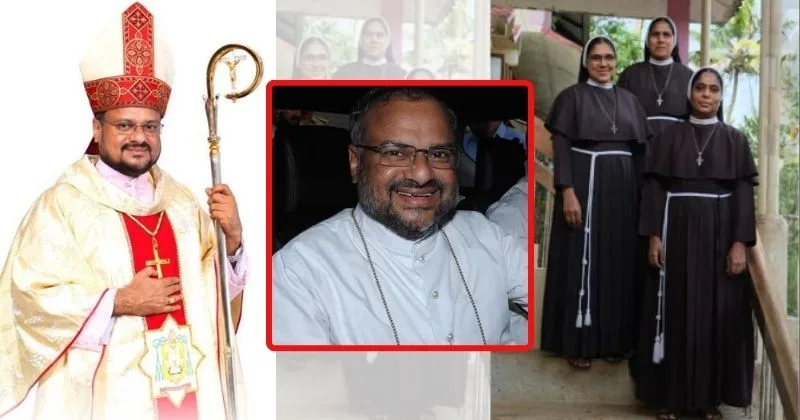
Eight years on, Sister Ranit MJ is still living in the same convent where she says it all happened. The man she accused is still a bishop, at least in name. And the nuns who stood beside her when almost no one else would have quietly lost the little security they had left.
This is where things stand in one of the most explosive cases the Catholic Church in India has ever faced.
It began in 2018, when Sister Ranit, a nun belonging to the Missionaries of Jesus congregation, went to the police and said she had been raped multiple times — thirteen times, by her account — by Bishop Franco Mulakkal, who headed the Jalandhar Diocese and had authority over her convent in Kuravilangad, Kottayam.
When the Nun exposed the Jalandhar Bishop Franco Mulakkal
She said she had gone to church authorities first, more than once, and been ignored. It was only after five fellow nuns broke with tradition and staged a public protest outside the Kerala High Court that the case finally forced the hands of both the police and the public. Mulakkal was arrested that September — the first Catholic bishop in India ever taken into custody on a rape charge.
What followed was a long, bitter fight. A chargesheet ran to 83 witnesses, among them a cardinal, three bishops, a string of priests, and more than twenty nuns. Mulakkal denied everything, and his congregation largely stood by him, framing the case as a conspiracy against a man who had simply cracked down on financial irregularities at the convent.
Then, in January 2022, the Kottayam Additional Sessions Court acquitted him on all counts, ruling that the prosecution had not proved the charges beyond reasonable doubt. The judge also pointed to inconsistencies in the survivor’s testimony — while, in the same order, acknowledging that Mulakkal held real and considerable authority over the nuns in his diocese. That contradiction has stayed with the case ever since. Sister Ranit challenged the acquittal in the Kerala High Court, and the state government filed its own appeal too. Both are still pending, unresolved more than four years later.
Four Years On, Bishop Acquitted for Lack of Sufficient Evidence in the Brutal Rape Case
Mulakkal never went to prison, and he was never thrown out of the priesthood. Under mounting pressure, he resigned as Bishop of Jalandhar in June 2023, and the Vatican accepted it. But resigning a post is not the same as being defrocked. He kept the right to say Mass, hear confession, and offer communion — he simply lost the specific powers that come with actively running a diocese. Today he carries the honorary title of Bishop Emeritus and, by recent accounts, lives quietly at a retreat centre in Kottayam, still involved in church life, still holding private prayers.
The people who paid the heavier price were the nuns who spoke up for the survivor.
Nuns Transferred and Pushed out of Convent
In 2019, four of them were handed transfer orders pulling them out of their convent — a move they called vindictive, timed to break their solidarity just as the case was heating up. Church leadership called it routine. Few believed that. One nun, Sister Lucy Kalappura, who wasn’t even part of the original group but voiced her support publicly, was quietly told to stop her church duties elsewhere. It was a pattern that repeated for years: sympathy for the accused bishop, suspicion and quiet punishment for the women who backed his accuser.
Some of that cost has only become visible more recently. Last year, Sister Anupama — who became something like the public face of the fight, the nun who led the original sit-in protest — left religious life altogether and went back to her family. Of the five nuns who first stood by Sister Ranit, three have since left the congregation. That leaves just two — Sister Alphy and Sister Ancitta — still by her side.
Church and the Diocese stopped the Assistance to the Nuns
The three of them say their allowances and institutional support stopped altogether in 2023, leaving them to figure out daily expenses on their own. Two of the nuns hold MSW degrees and tried to find internships, but institutions turned them away one after another — a rejection Sister Ranit has said made it clear that regular employment wasn’t going to be an option for women in their position. What they landed on instead was something no one could take from them: a sewing machine. What had once been a convent pastime became, in her words, their livelihood.
“Stand By Me,” – the Clothing brand to support the legal fight against the Powerful Bishop
The result is a small clothing brand called “Stand By Me,” which the three nuns now run out of the Kuravilangad convent, selling nightdresses, churidar tops, co-ord sets, bags and home furnishings. They recently displayed the range at an exhibition in Kozhikode. It’s a strange, almost quiet second act to a case that once dominated national headlines — three women stitching clothes to fund both their daily lives and an appeal that’s still crawling through the Kerala High Court.
Their situation only became widely known earlier this year, after which the Kerala government stepped in to issue them ration cards. The Jalandhar diocese, for its part, disputes their account of being cut off — the current bishop has maintained that the Mission Home has continued to receive support from the diocese all along.
Sister Ranit is still there, at the same mission home, still waiting. A report earlier this year described her pushing back against the assumption that people seem to have settled into — that the case is over, that she has moved on, that there’s nothing left to watch.
There isn’t, not legally. The appeals are still pending. Nobody knows when the Kerala High Court will rule, or which way it will go. What is already clear, though, is the shape of the outcome so far: the man accused of rape kept his priesthood and his standing in the church community. The women who believed the survivor and said so out loud did not come out the same way.