Imphal: Manipur appears to be entering a cautious new phase in its difficult journey towards normalcy, with the State Government announcing plans to reopen National Highway-2 and resume the Imphal-Guwahati bus service for people of all communities.
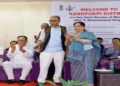
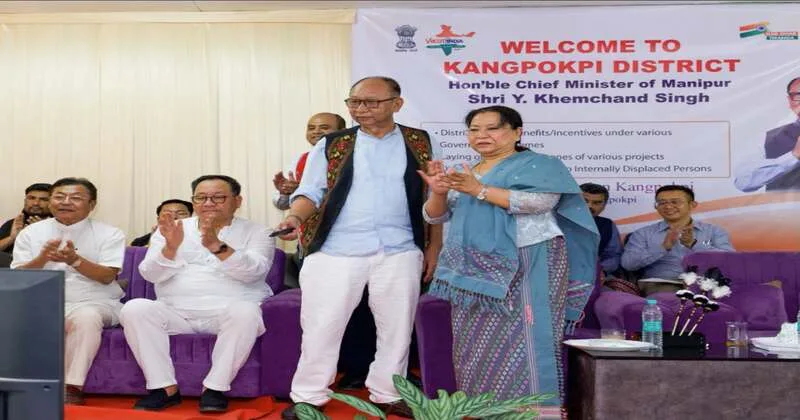
The announcement was made on Saturday (August 8) during a public meeting at the Kangpokpi district headquarters in the presence of NDA legislators from different communities and leaders of Kuki-Zo civil society organisations.
Flanked by Deputy Chief Minister, Nemcha Kipgen and Saitu Assembly Constituency’s MLA, Haokholet Kipgen, Chief Minister, Yumnam Khemchand Singh said legislators had resolved to open the national highway and resume the Imphal-Guwahati bus service with appropriate security arrangements to ensure the safety of passengers. The announcement was endorsed by both Nemcha Kipgen and Haokholet Kipgen, who belong to the Kuki-Zo community.
The significance of the announcement goes well beyond transportation. After more than three years of ethnic conflict, the reopening of a major highway for all communities could become an important confidence-building measure between people who have remained largely separated because of fear, insecurity and deep mistrust.
The disruption of movement along the national highways has been one of the most sensitive consequences of the conflict that erupted on May 3, 2023. The crisis has not only divided communities geographically but has also disrupted trade, education, healthcare, employment and ordinary social interaction. The prolonged disruption created a peculiar situation in which different communities became dependent on different modes of connectivity.
Kuki-Zo people faced difficulties accessing Imphal and the airport through the valley, while Meitei people increasingly depended on air connectivity because movement through Kuki-Zo-dominated hill areas remained difficult and uncertain.
Land transportation, which should ordinarily have been the most accessible and affordable means of movement, consequently became associated with security concerns and fear. The proposed reopening of National Highway-2 and resumption of the Imphal-Guwahati bus service could therefore restore more than a physical connection. It could reopen an important common economic and social lifeline for students, patients, traders, workers, families and other ordinary citizens.
The real significance of reopening the road will ultimately depend on whether people actually begin using it without fear. When buses start running, traders travel, patients cross former lines of separation for treatment, students travel for education and families begin visiting one another again, communities may gradually encounter each other not merely as members of opposing groups but as ordinary citizens sharing the same public space.
This is where the proposed reopening could acquire a significance greater than a transport policy. However, opening a highway officially does not automatically remove fear from people’s minds. The government will have to ensure effective security, prevent illegal barriers, protect passengers and transport operators, and establish a rapid response mechanism in case of any incident. The success of the initiative will ultimately be measured not by the formal announcement but by the confidence with which people use the road.
A genuinely significant milestone would be when a Meitei passenger can travel through Kuki-Zo-dominated areas without fear and a Kuki-Zo passenger can travel towards Imphal without fear.
The proposed reopening of the highway has come amid another significant development—the meeting of Zomi Council leaders with the Chief Minister and Meitei community MLAs in Imphal.
The meeting can be viewed as another important channel for dialogue and engagement between the communities. While a single meeting cannot resolve the deep political and social differences that have emerged during the conflict, direct interaction among representatives of the affected communities is important for rebuilding communication.
Taken together, the meeting with Zomi Council leaders and the proposed reopening of the highway indicate a possible shift, however cautious, from prolonged separation towards dialogue and engagement.
Physical connectivity and political communication can reinforce each other. Roads can facilitate interaction among ordinary people, while dialogue among political and community representatives can create an environment in which such interaction becomes safer and more sustainable.
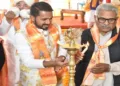
The Chief Minister’s visit to Kangpokpi also assumes significance in this broader context. During the visit, he laid the foundation stone for an Observation Home at the Kangpokpi district headquarters and distributed Rs. 4,000 each to beneficiaries under the Mission Vatsalya Scheme.
He also inaugurated a dialysis unit at the Community Health Centre, Kangpokpi, along with a district blood donation facility at the District Hospital, and handed over an ambulance.
These initiatives may appear separate from the larger question of reconciliation, but they are important to the process of restoring public confidence.
Reconciliation cannot be sustained through political negotiations alone. People also need functioning institutions, healthcare, welfare support, social protection and reliable public services. When government institutions begin delivering services in conflict-affected areas, it can gradually strengthen people’s confidence that the State remains present and responsive.
The Chief Minister has acknowledged the fear and mistrust between communities and sought cooperation from all sections of society. That cooperation will be essential.
The government’s assurance of full security is an important starting point, but security arrangements alone cannot guarantee the long-term success of the initiative. The opening of the highway will require cooperation from communities, transport operators, civil society organisations and local stakeholders.
The authorities will also have to ensure that the road remains genuinely accessible to all communities without discrimination or obstruction. This is particularly important because the highway has become more than an infrastructure issue. It has acquired a psychological and political meaning during the conflict.
If people perceive the road as unsafe, the reopening will remain largely symbolic. If people begin using it confidently, however, the road itself could become a visible sign that normal civilian life is returning.
The Chief Minister’s visits to Kangpokpi, Churachandpur, Senapati and other hill districts, meetings with community representatives, proposed reopening of highways and development initiatives in the hill districts indicate continuing efforts towards engagement and normalisation.
But these developments should not be mistaken for a resolution of the underlying conflict.
Deep mistrust, displacement, competing political demands and unresolved grievances cannot disappear overnight. Nor can reconciliation be achieved simply through administrative announcements or infrastructure projects.
What these developments can provide is something more fundamental—the everyday conditions in which reconciliation becomes possible. For Manipur, reopening the roads could therefore mean much more than restoring transportation. It could be the beginning of restoring confidence, interaction and the idea of shared public space.
If implemented safely, fairly and without discrimination, the proposed reopening of National Highway-2 and the Imphal-Dhimapur-Guwahati bus services could become an important confidence-building step. If physical connectivity is accompanied by sustained political dialogue, community engagement and effective delivery of public services, the process could gradually rebuild the habits of everyday interaction that conflict has disrupted.
The real milestone will not be the day the highway is officially declared open. It will be the day people begin travelling on it without fear. That is when the highway will cease to be perceived as a dividing line and once again become what it was always meant to be—a public road connecting people.
The journey towards reconciliation will be long and difficult. But the return of free and safe movement could be one of its most visible and meaningful first steps.