Over a decade ago, a large population of Uttar Pradesh spent their evenings in darkness. India’s most populous state carries one of the country’s heaviest burdens of energy poverty, with millions of homes still lit by kerosene lamps and villages that receive power for only a handful of unreliable hours. The decade that followed brought one of the most concentrated electrification pushes in independent Indian history. Through a sequence of central and state schemes, Uttar Pradesh moved from being the country’s biggest electrification challenge to its biggest electrification success story. The journey of a decade has been full of schemes by the double-engine government at the centre, and states deserve a closer look.
From Villages to Homes: DDUGJY and the Groundwork
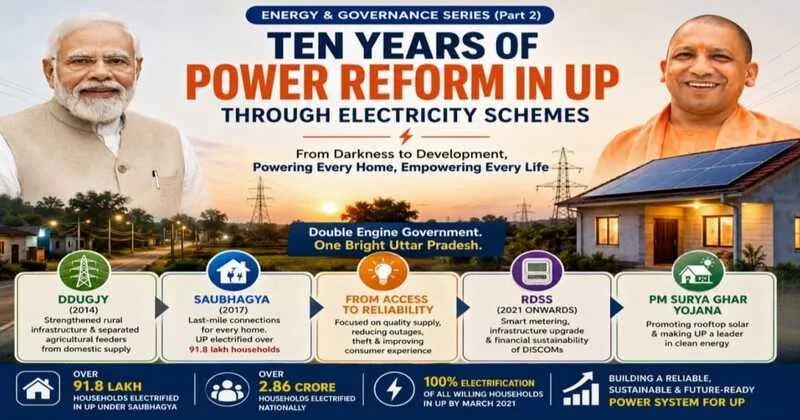
The first scheme begins with the Deen Dayal Upadhyaya Gram Jyoti Yojana (DDUGJY), launched in December 2014. Where earlier programmes had focused on connecting villages to the grid, DDUGJY tackled the plumbing of rural power by separating agricultural feeders from domestic ones so that farm supply could be managed without cutting household lights, strengthening sub-transmission and distribution networks and installing metering at transformers, feeders and consumer points.
For Uttar Pradesh, feeder separation was transformative in principle. It allowed distribution companies to give farmers a scheduled supply for irrigation while insulating villages from the outages that agricultural demand had long caused. By late April 2018, the scheme had helped ensure that every inhabited un-electrified census village in the country, more than 18,000 of them, was connected to the grid. DDUGJY did the unglamorous structural work that later schemes would build upon, and it has since been folded into successor programmes and formally closed.
Saubhagya: The Last-Mile Push
If DDUGJY connected the villages, the Pradhan Mantri Sahaj Bijli Har Ghar Yojana, known as Saubhagya and launched in October 2017, connected the homes. This was the scheme that mattered most for Uttar Pradesh, because the state carried the single largest share of the national problem. At launch, UP had an estimated 15 million un-electrified households, more than any other state.
Saubhagya’s logic was simple and generous. Households below the poverty line, as identified by the 2011 Socio-Economic and Caste Census, received a free connection. Other households paid a token 500 rupees, recoverable in ten instalments, so that cost was never the barrier to getting wired. For remote hamlets where extending the grid was neither feasible nor economical, the scheme offered standalone solar photovoltaic systems with battery packs, delivering basic lighting and mobile charging where poles and wires could not reach.
The state electrified over 91.8 lakh households under the scheme, by far the highest of any state and roughly a third of the entire national total of 2.86 crore. Bihar, the next highest, recorded 32.6 lakh. By March 2021, UP was among the states reporting 100 per cent electrification of all willing, identified households. In a state that had defined India’s energy-access deficit, this was a genuine milestone, and it reset the baseline for everything that followed.
The Reliability Question
Yet a connection is not the same as a supply, and this is where the decade’s story grows more complicated. Independent studies conducted in rural UP around the time of Saubhagya’s rollout found that being connected often meant only intermittent power. Surveys reported that the average electrified rural household received roughly thirteen hours of electricity on a typical winter or summer day, with supply falling below ten hours in the monsoon, when fog and rain could leave villages dark for stretches at a time.
This gap between access and reliability shaped the design of the schemes that came next. It also fed persistent problems that UP shares with Bihar, unscheduled cuts, low voltage and rampant power theft, which in turn strained the finances of distribution companies and their ability to invest in better supply. The lesson policymakers drew was that the next phase could not simply be about counting new connections. It had to be about the quality and financial sustainability of the network itself.
RDSS and the Turning to Quality
The current centrepiece of distribution reform is precisely the ambition of the Revamped Distribution Sector Scheme (RDSS). Rather than chasing coverage, RDSS targets the reliability and viability of the system. Nationally, projects worth around Rs 2.62 lakh crore have been sanctioned for infrastructure strengthening and smart metering, with a smaller carved-out allocation of about Rs 6,522 crore aimed specifically at electrifying the last tranche of households missed before, including particularly vulnerable tribal groups and other marginalised communities.
For Uttar Pradesh, RDSS matters on two fronts. First, it funds the electrification of left-out households, those that existed during the Saubhagya window but slipped through the net, with approvals accorded for such households across UP, Rajasthan and Andhra Pradesh. Second, it is for the average consumer, it drives the rollout of smart prepaid metering. Smart meters promise more accurate billing, reduced theft and better load data for utilities, addressing the revenue leakage that has long undermined UP’s power sector. The transition has not been without friction, with consumers in some quarters wary of prepaid meters, but it represents the clearest structural attempt yet to fix the reliability problem at its financial root.
Consumer Relief: The Bijli Bill Rahat Yojana
Alongside infrastructure, the state has periodically deployed consumer-facing relief measures, and the most recent is a useful example of how UP addresses the affordability side of the equation. The Uttar Pradesh Bijli Bill Rahat Yojana, implemented by the UP Power Corporation Limited (UPPCL) and running from December 2025 through February 2026, offered a complete waiver of the late-payment surcharge accumulated on overdue bills, along with a rebate on the principal amount for consumers who registered and paid within the scheme window.
The rebate was structured in phases to reward early action, with the largest reduction, up to 25 per cent on the principal, available to those who cleared their dues in the first month, tapering to smaller rebates in later phases. Schemes like this serve a dual purpose. They ease the burden on households carrying arrears, and they help UPPCL recover locked-up revenue from bills that might otherwise never be paid, improving the utility’s cash position. In effect, the demand-side companion to the supply-side reforms of RDSS.
UP Electricity Regulatory Commission, PuVVNL’s Managing Director, Shambhu Kumar, said that across the 30 districts under PuVVNL, some 1.12 crore consumers were drawing power in 2025–26, and noted that the Bijli Bill Rahat Yojana saw its highest uptake here, with around 15.68 lakh consumers clearing their arrears at once.
The Solar Turn: PM Surya Ghar in UP
The most recent shift in the decade is toward rooftop solar as a route to both cheaper power and grid relief. The PM Surya Ghar Muft Bijli Yojana, launched to promote household rooftop solar, provides up to 300 units of free electricity per month to participating homes along with a subsidy on installation costs, with the national programme targeting one crore households by 2026-27.
In Uttar Pradesh, where summer air-conditioning loads push many households into the highest and most expensive tariff slabs, rooftop solar offers a way to shave bills while easing pressure on an overstretched distribution network during peak demand. For the state, widespread adoption also means less strain on thermal generation, which still supplies the bulk of UP’s electricity and a modest step toward its renewable commitments. The scheme marks a philosophical evolution across the decade from the state bringing power to the household, to the household generating power for itself and feeding the surplus back.
An Unfinished Transition
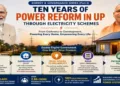
Viewed across ten years, Uttar Pradesh’s electricity schemes trace a clear and positive progression. DDUGJY built the network’s bones. Saubhagya put a connection in nearly every home, an achievement of genuine scale that few predicted the state could deliver. RDSS is now attempting the hardest task of all, turning those connections into a reliable, honestly-billed, financially-sustainable supply. And relief schemes and rooftop solar are addressing affordability from opposite ends, one forgiving old debts, the other lowering future bills.
The unfinished work is reliable. Universal access, on its own, did not guarantee that the lights stay on, and the state’s persistent challenges with supply hours, voltage, theft and distribution-company finances remain the real test of whether a decade of schemes translates into a durable change in daily life. The infrastructure and the intent are now in place. Whether Uttar Pradesh can convert its remarkable connection numbers into consistently dependable power will define the next decade as decisively as electrification defined the last.






![Melbourne [Australia], Jul 09 (ANI): Prime Minister Narendra Modi and Australian Prime Minister Anthony Albanese exchange a handshake, in Melbourne on Thursday. (@narendramodi X/ANI Photo)](https://organiser.org/wp-content/uploads/2026/07/20260709084l-2-120x86.webp)