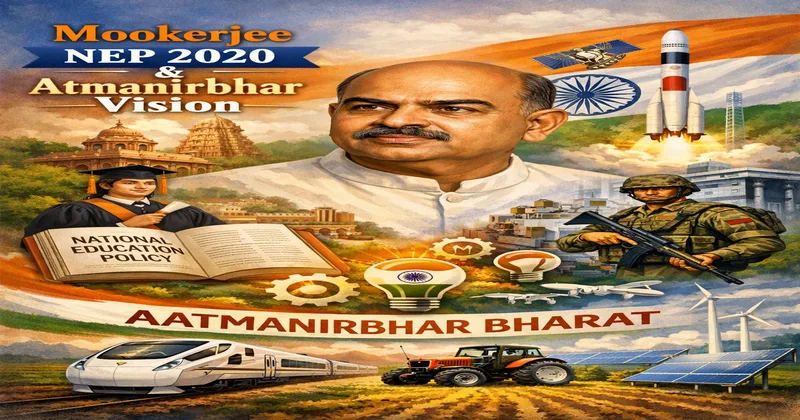
Nearly a century separates Dr Syama Prasad Mookerjee’s tenure as an educationist and industrial statesman from India’s contemporary policy landscape. Yet two of the country’s most significant modern initiatives — the National Education Policy (NEP) 2020 and the Atmanirbhar Bharat movement — echo convictions he articulated and acted upon decades before either was named. This is not a matter of coincidental phrasing. Mookerjee’s work as Vice-Chancellor of Calcutta University, and later as independent India’s first Minister for Industry and Supply, left behind a coherent philosophy: that a nation’s education and its industrial capacity must both be self-reliant, rooted in its own languages and traditions, yet oriented toward the highest global standards. Examining his specific initiatives makes that resonance concrete rather than rhetorical.
Mother Tongue and Multilingual Education
Mookerjee’s own academic choices reveal an early and deliberate commitment to Indian languages in higher learning. In 1923, he chose to pursue his Master’s degree in Bengali rather than English, and topped the University in doing so — a decision that reflected his father Sir Ashutosh Mookerjee’s conviction that Indian languages deserved their rightful place in serious scholarship, not merely in everyday life. As Vice-Chancellor, he carried this belief into policy. In 1937, he invited Rabindranath Tagore to address the Convocation of Calcutta University in Bangla — the first time in British India that a university convocation had been addressed in an Indian language.
NEP 2020 formalises precisely this principle. It mandates, wherever possible, instruction in the mother tongue or regional language through the foundational years of schooling, and treats multilingualism not as an obstacle to academic rigour but as a cognitive and cultural asset to be cultivated. Its insistence that Indian languages be strengthened in research and higher education, rather than treated as vernacular afterthoughts, gives institutional form to a belief Mookerjee lived out personally nearly a century earlier — that the mother tongue and academic excellence were never in conflict. NEP 2020’s three-language formula, which allows states and institutions flexibility while insisting that no child be taught in a language they do not understand, echoes this same spirit of linguistic confidence rather than linguistic imposition.
Multidisciplinary Learning and Industry-Academia Linkage
A second thread concerns the structure of knowledge itself. As Vice-Chancellor, Mookerjee consolidated the biological sciences — Zoology, Botany, Anthropology, Experimental Psychology and Physiology — onto a single campus, anticipating what would later be called interdisciplinary research. He expanded Applied Chemistry, increased intake in Applied Physics, and introduced Communication Engineering into the Applied Physics curriculum, a decision that eventually grew into the well-known Institute of Radio Physics and Electronics. Underlying these moves was a conviction he stated explicitly: that scientific excellence could be achieved only through close interaction among universities, research institutions, industry, and government.
NEP 2020 makes this same conviction a structural premise. It dissolves rigid boundaries between disciplines in favour of multidisciplinary institutions, mandates vocational education and internships from an early stage, and calls for stronger, more systematic linkages between higher education and industry. Institutions such as IIEST Shibpur, with their engineering pedigree and growing emphasis on industry-linked projects, embody a model Mookerjee first sketched in the lecture halls of Calcutta University nearly a century ago. NEP 2020’s push for skilling and apprenticeship-integrated degrees, and its emphasis on lifelong learning outside conventional degree structures, extends this same logic: that technical capability must be distributed widely across society, not concentrated narrowly within an elite few institutions.
This impulse toward coordinated national research architecture is visible elsewhere too. On January 7, 1935, under Mookerjee’s leadership, the inaugural meeting was held in the Senate Hall of Calcutta University that led to the founding of the National Institute of Sciences of India — later renamed the Indian National Science Academy (INSA). The underlying insight — that research flourishes not through isolated individual effort but through deliberate national architecture — finds its contemporary descendant in NEP 2020’s proposal for a National Research Foundation, intended to fund, mentor, and coordinate research across disciplines and institutions nationwide.
From Industrial Policy 1948 to Atmanirbhar Bharat
The second, and perhaps more direct, line of continuity runs from Mookerjee’s industrial vision to India’s contemporary pursuit of self-reliance under Atmanirbhar Bharat. As independent India’s first Minister for Industry and Supply from 1947 to 1950, Mookerjee shaped the Industrial Policy Resolution of 1948 — India’s first industrial policy after Independence. Its guiding principle was that heavy industry and small, cottage, and village industry must grow together rather than in competition, generating employment while building strategic national capacity.
Under his stewardship, India advanced several landmark projects: the Chittaranjan Locomotive Works, the Hindustan Aircraft Factory (known today as Hindustan Aeronautics Limited), the Sindri Fertilizer Factory, and the Damodar Valley Corporation. Each of these was, in its own way, an assertion that India need not depend on others for the tools of its own progress.
Compare this with the stated aims of Atmanirbhar Bharat and the Make in India programme: building domestic manufacturing capacity in strategic sectors, strengthening MSMEs, promoting “Vocal for Local,” and reducing dependence on imports in critical areas such as defence production, electronics, and pharmaceuticals. The specific vocabulary has changed across seven decades; the underlying strategic logic — that national strength requires self-sufficiency in the tools of production — has not.
Mookerjee’s commitment to India’s traditional and rural economy was equally deliberate, and equally structural. The All India Handicrafts Board, the All India Handloom Board, and the Khadi and Village Industries Board were all established during his tenure, to protect artisans and rural livelihoods even as the country industrialised around them. This balanced model finds its modern equivalent in the coexistence of large-scale manufacturing missions — such as the Production Linked Incentive (PLI) schemes — with continued government support for MSMEs and traditional artisans through schemes for handloom, khadi, and handicrafts. The institutional lineage here is not merely thematic but direct: the very boards that anchor these sectors today trace their origin to Mookerjee’s own tenure as Minister.
A Shared Underlying Philosophy
As India looks toward the vision of Viksit Bharat @2047 — a developed nation by the centenary of its independence — it is worth recognising that the underlying philosophy driving both NEP 2020 and Atmanirbhar Bharat is not new. Successive government communications, including Prime Minister Narendra Modi’s own tribute to Mookerjee in the 45th episode of Mann Ki Baat in 2018, have explicitly drawn this line of continuity, crediting him with laying the foundation of India’s industrial development and envisioning the simultaneous growth of heavy industry alongside MSMEs, handloom, and cottage industries.
What Mookerjee argued and built between the 1930s and the early 1950s was, in substance, a single unified claim: that political freedom is incomplete without technological capability, industrial self-reliance, and scientific excellence — and that all three must be rooted in India’s own languages, institutions, and traditions rather than imported wholesale. NEP 2020 and Atmanirbhar Bharat are, in this sense, not new philosophies but the contemporary instruments of a conviction Mookerjee held and acted upon nearly a century before either policy carried a name. That two of India’s most consequential twenty-first-century policies should so closely track the priorities of a man who died in 1953 is not an accident of framing; it is evidence of how far ahead of his moment his diagnosis of India’s needs truly was.