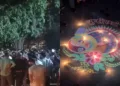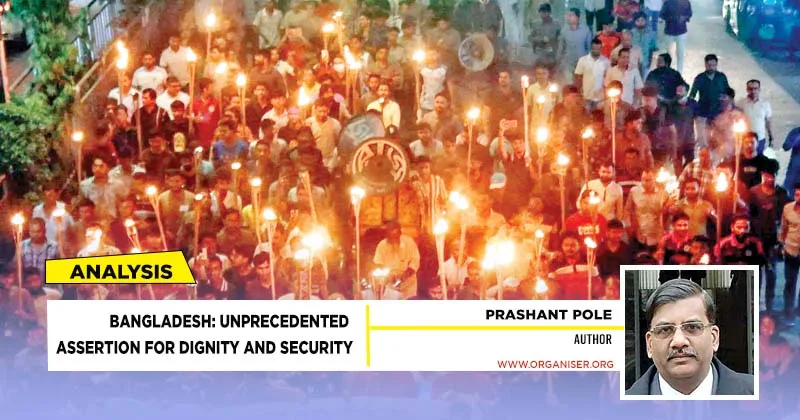
An unprecedented scene unfolded in Bangladesh on Friday, June 19. A massive human chain was formed in front of the National Press Club in Dhaka. By noon, students from various universities across Dhaka had gathered in the Shahbagh area. Their numbers were so large that the entire Shahbagh precinct came to a standstill. By evening, these students carried out a grand and impactful torch procession. The sight of this procession seemed to leave the metropolis of Dhaka stunned. Such scenes are not unusual in Dhaka. Then what was so special about this demonstration that not only Dhaka but all of Bangladesh appeared shaken?
The reason was that all these students were Hindus. The karyakartas who formed the human chain were Hindus. They were protesting under the banner of ‘Hindu Mahajot’ (Bangladesh National Hindu Grand Alliance) against the insult to Bhagwan Sri Ram. There was a difference — a very significant difference. The Hindu who until yesterday endured attacks was now overflowing with confidence, openly protesting the desecration of his revered deity and issuing an ultimatum to the Bangladeshi government.
If we imagine the map of Bangladesh as a person wearing a kurta, then the district of Gaibandha would be located at the neck of that figure. The village of Palashbari in Gaibandha district is currently in the spotlight across Bangladesh. In Palashbari, the Hindu community is constructing an 81-foot statue of Bhagwan Sri Ram. The work on the statue, being built within the premises of the Sri Sri Radha Govinda and Kali Temple, is approximately 80 per cent complete. The project is being carried out under the leadership of Haridas Chandradas, President of the Radha Govinda Temple Committee. (It is said that Emperor Virat ruled this region during the Mahabharat period. He cared for hundreds of cows. The place where the city now stands was used for tying cattle. It is said to be the origin of the name Gaibandha.)
Over the past several days, construction of the statue has come to a complete halt due to opposition from the Imam-Ulema Council and other Islamist organisations. These groups have threatened to demolish the statue. During the week, some miscreants reportedly piled shoes and slippers on the under-construction statue. In protest, Bangladesh’s Hindus became more assertive. Hindu students of Jagannath University, located in southern Dhaka, were the first to take to the streets against religious desecration. The spark ignited by this movement awakened Hindus across Bangladesh. It was in this context that the unprecedented demonstration by Hindus took place in Dhaka.At present, only about 9 to 10 per cent Hindus remain in Bangladesh. In Gaibandha, the number dwindles to about 7 per cent. This was not the first time Hindus had faced repression. Numerous Hindu temples have been demolished in Bangladesh over the years. Several Vigrahas of Hindu deities have been destroyed. At times, Hindus offered limited protests; more often, they silently endured. So where did this newfound courage come from? The answer lies in the election results of West Bengal. The wave of Hindutva that emerged from the West Bengal election results gave confidence and courage to Bangladesh’s Hindus. Their self-confidence was awakened, culminating in this unprecedented movement.
For years, news reports have described severe persecution of Hindus in Pakistan, including forced religious conversions and the abduction of Hindu girls. Similar reports keep emerging from Bangladesh. From 1947 to 1975 in East Pakistan, and from 1975 to the present day in Bangladesh, numerous Hindu temples have been attacked or demolished from time to time. In 1971, the West Pakistan army reportedly committed the genocide of Bangladeshi Hindus. In the disorder of 2024, similar incidents were reported again. Hundreds of Hindus were killed, and several Hindus have been victims of mob lynching.
On all these occasions, those who speak of human rights, and lecture on humanity and secularism always remained silent. In Bharat too, Muslims constitute around 15 per cent of the population. Yet, even a fringe incident is blown out of proportion internationally by these so-called human-rights activists. Many times, claims of ‘Muslims unsafe in Bharat’ are circulated widely even when nothing has happened, as did during the
COVID–19 period. The question therefore remains: There is no parallel to the atrocities being committed on Hindus in Bangladesh and Pakistan. Yet, why do horrific incidents involving Hindus in Bangladesh and Pakistan find no front space in print, while even minor incidents in Bharat become major news stories internationally?
The answer is — organisation. Bharat’s Muslim community is organised, even if through different groups and organisations. Unfortunately, the same cannot be said of Hindus in Pakistan and Bangladesh. Before Partition, Muslims had a political party in the form of the Muslim League. After Partition, the Muslim League lost much of its relevance in Bharat but continued under the name Indian Union Muslim League. It expanded its influence in Keralam, elected members to Parliament, and was a constituent of the United Progressive Alliance (UPA). During the UPA’s ten years in power, the party was represented in the Union Cabinet. Significantly, even today, the Chief Minister of Congress in Keralam depends on the approval and support of the Muslim League. Other Muslim organisations also engage dominantly in Muslim politics.
Before Partition, the principal political organisation identified with Hindu interests was the Hindu Mahasabha. However, Hindus of Hindustan did not regard it as their own political party. The British and Muslims viewed the Congress as a Hindu party, whereas Congress itself did not identify itself as a Hindu party. All policies of Congress were favourable towards Muslims.
The Hindu Mahasabha had some presence in West Pakistan. Many of its karyakartas migrated to Bharat, while those who remained suffered a decline in morale. Thus, by around 1950, the organisation had virtually disappeared from West Pakistan. In contrast, the Hindu Mahasabha possessed some strength in East Pakistan. In undivided Bengal, leaders such as Dr Syama Prasad Mookerjee and Nirmal Chandra Chatterjee were associated with it. It was Dr Syama Prasad Mookerjee who ensured that West Bengal remained with Bharat rather than becoming part of Pakistan. Today, several Hindu social organisations exist in Bangladesh. In 2006, some of these groups came together to form the ‘Hindu Mahajot’. However, its activities remained limited and it lacked political influence. Most Hindus supported Sheikh Hasina’s Awami League. After the overthrow of the Awami League government in 2024, Hindus faced severe attacks. Initially, the Hindu Mahajot viewed these incidents largely as political retaliation, and therefore, an expected organised Hindu response did not emerge. This movement, however, was different. It was a visible proof that Bangladesh’s Hindu has awakened. The West Bengal election has changed many things. The Hindus of Bangladesh are now asserting themselves with greater confidence and organisational strength.
This is a highly positive development for Hindus.