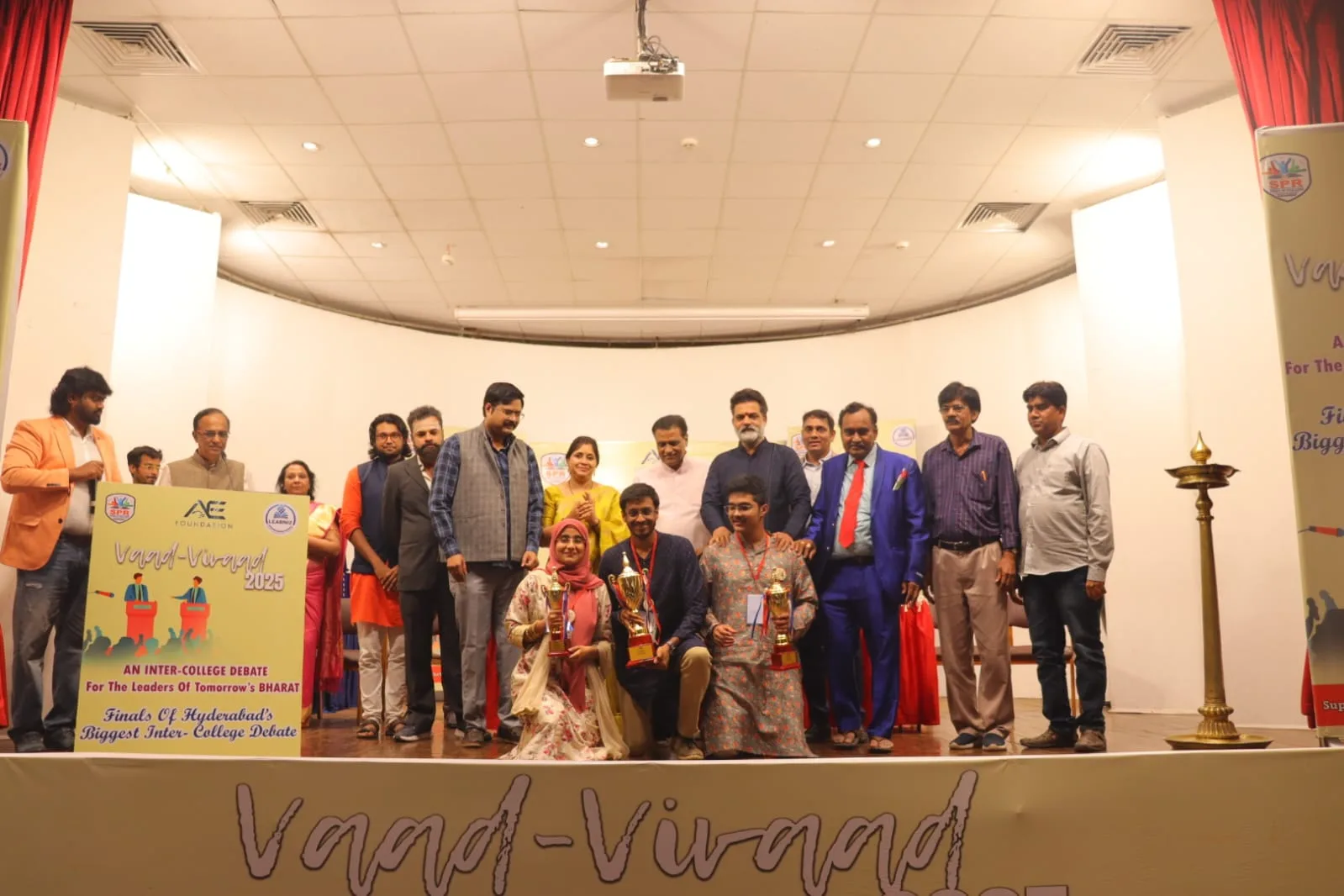
Hyderabad: AE Foundation, a Hyderabad-based non-profit organisation, conducted a month-long inter-collegiate debate competition ‘Vaad-Vivaad 2025’ aimed at encouraging structured public expression among undergraduate and postgraduate students.
This Vaad-Vivaad event reached over 55 colleges and witnessed participation of more than 650 students, bringing some of the brightest young minds to debate on thought-provoking theme “India and its Identity in the 21st Century: Redefining Our Nation and Our Position in the World Order”.
The competition was free to attend and open to students from any discipline. Participants were allowed to speak in either Telugu or English, with no language restrictions, and topics were given on the spot. Electronic devices were not permitted after the topic announcement to ensure spontaneous argumentation. The Foundation stated that the objective was to provide a platform for young people to articulate their views on societal and national issues in a formal setting.
Four Preliminaries Conducted Across the City
Four preliminary rounds were conducted on August 29, September 5, September 12 and September 19, 2025, with students allowed to participate in any one round based on convenience. The debates were held in two formats: turncoat and one-on-one.
Turncoat topics covered a wide range of themes, including national identity, secularism, digital transformation, welfarism, historical injustice, illegal immigration, political culture, and the role of social media. Some topics included:
- Religions that preach intolerance must not be tolerated
- Illegal immigration is economic terrorism against local populations
- A single cohesive national identity is the need of the hour
- Social media is a weapon of mass distraction destroying Indian youth
- Welfarism is the cloak for hiding incompetent governance
The one-on-one category focused on governance, security, judicial processes, foreign policy, gender roles and economic strategy. Topics included:
- Naxalism and separatist movements pose a greater threat than external forces
- Stringent laws like UAPA and AFSPA are necessary for national safety
- Judicial pendency is the result of vague laws, not a failing judiciary
- India’s global identity must be shaped by its culture, not its poor economy
- Non-alignment is not an option for an India that wishes to lead the world
AE Foundation stated that the structure was intended to encourage independent thinking and quick reasoning.
Several dignitaries attended the final event held on November 5 at Birla Planetarium Auditorium, representing diverse professional backgrounds. Film scriptwriter and director Vijayender Prasad was present, along with former Chevella MP Konda Vishweshwar Reddy, MLC Malka Komaraiah and MLA Dr Pallvai Harish Babu. Senior journalist Suresh Kocchatil, who also served as a judge, assessed the finalists, while Retired IAS officer Ajay Mishra provided administrative perspective. Socio-political activist Vakulabaram Krishna Mohan Rao observed the proceedings, and Retired Judge and Supreme Court Advocate Nerella Malyadri offered legal insight during the evaluations.
In the Telugu debate category, Nagarju of Mahatma Gandhi Law College secured the First Prize (Rs20,000). The Second Prize (Rs15,000) went to Srivigna Teja from Shreyas Institute of Engineering and Technology, while J. Shivprasad from Nizam Law College received the Third Prize (Rs10,000).
In the English category, Chakilam Varun from ICFAI Law College won the First Prize (Rs20,000). Vaishak of JNTUH took the Second Prize (Rs 15,000), and Mahasin Fathima, also from ICFAI Law College, received the Third Prize (Rs 10,000). Certificates and prize money were distributed at the venue.
AE Foundation stated that the debate series was designed to revive structured opinion-sharing among young people, noting that academic competition and timetable pressure often reduce such discussions to informal settings like to canteens or political gossips.
Speaking with Organiser, Sangeeta Mishra, Founder & Director of AE Foundation, said, “Debates are vital to nation-building, Yet many students, brilliant in thought but more comfortable in Telugu, are left behind. Vaad-Vivaad was created to ensure every voice finds expression.”
According to the organisers, providing formal platforms helps students articulate their perspectives on issues of national relevance and strengthens their ability to engage in civil, policy-oriented discourse.
Dignitaries present at the finals noted that such events contribute to preparing students for future roles in society by improving analytical thinking, communication skills and understanding of public issues. The Foundation stated that it intends to continue similar initiatives to ensure young voices are encouraged and channelled constructively across educational spaces.