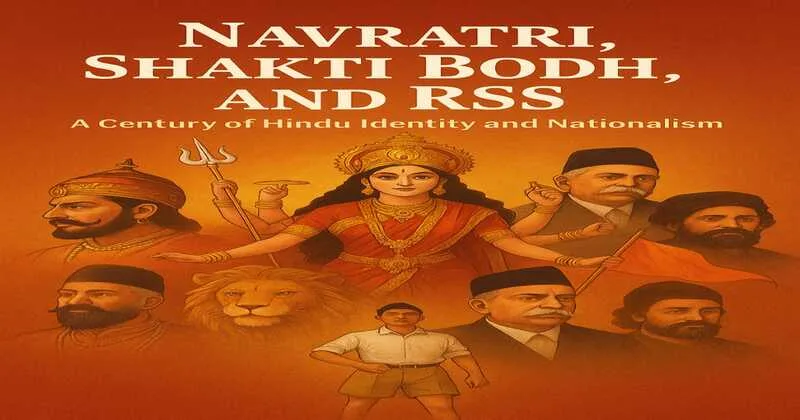
Every year Navratri begins on the Pratipada (Shukla Paksha) of the month of Ashwin in the Hindu lunisolar calendar. This year Navratri begins on September 22, 2025 (Ashwin Shukla Pratipada) and culminates in Vijaya Dashami (Dussehra) on 2 October 2025. The festival in 2025 falls in Vikram Samvat 2082 (Shaka Samvat 1947: Amanta/ Purnimanta month: Ashvina) observed with ghatasthapana, vrata, Durga Saptashati recitation, fasting and ritual worship across regions.
Navratri is not merely a festival: it is the embodiment of Hindu civilizational consciousness, a ritual, a philosophy, and a call to action. For nine nights, Hindus worship Maa Durga, Maa Chandi, and Maa Bhawani, invoking the eternal Shakti that has historically sustained society against subjugation and moral decay. This invocation is both spiritual and existential: it is a reminder that identity, courage, and dharma must be consciously preserved and acted upon.
The last thousand years of Indian history testify to repeated attempts to suppress Hindu society from Mughal invasions to British colonial domination, and from ideological incursions to cultural distortions in the modern era. Yet, the thread of Hindu identity remained unbroken. Warriors and sages alike invoked the Goddess to awaken strength in the collective conscience: Maharana Pratap defending the sovereignty of Mewar, Guru Gobind Singh Ji inspiring the Khalsa, Chhatrapati Shivaji Maharaj reclaiming self-respect and territory. These acts were not just martial victories, they were affirmations of civilizational resilience, moral courage, and dharmic nationalism.
In contemporary times, the Rashtriya Swayamsevak Sangh, now over a century old, has inherited this legacy. Its mission is not only to organize society but to rekindle the timeless Shakti of Hindu civilization: discipline, moral courage, cultural self-awareness, and collective identity. This is the essence of Hindu nationalism: an assertive, self-aware, and morally rooted consciousness that defends and celebrates identity without aggression or compromise.
This year’s Navratri and Vijaya Dashami hold special significance because the Rashtriya Swayamsevak Sangh (RSS), since its establishment in 1925, has continuously invoked Maa Bharti every Vijaya Dashami to awaken the spirit of Shakti, courage, and dharmic responsibility. On October 2, 2025, the RSS will complete its 100 years, marking a century of dedicated service to Hindu civilization and the preservation of identity, values, and nationalism. This centennial serves as a vivid reminder that the timeless ethos of Shakti, the power to uphold truth, resist oppression, and ensure the triumph of Good over Evil remains eternal and alive in every generation.
Navratri itself is a profound lesson in Shakti Bodh, the awakening of inner and collective power. The nine forms of the Goddess, from Shailputri to Siddhidatri, represent not just spiritual virtues but practical principles of courage, wisdom, and action. The fearless Kalaratri teaches that darkness, ignorance, and oppression must be confronted decisively; the benevolent Mahagauri teaches that virtue, purity, and discipline are the foundations of sustainable strength. Through these archetypes, Navratri becomes a civilizational curriculum, teaching that survival, self-respect, and identity require both inner power and active engagement with the world.
Vijaya Dashami, the celebration of the Goddess’s triumph over Mahishasura, is emblematic of every epoch in which Hindu society faced existential threats and yet emerged victorious. It is a reminder that the preservation of identity and the assertion of dharma are inseparable from courage, action, and unity. The same Shakti that inspired historical warriors now inspires a society committed to cultural revival, national self-respect, and moral clarity.
In the modern global context, Hindu identity and nationalism are under pressure from both internal fragmentation and external narratives. Yet, the spiritual and cultural framework of Navratri offers a template for resilience: invoke Shakti, cultivate moral courage, unite through dharma, and act decisively to preserve truth. Hindu nationalism, therefore, is not merely political , it is civilizational, ethical, and spiritual. It asserts that a people who know their roots, their dharma, and their power cannot be subdued, distorted, or erased.
Navratri, in essence, is both a celebration and a call to action. It reminds us that for over a millennium, Hindus have survived suppression because they invoked Shakti to defend truth and dharma. It calls the present generation to awaken the same power, to honor the sacrifices of forebears, and to ensure that Hindu identity, culture, and nationalism continue to shine as an undefeatable force, a beacon of resilience, courage, and moral clarity in the world.
As the nine nights of Navratri culminate in Vijaya Dashami, the festival leaves us with a profound message: the triumph of dharma, the preservation of identity, and the awakening of inner Shakti are never accidental, they are the fruits of courage, discipline, and conscious action. From Maharana Pratap defending Mewar, Guru Gobind Singh Ji inspiring the Khalsa, to Chhatrapati Shivaji Maharaj reclaiming sovereignty, history bears witness to the power of this awakened Shakti in defending our civilization.
In the modern era, institutions that embody and propagate this civilizational ethos continue to channel this Shakti ensuring that Hindu nationalism is not mere politics but a conscious affirmation of identity, moral courage, and dharmic responsibility. Navratri reminds us that a society that knows its roots, celebrates its values, and invokes its spiritual power will withstand oppression, resist distortion, and rise victorious.
Thus, Navratri is not merely a festival: it is a call to awaken, preserve, and assert the eternal spirit of Hindu identity and nationalism. It teaches every generation that Shakti, once invoked in thought, word, and action, cannot be subdued, and that the triumph of Good over Evil, Dharma over Adharma, and Self over Oppression is inevitable when courage aligns with conviction.