“I have faith in my country, and especially in the youth of my country. …Be not afraid, for all great power, throughout the history of humanity, has been with the people. From out of their ranks have come all the greatest geniuses of the world, and history can only repeat itself. Be not afraid of anything. You will do marvellous work. The moment you fear, you are nobody. It is fear that is the great cause of misery in the world. It is fear that is the greatest of all superstitions. It is fear that is the cause of our woes, and it is fearlessness that brings heaven even in a moment. Therefore, “Arise, awake, and stop not till the goal is reached” – Swami Vivekananda, Address of Welcome Presented At Calcutta and Reply, Lectures from Colombo to Almora, The Complete Works of Swami Vivekananda, Volume 3, pp. 320-21
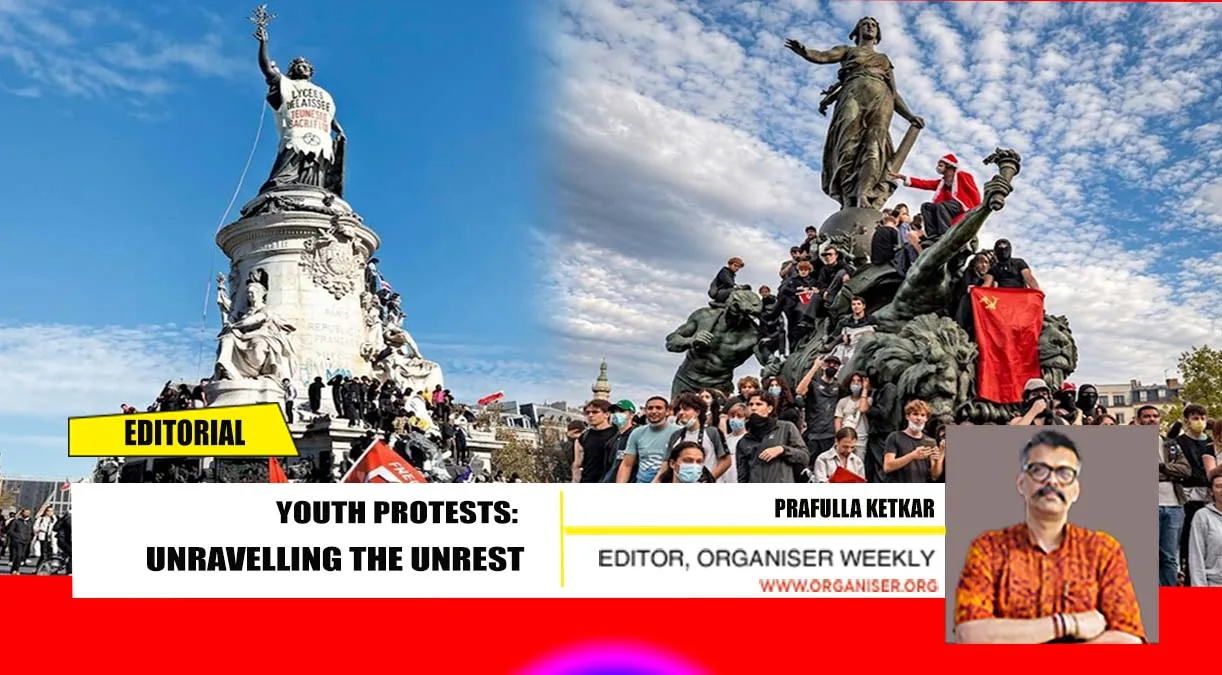
The streets across France are burning with student demonstrations over teacher shortages, overcrowded classrooms, and deteriorating school buildings. Echoing the same issues and similar protests, students of Belgium’s French-speaking community are raising concerns about education reforms and a tuition increase, clashing with authorities. Albania, Greece, Italy, Ireland, and other European countries are seeing nationwide protests over university conditions, higher education costs, financial support, and post-graduation employment prospects as part of the ‘Fund our Future’ campaign. In Germany, school strikes are taking place to protest against the reintroduction of compulsory military service, which is not yet a policy. It may soon spread to the United Kingdom or the United States of America over rising prices and school infrastructure.
Now compare this with what started with self-labelled leaders of the entire student and youth community in Bharat, the CJP. From NEET paper leakage to School Thik Karo (Improve the Schools) to opposing the Election Commission’s Special Intensive Revision (SIR) of electoral rolls, the CJP is trying to apply the same playbook in Bharat. In Europe, “Let’s do like in France” has become a catchy slogan, while in Bharat, we want to do Bangladesh and Nepal is commonly used. Why are youth across regions protesting with the same pattern? Are they genuinely angry, or is something else bothering them? We need to unravel this phenomenon with deeper analysis, instead of getting carried away and feeling threatened by their posturing and imagery.
American-imposed global capitalism has created another crisis for the world order. The incessant wars necessitated by the military-industrial complex, with a strategy of pitting one group against another, have created global uncertainties. Global inequalities within and between countries are rising. Since the Cold War ended, the promise of a more peaceful and stable world has seemed illusory. The Ukraine-Russia and US-Israel vs Iran wars have further created pressures on economies, with the crumbling of crude oil supply chains. The global experience of the US-promoted capitalist model has been unsustainable, with regular cycles of inflation and depression. Everyone is looking for an alternative. Naturally, these developments create heavy pressure on families, and youth are sensitive to such turmoil.
The Communists across the borders that had crumbled with the Cold War have been regrouping and looking for an opportune time to strike back at the ‘capitalist system’. A cultural variant of communism, inspired by Gramsci and Mao, cleverly uses capitalist funding to create social fissures and identity-based divisions. Their standard modus operandi is to pit one group against another, and against the popular national ethos, to undermine collective identity. The systematically infiltrated and nurtured academia and media effectively play a role in this process by monopolising narratives and branding or negating non-left points of view as ‘fascist’ or ‘right-wing’. The NGO network provides the penetration and recruitment needed to influence policymaking. They are the ones who are effectively cashing in on the global and social tensions and creating narratives to mobilise one group after another to discredit liberal democracy.
Digital technology, especially social media platforms developed by capitalists, has proven handy for preparing toolkits, communicating through symbolism, and mobilising visible numbers. The individuals and parties that are rejected on the ground in electoral politics can create the perception of disproportionate power to challenge the system. Establishing new faces with a strong narrative of victimhood and some ‘class exploitation’ has become easier. To build a consumer base for their products, tech companies have created fancy categories and their characteristics to generate a sense of uniqueness, like Gen-Z or Gen-Alpha. Artificial Intelligence-based content has fuelled misinformation and disinformation warfare. New kinds of insecurities, real and imagined, are fed to instigate targeted groups – based on age, gender, caste, class or ethnicity and their tactical issue-based alliances are formed to destabilise and discredit the entire existing systems. The ideology that could not give any credible alternative anywhere in the world is using the neo-Left strategies of reject, resist and rebel to create anarchy across societies.
What is common in all these protests? Beyond education or student-linked issues, red flags and powerful imagery on social media are driving these protests. The protest may start with some genuine issue. Eventually, it will suddenly shift to defending some terrorist or ‘Free Palestine’ campaign with anti-Semitism overtones and finding some leader or organisation as a villain and cause of all problems. Occupy an iconic place to designate it as a protest site, like Place de la République in France; in Bharat, it is Jantar Mantar. Make unreasonable and unconstitutional demands and push the authorities to the wall, leaving them in a dilemma about whether to act.
A section will normalise abusive language and hatred towards certain sections of society, while others will contribute to creating the FOMO syndrome among youth. Islamic fundamentalists, with their religious sentiments and Umma mindset, will always be trusted alliies of the Communists in the mobilisation process. Loose front organisations and NGOs provide depth, and a political party or formation brings scale to the revolutionary agenda. Use influencers and prominent icons from sectors already targeted by cancel culture to create the impression of mass support. Disrupt law and order and further pressure the economy, so more people get frustrated with the system. If authorities use legal measures to maintain law and order, they also use them to gain sympathy. The cycle continues until the regime changes and the system completely breaks down.
Youth, especially students, are the natural targets in this process. Anywhere in the world, across time and generations, youth are intrinsically connected to energy and a sense of unrest about the prevailing situation. Challenging the status quo is a natural tendency, and when that energy is not channelised positively, destructive forces naturally benefit. Monopolisation of academic campuses by the self-certified ‘Left’ across the globe has effectively begun to cash in on the failures of the prevailing system. Their anti-Americanism is well known but they will never utter a word against the internal situation in China, North Korea or Cuba. Effective use of social media to subvert democracy with a Communist agenda and symbolism has become easier for these forces. Not that they have real appeal on the ground; they can create noise and shape subversive perceptions.
In the case of Bharat, what they forget is the civilisational wisdom and resilience to channelise generations after generations. The path shown by Swami Vivekananda will always guide larger sections of youngsters to work constructively for the nation. For every false narrative, there will be a bigger, better positive narrative of Bharat. For every attempt to destabilise, stabilising forces will rise. For any deterioration in the system, Madhyam and Samyak Marg (the middle and righteous path of Buddha) will prevail. For any attempt to destroy the national ethos, there will be renewed determination to re-galvanise the civilisation. Any manipulation of national icons to create social divisions will be countered with a unifying message. The ancient Rashtra has seen many onslaughts and ups and downs, and it has not just survived but resurrected with the same spirit and new dimensions. This Vijayadashami, we need to take a new resolve to channelise youth energy for national reconstruction, saving our youth from a destructive path without any credible alternative. From families to educational institutions, we need a renewed spirit to spread Swami Vivekananda’s message: “Arise, awake, and stop not till the goal is reached”.
