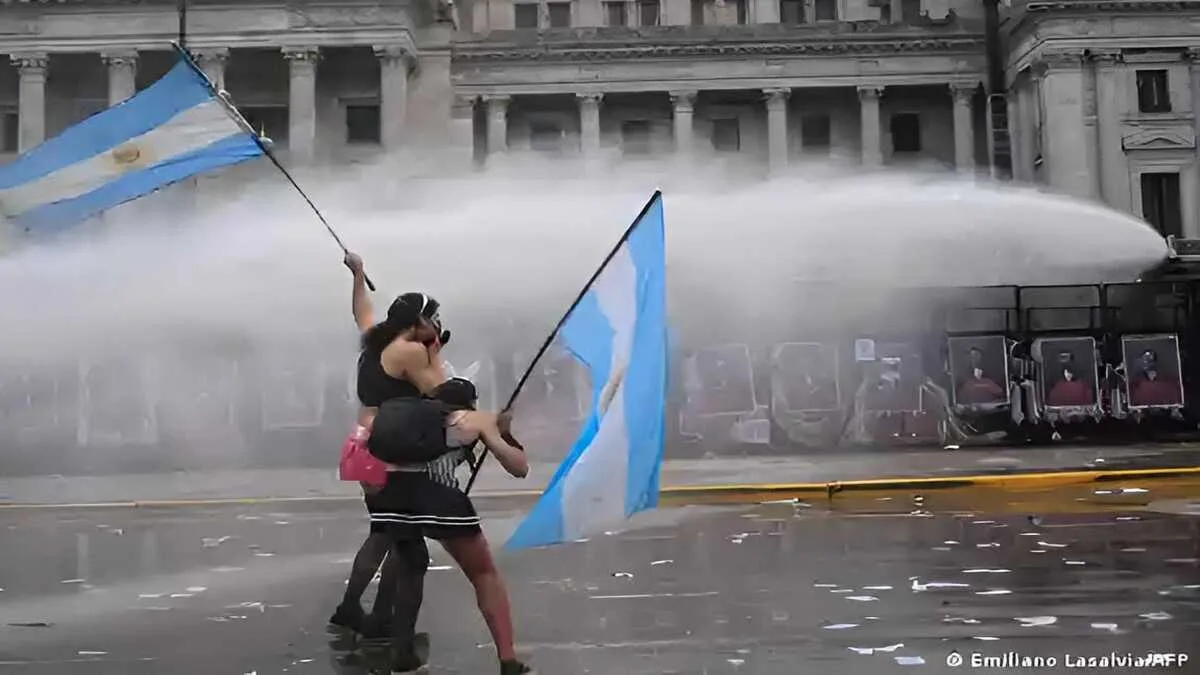
Left-wing protesters wave Argentine flags as police deploy water cannons outside Congress in Buenos Aires during the protest against university funding cuts
BUENOS AIRES: Thousands of leftist students, university employees, trade unionists and opposition supporters took to the streets of Buenos Aires on October 15, protesting President Javier Milei government policies on public education funding.
The demonstration, organised around demands for increased university spending, descended into violent confrontations near the Argentine Congress, leaving at least eight police officers injured and around 25 people arrested, according to the National Security Ministry.
The protest brought together left-leaned student groups, university representatives, trade unions and political organisations opposed to Milei’s austerity programme. The mobilisation highlighted how opposition forces have turned education funding into a rallying point to fuel unrest on the streets and intensify their campaign against the government.
The demonstration was backed by prominent trade union organisations, including the General Confederation of Labour (CGT) and the two branches of the Argentine Workers Central (CTA). Leftist student organisations, university representatives and other left-linked groups also joined the mobilisation, turning a dispute over university funding into a broader campaign against President Javier Milei and his government’s fiscal policies.
The participation of organised labour and opposition groups gave the demonstration a wider political dimension. Left-wing coalitions have exploited concerns over university budgets and public spending to intensify opposition to Milei’s economic reforms, bringing together unions, student groups and activists to escalate pressure on the government and sustain street mobilisation against its austerity agenda.
The mobilisation also provided opposition forces with a platform to challenge the government beyond parliament, despite their inability to secure a governing mandate at the ballot box. The October demonstration was the fifth major university protest since Milei assumed office in 2023. An earlier mobilisation in May reportedly attracted a large crowd nationwide, according to organisers.
Violent Protest started in Argentina against RW Milei govt
Protest started by communist student unions soon communist trade unions and labour unions joined it
Opposition Argentina Congress party supporting these protestsSuddenly protests in entire world by Communist groups… pic.twitter.com/fVBlAQtYbd
— STAR Boy TARUN (@Starboy2079) October 18, 2026
In the November 2023 presidential runoff, Javier Milei of Freedom Advances defeated left-Peronist candidate Sergio Massa of the Union for the Homeland coalition, winning 55.65% of the vote against Massa’s 44.35 per cent. Milei’s party consolidated its position in the October 2025 legislative elections, while the opposition’s Homeland Force coalition, which includes Peronist factions, finished second.
The results marked a setback for the left-leaning opposition, which has continued to challenge Milei’s austerity measures through trade unions, student organisations and street protests. Although much of the October demonstration remained peaceful, clashes erupted when masked protesters threw stones at police personnel. Police responded with water cannons and tear gas to disperse crowds gathered near Congress.
Security Minister Alejandra Monteoliva accused those involved in the violence of attempting to create disorder. In a statement posted on X, she stressed that the right to demonstrate did not extend to violence. The clashes highlighted the risks of street mobilisation becoming a vehicle for confrontation as opposition groups intensify their campaign against the government.
The unrest stems from the governments refusal to implement the University Funding Law passed by Congress in 2025. The legislation provides for salary adjustments for university employees in line with inflation from December 2023, the restoration of student scholarships and additional funding for university operations.
Milei vetoed the legislation, arguing that the government could not afford inflation-linked spending increases without compromising its fiscal objectives. Congress subsequently overrode the veto, while several court rulings directed the government to release the funds.
The administration has nevertheless continued to withhold the funding, with a government spokesperson maintaining that the law had been suspended amid legal proceedings initiated by the executive. The dispute has placed university funding at the centre of a broader confrontation between Milei administration and organised leftist labour, student groups and opposition forces.
For the government, controlling public expenditure remains central to its economic programme; for protesters, the funding dispute has become a rallying point against austerity. Argentina’s free public university system attracts students from across South America, making higher education a key battleground in Milei’s drive to cut public spending. The repeated protests have kept pressure on Milei’s administration, while clashes and street violence risk overshadowing the policy debate and deepening political divisions.
