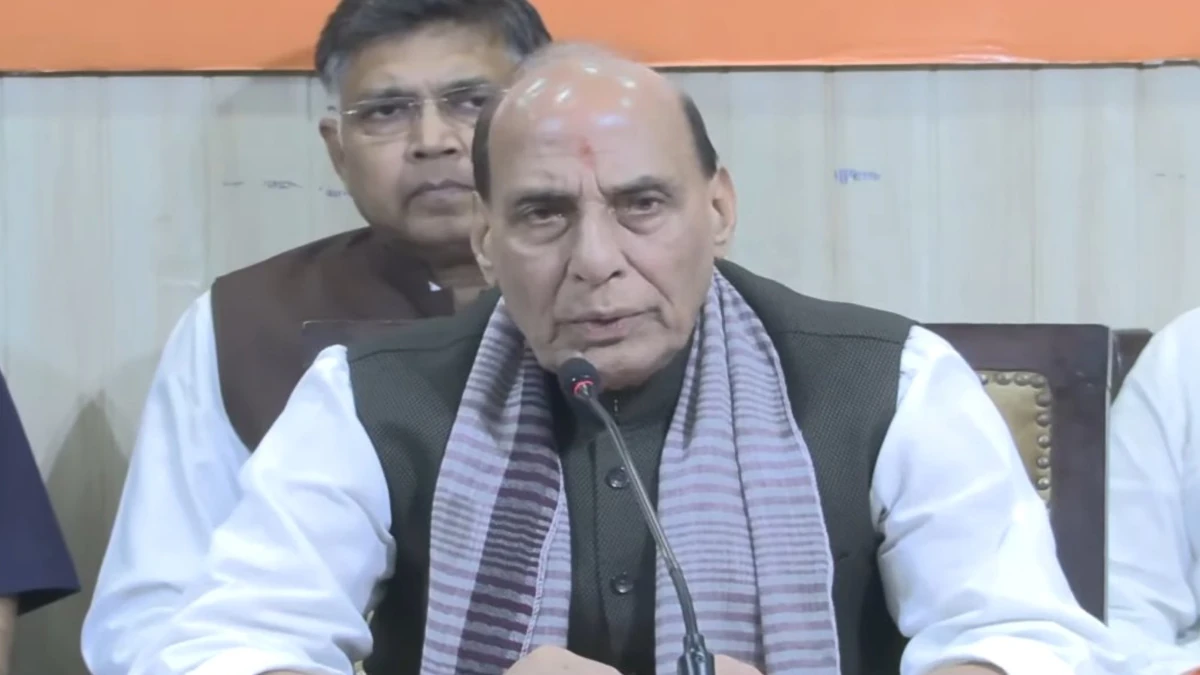
Union Defence Minister Rajnath Singh
LUCKNOW: Union Defence Minister Rajnath Singh has launched a sharp attack on the Congress and its political allies, accusing them of attempting to push India towards political instability under the guise of democratic reform. Invoking the example of Bangladesh, Singh alleged that efforts were being made to engineer a “regime change” through street-level agitation, political confrontation and the mobilisation of young people.
Speaking at a press conference in Lucknow amid escalating political tensions in Delhi, Singh asserted that the opposition’s actions raised serious questions about its intentions, warning that the pursuit of political power through unrest could undermine democratic institutions and disrupt the country’s development.
The Defence Minister’s remarks came as the opposition intensified its protests in the national capital. In a forceful message directed at Rahul Gandhi and his colleagues, Singh said that attempts were being made to turn the country’s youth into pawns in what he described as the politics of anarchy.
Singh’s most pointed allegation centred on what he described as attempts to replicate the Bangladesh model of regime change in India. Referring to statements allegedly made at public appearances and press conferences, he claimed that some individuals had openly spoken about drawing inspiration or receiving training from Bangladesh for regime change, while others had advocated bringing down the government through street-level mobilisation.
“These recent events in Delhi raise serious questions,” Singh said, that the Congress, its political allies and supporting organisations were attempting to encourage political confrontation instead of channeling the energy of young people towards constructive work and nation-building.
He further alleged that the objective was not merely to challenge the government politically but to weaken democratic institutions and create widespread unrest.
Singh questioned the opposition’s stated objectives, arguing that the language of “regime change” exposed what he characterised as a larger political agenda. He rejected the suggestion that the confrontation was fundamentally about electoral reforms, justice or the future of the country’s youth.
Referring to Gyanesh Kumar, the Chief Election Commissioner, Rajnath Singh Singh argued that the opposition’s campaign went beyond institutional criticism and was instead aimed at creating chaos to secure political power.
According to the Defence Minister, the distinction between legitimate democratic protest and attempts to destabilise constitutional institutions must not be blurred.
Directly targeting Rahul Gandhi, Singh urged the Congress leader and his colleagues to reconsider their political strategy and respect public opinion. “Democracy is not a licence to spread anarchy, undermine the credibility of constitutional institutions, or hinder India’s development journey,” Singh said.
He also invoked the Supreme Court’s observations from the previous day, arguing that respect for the law was essential to maintaining public order. Without detailing the specific observations in his remarks, Singh presented them as reinforcing the importance of constitutional discipline and lawful conduct.
The Defence Minister maintained that democratic freedoms must operate within the framework of the law and that political opposition should not become a vehicle for disruption. He advised Rahul Gandhi to introspect on his political role instead of pursuing what he described as disruptive politics in the name of protecting democracy.
