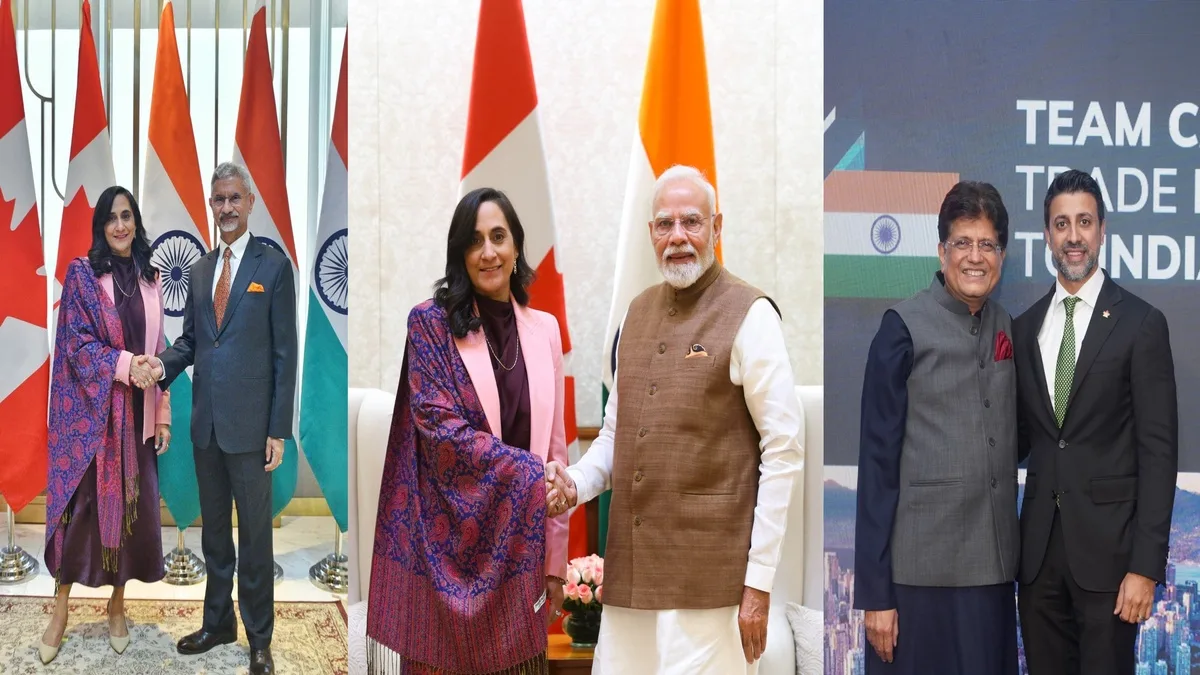
(From Left to Right): Canada FM Anita Ananad with EAM Jaishankar, Anita Anand with PM Modi & Commerce Minister Piyush Goyal with Canada International Trade Minister Maninder Sidhu
NEW DELHI: India and Canada have intensified diplomatic and economic engagement, with Canadian Foreign Minister Anita Anand holding talks with Prime Minister Narendra Modi and External Affairs Minister Dr. S. Jaishankar meeting. Candian FM Anita Anand is on a vist to India to advance bilateral ties across trade, technology, energy, defence and security.
The high-level engagements come as both countries push to conclude negotiations on a Comprehensive Economic Partnership Agreement (CEPA), with Ottawa seeking to diversify its trade partnerships and New Delhi looking to expand market access, investment and strategic cooperation. On the other hand, Canada’s largest corporate trade delegation to India in three decades, led by International Trade Minister Maninder Sidhu, has also added fresh momentum to strengthen economic relations.
Prime Minister Narendra Modi on October 14, Wednesday held a meeting with Canadian Foreign Minister Anita Anand in New Delhi, emphasising India’s commitment to build a constructive, forward-looking strategic partnership with Canada.
The discussions covered a broad range of bilateral priorities, including trade, technology, security, energy, education and people-to-people exchanges. PM Modi underlined the importance of translating the renewed diplomatic engagement into tangible benefits for the people of both countries.
“Pleased to meet Canadian Foreign Minister Anita Anand. We had a productive discussion on further strengthening India-Canada ties in trade, technology, security, energy, education and people-to-people exchanges”, the Prime Minister said in a post on X. He added that India remained committed to building a constructive and forward-looking partnership with Canada that delivers concrete outcomes for the benefit of people of both the countries.
Pleased to meet Canadian Foreign Minister Anita Anand. We had a productive discussion on further strengthening India-Canada ties in trade, technology, security, energy, education and people-to-people exchanges.
India is committed to building a constructive and forward-looking… pic.twitter.com/E5mRFl7eGG
— Narendra Modi (@narendramodi) October 14, 2026
Earlier, External Affairs Minister Dr. S. Jaishankar also met Canada FM Anita Anand to review progress across key areas of bilateral cooperation, including trade and investment, education, energy, defence and people-to-people exchanges. The two leaders also exchanged views on regional and global developments and discussed advancing the strategic partnership.
“Delighted to meet FM @AnitaAnandMP of Canada in New Delhi today. Reviewed progress in our ties across trade & investment, education, energy, defence and people-to-people exchanges”, EAM Jaishankar wrote on X, adding that the sustained engagement across governments and industries was helping advance bilateral relations.
Delighted to meet FM @AnitaAnandMP of Canada in New Delhi today.
Reviewed progress in our ties across trade & investment, education, energy, defence and people-to-people exchanges. Also exchanged views on key regional and global developments.
Guided by our leadership and… pic.twitter.com/zIQN8cMFJw
— Dr. S. Jaishankar (@DrSJaishankar) October 14, 2026
Anita Anand, in turn, highlighted the potential for India and Canada to build a more prosperous future together through stronger cooperation in trade, investment and security. She noted that nearly 80 years of diplomatic relations had been strengthened by generations of families, students and entrepreneurs who had brought the two countries closer.
Exactly one year ago in New Delhi, I met with my Indian counterpart @DrSJaishankar to establish a Joint Roadmap for Canada–India relations. Returning today, I am encouraged by how far we have come — from advancing trade negotiations to expanding cooperation on energy, innovation… pic.twitter.com/Fu0eAN4qmw
— Anita Anand (@AnitaAnandMP) October 14, 2026
In a separate post, Anita Anand said she was encouraged by the progress achieved since her meeting with EAM Jaishankar in New Delhi a year earlier, particularly in trade negotiations and cooperation in energy, innovation and security. She also stressed that stronger India-Canada ties could contribute to a free, open and prosperous Indo-Pacific at a time when the international order is undergoing profound changes.
The Ministry of External Affairs (MEA) described Anand’s visit as an important opportunity to build on recent progress. It noted that this was her third visit to India since June 2025, reflecting sustained high-level engagement and positive momentum in bilateral relations.
Economic cooperation has emerged as a central pillar of the renewed engagement, with both countries working towards concluding negotiations on the India-Canada Comprehensive Economic Partnership Agreement. On October 13, Tuesday, PM Modi and Canadian Prime Minister Mark Carney held a telephone conversation and agreed to build on the positive momentum in bilateral relations, focusing on trade, energy, technology, security and people-to-people ties.
According to a statement from the Office of the Canadian Prime Minister, the two leaders reaffirmed their commitment to conclude CEPA negotiations at the earliest opportunity, supporting efforts to double bilateral trade by 2030. They also welcomed increased engagement over the past year and the ongoing Team Canada Trade Mission to India. The leaders discussed geopolitical instability in the Indo-Pacific and the importance of trusted partners in energy and agriculture.
PM Carney thanked PM Modi for his leadership in seeking a peaceful resolution to Russia’s war on Ukraine. The two leaders also welcomed the bilateral security dialogue held in India the previous week as part of continued security and law-enforcement engagement at the National Security Advisor level. They agreed to remain in close contact ahead of PM Modi’s proposed visit to Canada in December.
Meanwhile, Commerce and Industry Minister Piyush Goyal met Canadian International Trade Minister Maninder Sidhu to discuss advancing CEPA negotiations. Goyal said that the proposed agreement should be balanced and mutually beneficial, improving market access while unlocking fresh trade and investment opportunities.
Sidhu is leading approximately 300 Canadian business representatives to India, making it Canada’s largest corporate trade delegation to the country in three decades. The delegation is exploring opportunities across aerospace, clean technology, space, agritech, life sciences, agri-food, forestry and other sectors.
It was a pleasure to address the 'Team Canada Trade Mission to India' event alongside Mr. Maninder Sidhu, Minister of International Trade of Canada.
India & Canada are embarking on a promising new chapter. Nearly 300 delegates have accompanied Minister Maninder Sidhu on this… pic.twitter.com/WsFoQpVhfC
— Piyush Goyal (@PiyushGoyal) October 14, 2026
Speaking to ANI, Sidhu said the negotiations were gaining momentum following the completion of the fifth round of talks, with a possible conclusion in the coming months. He described the partnership as one based on mutual prosperity, shared responsibilities and collaboration, adding that the current engagement represented only the beginning of the opportunities available to both countries.
Canada’s Minister of International Trade, Maninder Sidhu, also said that Ottawa was committed to ensuring community safety and maintaining dialogue with India on security and law enforcement issues amid concerns over Khalistani extremism.
Speaking to ANI Sidhu said that both countries were continuing discussions at various levels to address security concerns and stressed that peaceful protests must not involve violence. Sidhu also emphasised the Canadian government’s commitment to national unity and the safety of communities, adding that Ottawa would continue engaging with New Delhi on these matters.
On October 8, the two countries agreed to deepen coordination in combating transnational organised crime, terrorism and violent extremism, human and drug trafficking, cybercrime, extortion and the extradition of criminal offenders, according to a joint statement issued after the India-Canada National Security Adviser-level Security Dialogue.
The meeting was held in New Delhi following a visit by David Morrison, Senior Diplomatic and International Affairs Advisor to Canadian Prime Minister Mark Carney, from October 5 to 7, at the invitation of National Security Adviser Ajit Doval.
During the dialogue, both sides reviewed progress under their shared Security Work Plan, concluded in February 2026 and agreed to strengthen institutional mechanisms and information-sharing on matters of mutual concern. They also discussed exploring structured dialogues on cybersecurity and economic security, while reaffirming their commitment to continued cooperation
Sidhu also pointed to Canada’s potential to support India’s growing energy and infrastructure requirements. He noted that India’s energy demand was expected to rise significantly by 2035 and identified liquefied natural gas (LNG), liquefied petroleum gas (LPG) and nuclear energy as important areas of cooperation.
He said Canada possessed nuclear technology and uranium resources that could support India’s ambitions to expand its nuclear capacity. Critical minerals required for electric vehicles and advanced manufacturing also featured prominently in discussions with major Indian conglomerates.
For Ottawa, the trade agreement forms part of a wider strategy to diversify export markets and reduce excessive dependence on a single trading partner. “We have made it clear that Plan A is always diversification”, Sidhu said, explaining that businesses needed multiple markets to avoid becoming vulnerable to price pressures from a dominant customer.
For India and Canada, the renewed engagement, after a phase of freezed diplomatic ties presents an opportunity to translate diplomatic goodwill into practical cooperation. Progress on CEPA, stronger energy and technology partnerships, expanded investment and continued security dialogue are expected to remain central to the relationship.
