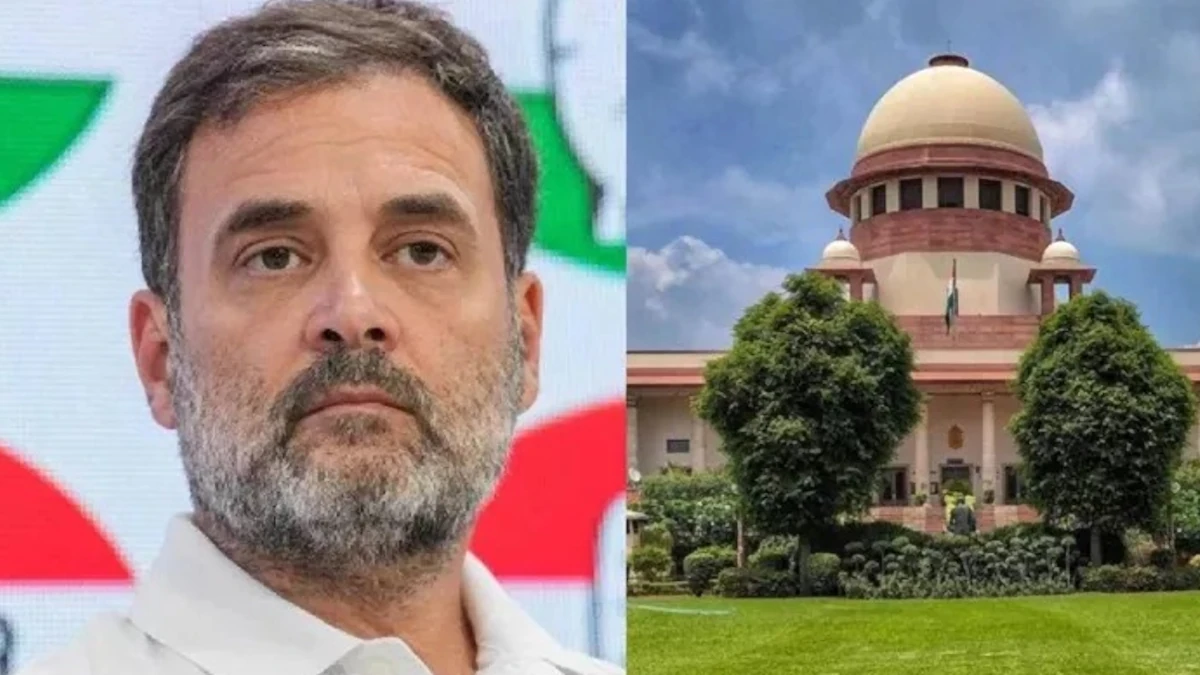
NEW DELHI: The Supreme Court on October 15 delivered a sharp warning to the Congress and its INDI bloc allies, making it clear that the judiciary cannot be pressured through political demonstrations. Issuing notices to Rahul Gandhi and other opposition leaders over their October 12 march towards the apex court, Chief Justice of India Surya Kant declared unequivocally, “Nobody can browbeat the judiciary.”
The strong observation has placed the conduct of opposition leaders under scrutiny after they brought their political protest over electoral issues to the doorstep of the country’s highest court.
The Supreme Court, while clarifying that issuing notices does not amount to condemning anyone, said it wanted Rahul Gandhi to explain his conduct at the next hearing. The court also directed law enforcement agencies to preserve CCTV footage and other digital evidence relating to the incident.
The proceedings raise a fundamental question for the Congress leadership: where does the right to protest end, and where does the obligation to respect the independence of the judiciary begin?
On October 12, Rahul Gandhi, Congress president Mallikarjun Kharge, Priyanka Gandhi Vadra, Samajwadi Party chief Akhilesh Yadav and other INDI bloc leaders joined a march demanding the resignation of Chief Election Commissioner Gyanesh Kumar and an end to the Special Intensive Revision (SIR) of electoral rolls.
The opposition claims that the exercise raises concerns over voter deletions and electoral transparency. Those allegations are being pursued through legal proceedings, and the Supreme Court has separately issued notice to the Election Commission of India on the relevant petitions.
However, the controversy surrounding the march is no longer limited to the opposition’s allegations against the electoral process. It now extends to the manner in which political leaders and supporters approached the Supreme Court and the commotion reported within its precincts.
The procession drew crowds into central Delhi, with police stopping demonstrators near Barakhamba Road. Reports described supporters pushing against barricades and some climbing onto parked police vehicles and buses.
Rahul Gandhi subsequently entered the Supreme Court premises in connection with the proposed petition. With the registry nearing closing time, the filing was ultimately handled through lawyers. The incident was followed by a legal challenge seeking safeguards against political demonstrations around judicial complexes.
The court will now examine the issues raised in the petitions. The notices are not findings of guilt, but they place the conduct of prominent opposition leaders under judicial scrutiny.
During October 15’s hearing, senior advocate Gaurav Bhatia argued that a political procession directed towards the Supreme Court was unacceptable and should not have occurred. He also referred to concerns among members of the legal fraternity, stating that around 200 lawyers had signed a memorandum expressing their objections.
The Chief Justice responded firmly: “Nobody can browbeat us.”
He further remarked that the court was not sitting in an ivory tower and was aware of statements made outside the courtroom as well as developments around its premises. The message was unmistakable: the judiciary will not allow political pressure to dictate its functioning.
For the Congress, which has repeatedly raised concerns about the independence of institutions, the episode presents an uncomfortable test of consistency. Defending institutional independence cannot mean demanding that institutions accommodate political pressure when their decisions or procedures become contentious.
Political leaders have every right to challenge decisions they believe are unlawful. But that right comes with a responsibility to pursue remedies through established legal channels and respect the boundaries of judicial proceedings.
The Supreme Court has directed law enforcement agencies to preserve CCTV footage and other digital material connected with the October 12 events.
The direction follows submissions by the petitioners concerning the conduct of the procession and an allegation that a pregnant journalist was pushed during the demonstration. That allegation has not been established by the court.
The petitions seek a regulatory framework for demonstrations near the Supreme Court and High Courts, restrictions on political protests inside judicial complexes, and safeguards against campaigns intended to influence pending judicial proceedings. They also seek consideration of criminal contempt proceedings against Rahul Gandhi, Mallikarjun Kharge, Akhilesh Yadav, Mahua Moitra and other named leaders.
Whether contempt proceedings are warranted remains for the court to decide. The issuance of notices does not establish that contempt has occurred. Nevertheless, the preservation of footage ensures that the events can be assessed on the basis of available evidence rather than competing political narratives.
The Supreme Court has also issued notices to the Election Commission and the Chief Election Commissioner on petitions challenging aspects of the Special Intensive Revision of electoral rolls.
The opposition alleges irregularities and arbitrary voter exclusions, while seeking disclosure of relevant records, greater transparency and procedural safeguards. Its petition also raises questions about the decisions and objections recorded by Election Commissioners Sukhbir Singh Sandhu and Vivek Joshi.
These allegations require examination on their merits. The court’s decision to issue notice does not amount to an endorsement of the opposition’s claims or a finding against the Election Commission.
In a separate matter, the Supreme Court sought responses from the Centre and Delhi Police on petitions challenging the decision to denotify Jantar Mantar as a designated protest site.
The court said it would examine whether the authorities had applied their minds before taking the decision. The government’s side argued that the move was based on a committee report and was not arbitrary.
The issue has wider implications for the right to peaceful protest and the responsibility of authorities to provide workable spaces for demonstrations. The court has yet to decide the challenge.
Separately, Delhi Police Commissioner Anurag Kumar tendered an apology in contempt proceedings concerning restrictions imposed in central Delhi during an October 10 protest. The dispute concerns whether police action complied with the Supreme Court’s directions.
These matters underline the delicate balance between maintaining public order, protecting citizens’ rights and ensuring that judicial directions are followed.
The Congress and its allies may insist that their march was intended to defend democracy and challenge alleged electoral irregularities. Their grievances, however, must stand or fall on the strength of their legal arguments and supporting evidence.
A political campaign cannot substitute for a judicial remedy. Nor should the physical presence of political leaders and supporters around a court become a means of exerting pressure on an institution whose authority depends on its independence.
The Supreme Court has not yet ruled that Rahul Gandhi or the other leaders committed contempt. It has, however, sought an explanation of the conduct surrounding the march and ordered the preservation of evidence.
