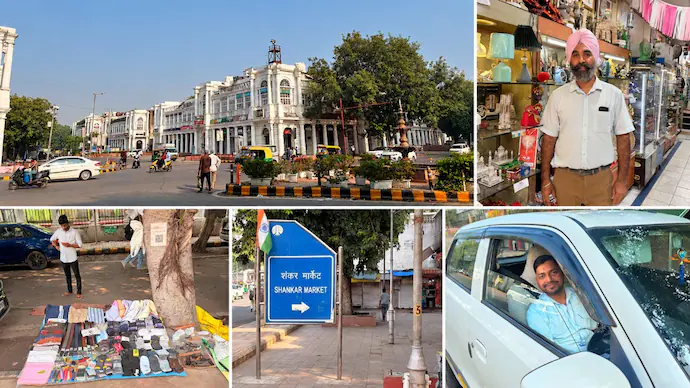
Delhi Businessman Slams CJP Protests (Image: India Today)
New Delhi: Traders from central Delhi have criticised the Cockroach Janta Party (CJP) and Opposition-led demonstrations, alleging that a movement that began around students’ concerns has been turned into a political platform.
In an interview with IANS, a trader said protests and restrictions in Connaught Place had severely affected business, with sales falling to around 10 percent of normal levels during an earlier spell of demonstrations, according to his account.
“If they have the right to protest, then I also have the right to my livelihood,” the trader said, arguing that shopkeepers must continue paying rent, salaries and other operating expenses even when customers stop visiting their businesses.
The interview, circulated on social media by BJP national spokesperson Pradeep Bhandari, captures the concerns of traders who say repeated demonstrations, police barricades and traffic restrictions have discouraged customers from visiting central Delhi markets during the festive shopping period.
Traders in Delhi are calling out the Anarchy of Cockroach!
Coward Kejriwal and Rahul Gandhi’s anarchy is leading to loss of business in and around Central Delhi!
People of India vs Cockroach+AAP+Congress https://t.co/fa38gI8r4X
— Pradeep Bhandari(प्रदीप भंडारी)🇮🇳 (@pradip103) October 11, 2026
The trader also alleged that the CJP had used education and students’ issues as a means to enter politics. His remarks reflect the anger among some business owners over the economic impact of the protests. The allegations about the movement’s political motives, however, represent the trader’s assessment rather than an independently established fact.
The trader questioned the direction taken by the CJP, saying its original focus on students’ concerns had given way to political activity.
“Their original issue was about students. Now they have entered politics,” he said, alleging that the education issue had been used as support for a broader political push.
The CJP movement and Opposition parties have been involved in demonstrations over the Special Intensive Revision (SIR) of electoral rolls and demands for the resignation of Chief Election Commissioner Gyanesh Kumar. Protesters have raised concerns about voter-list revisions, while the Election Commission and the BJP have disputed allegations that the process was designed to favour the ruling party.
The INDIA bloc, including leaders from the Congress and the Aam Aadmi Party (AAP), has also participated in demonstrations and marches linked to the issue.
The trader criticised the involvement of political parties in protests around central Delhi, arguing that the resulting disruption was affecting people who had no direct role in the political dispute.
He also referred to incidents of violence during earlier demonstrations and questioned the alleged mistreatment of police personnel. His comments came amid heightened security and restrictions around protest areas in the capital.
The trader said business in Connaught Place had dropped sharply during an earlier period of protests, with activity falling to around 10 percent of normal levels, according to his account.
He said the market had only begun to recover when fresh demonstrations and the participation of Opposition leaders again affected movement in the area.
The impact of protests in central Delhi has also been reported by other traders and business owners.
An India Today ground report described reduced customer footfall, shop closures and lower earnings among retailers, street vendors and cab drivers in Connaught Place and surrounding areas. Other media reports have documented similar concerns in Khan Market and Janpath.
For shopkeepers, the disruption is not limited to days when demonstrations take place. Traffic diversions, police barricades, security advisories and fears of congestion can also discourage customers from visiting the area.
The trader said public advisories asking people to avoid certain locations had affected business because customers who would normally visit the market chose to stay away.
He argued that shopkeepers faced financial losses even when their establishments remained closed for reasons beyond their control. Rent, staff salaries, electricity bills and other fixed expenses continued to accumulate, regardless of daily sales.
The timing of the demonstrations has become a major concern for traders, who say the festive and wedding seasons are important periods for retail business.
The trader said shopkeepers had already purchased and stocked merchandise in anticipation of higher demand during the coming months. With Navratri beginning and Diwali approaching, he warned that prolonged disruption could affect sales during a crucial period.
He said businesses across markets such as Connaught Place, Khan Market, Bengali Market and Janpath were concerned about the effect of repeated restrictions on customer movement.
For retailers, a lost trading day can mean more than a temporary fall in revenue. Businesses that have stocked goods in advance must still meet rent and salary commitments, while vendors selling prepared food may also lose perishable inventory.
An October 13 report by The Economic Times said retailers in Connaught Place and Khan Market had reported a steep decline in footfall amid protests and security restrictions. The report said some traders estimated that visitor numbers had fallen by as much as 90 percent.
The Chamber of Trade and Industry has separately estimated that the disruptions caused losses of around Rs 2,000 crore across Delhi businesses over three days. This is an industry-body estimate, not an independently audited calculation.
The trader said he did not oppose the right to protest but argued that demonstrations should not repeatedly disrupt commercial areas and the livelihoods of people who depend on them.
“Everyone has the right to peaceful protest, but the violence that happens is very bad,” he said.
He also referred to damaged vehicles and public property during earlier unrest, arguing that such incidents ultimately impose costs on the public and the government.
The trader’s position was that the right to demonstrate should be balanced with the rights of residents, commuters, workers and business owners. He said the consequences become particularly serious when restrictions prevent customers from reaching shops and markets for several days.
His remarks echo a wider demand from trader associations for a clear system governing protests near busy commercial zones. Associations have argued that designated venues should be used in a way that minimises disruption to businesses, transport and public services.
The trader said market representatives planned to write to the Lieutenant Governor and seek a meeting to press for the relocation of demonstrations away from central Delhi’s commercial areas.
He suggested that protests could be organised at alternative venues, including Ramlila Maidan or Burari, rather than locations where they could affect market access.
The issue has also reached the Delhi High Court. According to an Indian Express report published on October 13, traders’ and lawyers’ associations sought the implementation of a standard operating procedure for designated protest sites, citing restrictions and claimed losses of around Rs 2,000 crore. The figure reflects the petitioners’ claim.
Delhi Police has also moved to change the status of Jantar Mantar as a default protest venue and designated alternative locations, including Ramlila Maidan, Burari Ground and CBD Ground.
The trader’s remarks underline the tension between the right to peaceful protest and the economic consequences of prolonged demonstrations in busy urban areas.
The CJP and Opposition parties have continued to raise concerns over electoral-roll revisions and demand accountability from the Election Commission. Traders, meanwhile, say the political dispute should not leave shopkeepers, workers, vendors and transport operators bearing the cost of restrictions.
The trader called on authorities to act quickly, warning that further disruption during the festive period could deepen losses for businesses that have already faced reduced footfall.
What began as a social media movement claiming to champion students’ issues has now raised serious questions about the Cockroach Janta Party’s (CJP) political ambitions, methods and sense of responsibility.
A movement that claims to speak for the people cannot turn the streets into a battleground, disrupt the national capital and then walk away while ordinary families count their losses. From online campaigns to marches, clashes and repeated disruptions, the consequences are being felt by traders, shopkeepers, street vendors, cab drivers and workers who have nothing to do with the movement’s political agenda.
Now, with the festive season approaching, businesses that invested their hard-earned money in stock, paid shop rents and arranged salaries are watching customers stay away. For a small trader, an empty shop is not a political statement; it means mounting bills, unpaid dues and a family wondering how it will make ends meet. Will CJP take responsibility for these losses, or will it move on to its next protest while others pay the price?
If the protest has the financial backing to sustain prolonged agitation, that does not mean every shopkeeper has access to similar resources. But one thing is beyond dispute: no political movement has the right to treat the livelihoods of ordinary citizens as collateral damage. This nation does not run on slogans, viral videos and street demonstrations alone. It runs on people who open their shops every morning, work long hours, pay taxes, meet their obligations and struggle to keep their families afloat.
When their businesses suffer, their employees’ children, household expenses and future plans suffer too.
Who will pay the rent when sales collapse?
Who will compensate workers who lose their wages?
Who will put food on the table of a vendor whose stock goes unsold?
CJP may have the right to protest, but it must also recognise that democratic rights come with responsibilities. If it claims to fight for ordinary people, it cannot ignore the ordinary people whose lives its actions may disrupt. Political players can leave the protest site at the end of the day. The shopkeeper cannot leave behind his losses.
The worker cannot postpone his family’s hunger. And the small trader cannot pay tomorrow’s bills with yesterday’s slogans.
