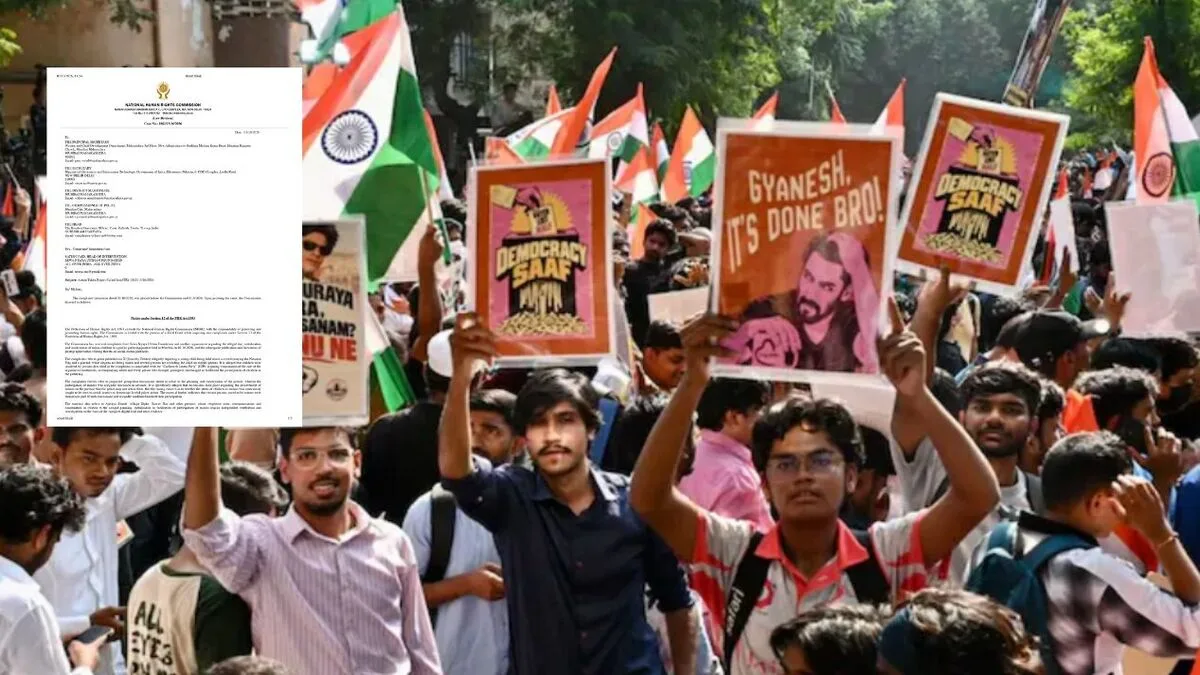
Minors at CJP Protest Under NHRC Scanner; Mumbai Police Asked to Probe Organisers’ Role
MUMBAI: The National Human Rights Commission has taken cognisance of complaints alleging the mobilisation and involvement of minor children in the Cockroach Janta Party protest held at Mumbai’s Shivaji Park on October 2, 2026.
A bench headed by NHRC Member Priyank Kanoongo issued notices under Section 12 of the Protection of Human Rights Act, 1993.
The Commission directed the Mumbai Police Commissioner, the Secretary of the Ministry of Electronics and Information Technology (MeitY), the Grievance Officer of X Corp for India, and the Principal Secretary of Maharashtra’s Women and Child Development Department to act.
Mumbai Police must examine videos, photographs and social media material, register FIRs where cognizable offences appear, identify organisers and accompanying adults, forensically examine alleged group chat discussions about involving minors to deter police action, and submit a comprehensive Action Taken Report within one week.
X Corp and MeitY received parallel directions to preserve digital evidence and explain content moderation failures regarding child-related posts.
The complaints, including one from Sewa Nyaya Utthan Foundation, refer to posts showing a young child held above a crowd with the National Flag and placards, and to discussions that allegedly treated minors’ presence as a shield against police intervention.
Named individuals including Ajinkya Shinde, Abhijit Dipke and Saurav Das face scrutiny of their roles.
Videos circulating on X show young participants, including those described as around 14 years old, who appear unaware of the protest’s core demands.
One widely shared clip features a boy at the Mumbai gathering who cannot name the resignation being sought and states he is present simply because others are standing in the sun.
A parallel video records a 14-year-old who came because the group came and will stay until they leave, unable to articulate the issue.
Another post criticises the practice of pushing 14-year-old children into protests and questions the use of minors as political pawns.
Similar concerns about clueless minors appearing at CJP events in Delhi and elsewhere have surfaced in earlier footage from previous mobilisations.
IANS reported the NHRC notice the same day, noting the panel’s demand for an Action Taken Report on allegations that minors were strategically used to deter police action.
The Commission has emphasised the need to protect children’s dignity, privacy and safety under the Juvenile Justice Act, 2015, while investigating any organised facilitation of their participation.
What does the law say?
The main law relevant to involving minors in protests in India is the Juvenile Justice (Care and Protection of Children) Act, 2015.
Any person who has actual charge or control over a child and assaults, abandons, abuses, exposes, or wilfully neglects the child in a manner likely to cause unnecessary mental or physical suffering can face imprisonment up to three years and a fine of up to ₹1 lakh (higher punishment in aggravated cases involving serious harm). This can apply if organisers, parents, or accompanying adults expose minors to risk at a protest (crowds, potential police action, heat, etc.).
Any adult or adult group that uses children for illegal activities (individually or as a gang) faces rigorous imprisonment up to seven years and a fine of up to ₹5 lakh.
This is the provision most directly cited by the NHRC in the current CJP Mumbai case. It becomes relevant if the protest itself is unauthorised or unlawful, and adults deliberately bring or mobilise minors (especially if their presence is used as a “shield” against police action).
