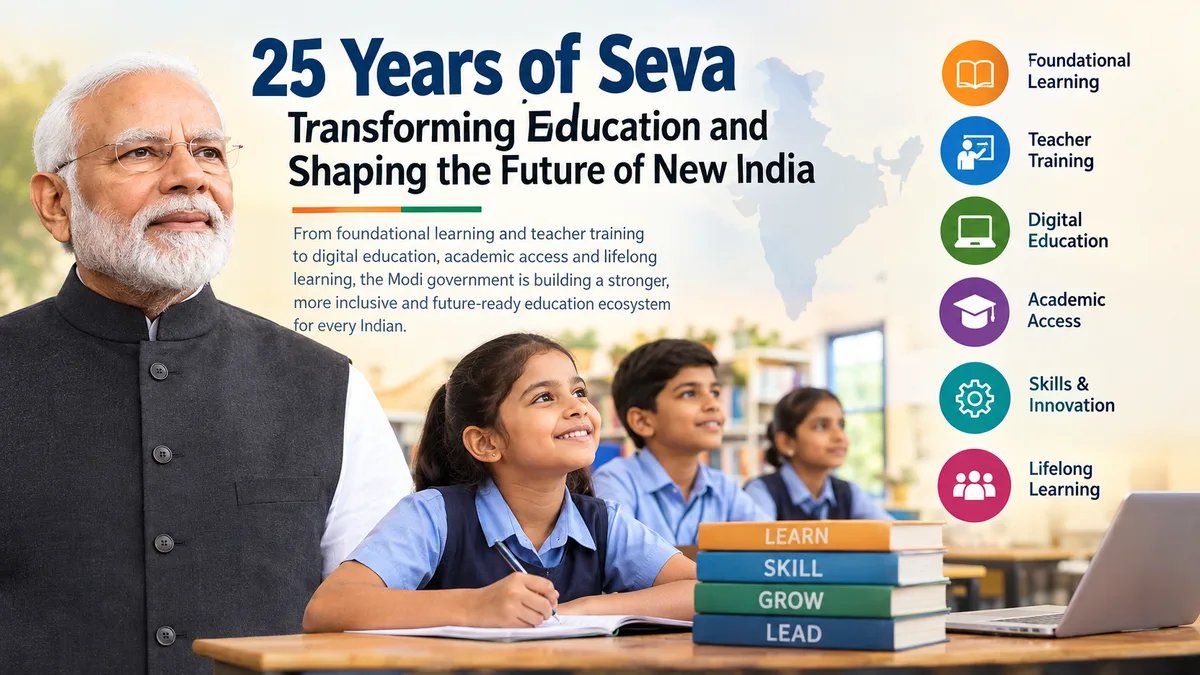
NEW DELHI: Education is not just about passing exams, getting a degree or finding a job anymore. At its heart, it is about giving a child the confidence to learn, the skills to face the real world and the opportunity to dream bigger. This larger idea has been an important part of the education journey during Prime Minister Narendra Modi’s 25 years of public service. From foundational learning and teacher training to digital education, research, skills and learning in Indian languages, the focus has been more on building an education system that can prepare a child not just for the next exam, but for life.
Since 2014, several programmes have been introduced or expanded, with the National Education Policy (NEP) 2020 providing a broader framework for these reforms. The larger aim is to ensure that every child gets the chance to learn, grow, discover their potential and become ready for a changing Bharat.
But what does this change actually mean for an ordinary student, parent or teacher? The answer can be understood through a few major shifts which are taking place across India’s education ecosystem.
The focus starts before Class 1
One of the biggest changes that happened under NEP 2020 is the recognition that education cannot begin meaningfully only after a child enters primary school. The government has therefore placed greater emphasis on the foundational stage, particularly the early years of a child’s development. Similarly, Vidya Pravesh provides a three-month, play-based school preparation module for children entering Class 1. The idea is simple: before asking a young child to cope with textbooks and examinations, help the child become comfortable with the school environment and develop basic learning habits.
The Jadui Pitara initiative takes this approach further by providing play-based learning and teaching material for children aged 3 to 8 years. The NIPUN Bharat Mission focuses on foundational literacy and numeracy, with the goal of ensuring that children acquire basic reading, writing and mathematical abilities by the end of Class 3.
In other words, the emphasis is moving from simply asking “What did the child score?” to an earlier question: “What has the child actually learnt?”
From one curriculum to a more flexible learning system
For decades, the education system in Bharat was often associated with textbooks that had fixed subjects and examination-oriented learning. But, NEP 2020 seeks to change this approach by encouraging holistic, multidisciplinary and experiential learning.
The National Curriculum Framework (NCF) for foundational and school education is helping drive this change. It focuses more on activity-based learning, critical thinking, practical skills and understanding, instead of simply memorising information.
Vocational and skill education is also becoming a part of school education. Under Samagra Shiksha, students from Classes VI to XII are introduced to vocational and pre-vocational learning. Students in higher classes can also choose skill-based courses linked to the National Skills Qualifications Framework (NSQF). For a student, this means education is increasingly being connected with the question: What can you do with what you have learnt?
Teachers are becoming a central part of the reform
A new curriculum cannot work without teachers who are prepared to teach differently. This is where programmes such as NISHTHA i.e., National Initiative for School Heads’ and Teachers’ Holistic Advancement come in. NISHTHA has been expanded across different stages of school education, including foundational literacy and numeracy. During the COVID-19 period, the Modi government decided to move NISHTHA online through the DIKSHA platform.
The Integrated Teacher Education Programme (ITEP) is another important component. It seeks to bring greater integration into teacher preparation, while the Malaviya Mission Teacher Training Programme focuses on developing the professional capabilities of teachers and faculty in higher education.
Digital education: From classroom to anywhere
COVID-19 period showed us how much dependent education had become on physical classrooms. It also highlighted the digital divide. The Modi government responded by expanding Bharat’s digital education ecosystem through initiatives such as DIKSHA, PM e-VIDYA and NDEAR.
DIKSHA works as a national digital platform for school education, while PM e-VIDYA brings together different modes of learning, including online and television-based education. The objective is to provide students with more than one route to access learning material. The National Digital Education Architecture (NDEAR) aims to provide a common digital infrastructure for the education ecosystem.
Education records are becoming digital too
Another less visible but important change is taking place in the way students’ academic records are maintained. The APAAR ID which is Automated Permanent Academic Account Registry has been built around the idea of “One Nation, One Student ID.”
It gives students a digital academic identity where their credits, certificates, marksheets, degrees and other achievements can be linked and stored. The government sees it as a lifelong academic record that can stay with students as they move from one stage of education to another. For students, this means their academic records can be connected in one place, instead of having to manage separate records from different institutions.
Higher education is becoming more flexible
The education reforms do not stop at school. NEP 2020 has introduced a larger conversation around multiple entry and exit, academic credits, multidisciplinary education and flexible learning pathways. The National Credit Framework (NCrF) and Academic Bank of Credits (ABC) are designed in such a way that students can easily move between different courses and learning programmes.
This is important because education does not always follow one fixed path. A student may leave a course and return later, study subjects from different fields, or combine formal education with skill-based learning. The new system aims to make these different learning paths easier and more flexible.
Financial barriers to higher education are also being addressed
Getting into a good college or university is not always just about marks and merit. For many families, the bigger challenge is finding the money to pay for higher education. The PM-Vidyalaxmi scheme, approved in November 2024, aims to reduce this financial burden for students admitted to eligible quality higher education institutions. It offers collateral-free and guarantor-free education loans. Students from families with an annual income of up to Rs 8 lakh can also get 3 percent interest support on loans up to Rs 10 lakh, subject to the scheme’s conditions.
Research is becoming a bigger part of the education story
The Anusandhan National Research Foundation (ANRF) has been created to improve research in India. Another initiative, One Nation One Subscription (ONOS), gives eligible government colleges, universities and research institutions access to thousands of international research journals through one national subscription. The government has allocated Rs 6,000 crore for 2025 to 2027, covering more than 6,300 institutions.
For students in big universities, research papers may be easily available. But for students in smaller cities and towns, access to the same research can make a big difference. It can help them learn more, explore new ideas and do better research, no matter where they study.
Indian languages and Indian knowledge are getting greater space
Another important change is the focus on Indian languages and traditional knowledge. The aim is not just to translate books into Indian languages. It is also about giving Indian languages, knowledge and traditions a place in today’s education system. NEP 2020 encourages children to learn in their mother tongue or Indian languages, especially in the early years. Schemes such as the Bharatiya Bhasha Pustak Scheme are also working to make study material available in Indian languages. In higher education too, there is a push to include Indian Knowledge Systems in courses and academic programmes.
Assessment is slowly moving beyond marks
Another important change is how students are assessed. The government has set up PARAKH, a national assessment centre, to bring common standards to student assessments. The aim is to understand what students actually know and understand, rather than looking only at their exam marks. This supports NEP 2020’s focus on understanding and skills instead of rote learning. And now, education is entering the AI era. The next challenge is already here: Artificial Intelligence.
𝟐𝟓 𝐘𝐞𝐚𝐫𝐬 𝐨𝐟 𝐒𝐞𝐯𝐚, 𝐭𝐫𝐚𝐧𝐬𝐟𝐨𝐫𝐦𝐢𝐧𝐠 𝐞𝐝𝐮𝐜𝐚𝐭𝐢𝐨𝐧 𝐚𝐧𝐝 𝐬𝐡𝐚𝐩𝐢𝐧𝐠 𝐭𝐡𝐞 𝐟𝐮𝐭𝐮𝐫𝐞 𝐨𝐟 𝐍𝐞𝐰 𝐈𝐧𝐝𝐢𝐚.
From foundational learning and teacher training to digital education, academic access and lifelong learning, the Modi government is… pic.twitter.com/pxMAJ3Pari
— BJP (@BJP4India) September 28, 2026
There are still challenges to address like differences between Indian States, the digital divide, teacher capacity, infrastructure gaps, etc., But the direction of the policy framework is increasingly clear. From basic learning to AI, from Jadui Pitara to digital academic records, and from classrooms to access to global research, India’s education system is changing. The focus is not just on helping students pass exams, but on helping them learn, build skills, adapt to change and prepare for the future. This is the education journey of 25 Years of Seva – an effort to make education better today and prepare young Indians for the vision of a Viksit Bharat.