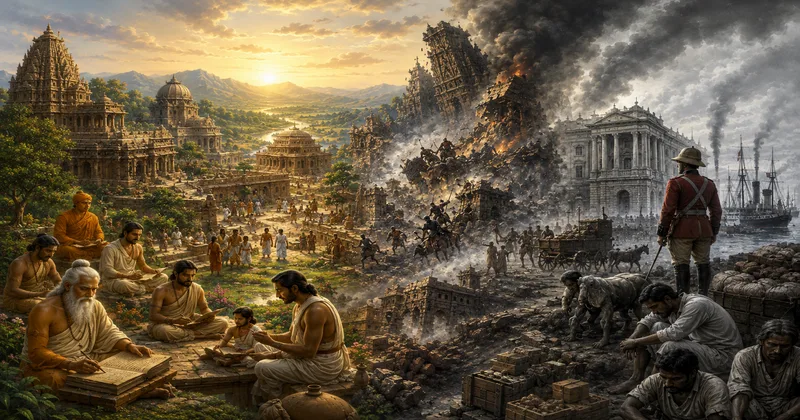
Bharat’s journey from ancient prosperity to colonial exploitation was marked by political upheaval, social disruption and economic decline (This image is generated by AI)
Bharat’s historical narrative is characterised by periods of immense intellectual and economic prosperity, followed by incessant disruptions that left a lasting legacy of colonial rule and the so-called “white man’s burden” of slavery. Understanding this trajectory is crucial to appreciating the contemporary pursuit of absolute freedom.
Before the advent of colonial rule, Bharat was a beacon of knowledge, home to ancient universities that attracted scholars and students from across Asia. Institutions like Nalanda, Vallabhi and Taxila epitomised Bharat’s scholarly eminence.
The Islamic incursions into Bharat began in earnest with Mahmud of Ghazni (998–1030 CE), whose repeated raids, 17 in total, were driven by both plunder and religious zeal. Ghazni targeted Bharat’s wealthiest temples, the most famous being the Somnath temple in Gujarat (1025 CE), looting its treasures and destroying its sacred structure. His campaigns extended across Punjab, Rajasthan, and parts of present-day Uttar Pradesh, deliberately attacking centres of Hindu worship and cultural pride to weaken local rulers and morale.
This pattern continued with Muhammad Ghori (late 12th century), whose deceitful and conspired victories, including the Second Battle of Tarain (1192 CE), paved the way for the Delhi Sultanate. Ghori’s commanders and successors, notably Qutb-ud-din Aibak and Iltutmish, sanctioned widespread destruction or conversion of temples into mosques, as seen in the Quwwat-ul-Islam (Might of Islam) mosque in Delhi, built from dismantled Hindu and Jain temples.
Nalanda, often considered the world’s oldest residential university, was a sprawling Buddhist monastery and learning centre in ancient Magadha (modern-day Bihar). It housed an estimated 12,000 monks and scholars and boasted an immense library, rumoured to be significantly larger and better stocked than the Library of Alexandria. Nalanda’s destruction in 1193 CE by Bakhtiyar Khalji, a Turkic general, marked a tragic end to a golden era of knowledge. This event involved a complete massacre of students and lecturers, alongside the burning of millions of irreplaceable Buddhist manuscripts, a conflagration rumoured to have lasted six months. The destruction of Nalanda, along with the earlier decline of Taxila, signalled a disruption in Bharat’s traditional knowledge, paving the way for subsequent intellectual subjugation.
The economic impact of colonial rule on Bharat was catastrophic. Historically, Bharat held an influential position in the global economy. Bharat was the world’s leading economy from 1 CE to 1000 CE, but in the second millennium it lost the top spot to China after the Islamic invaders razed India’s universities, disrupted the economic systems and caused havoc in religious and social life.
Additionally, estimates suggest that Bharat accounted for approximately 24.5% of the world’s Gross Domestic Product (GDP) in the 1700s, prior to British imperialism. However, by 1947, at the time of British departure, this share had plummeted drastically to a mere 3-4%. This precipitous decline reflected a systematic economic subjugation and deindustrialisation, where India was transformed from a manufacturing powerhouse into a supplier of raw materials and a market for British goods.
Art and culture took a leap with classical music, dance, temple architecture, and literature. Marco Polo, who toured India in the 13th century, was amazed at its richness, lively markets, and artistic finesse. In Kitab al-Hind, Al-Biruni, the Persian scholar, applauded Indian intellect, science, and religious acceptance.
The colonial mismanagement and exploitative policies led to devastating humanitarian crises. The Great Bengal Famine of 1770 stands as a stark example, claiming millions of lives; estimated between seven and ten million, or a quarter to a third of the presidency’s population. This catastrophe, caused by factors such as crop failure, the East India Company’s monopolisation of the grain trade, and continued tax collection during severe scarcity, highlighted the brutal consequences of colonial economic policies. The Company’s officials exploited the famine to create grain monopolies, purchasing rice at low prices and selling it at exorbitant rates, while continuing to collect taxes, further preventing Bengalis from acquiring necessary provisions. This period marked a significant shift from Bharat’s historical economic strength to widespread poverty and vulnerability.
The Colonisers systematically dismantled Bharatiya institutions and strategically exacerbated existing social divisions to consolidate their administrative control through Asiatic Society Surveys and various kinds of Acts. Prior to British rule, Bharat possessed diverse legal systems, often based on religious or customary laws, which varied by region and community. The British introduced a uniform legal system based on English common law, which, while introducing concepts like equality before the law and the rule of law, often disregarded local customs and was used as a tool of colonial control to suppress dissent. Exceptional laws were framed for tribal groups, placing them outside general legal purview and under direct British control.
A particularly damaging impact was the strategic codification and politicisation of the caste system. While caste divisions predated the British, colonial administrators, for imperial and administrative reasons, systematised and delineated castes into a rigid hierarchy that had not formally existed in such a rigid manner. This codification, allegedly based on texts like the Law Code of Manu, the Vedas and other scriptures, exacerbated existing differences and contributed to incessant caste conflict. Furthermore, the British selectively enforced narratives, such as Sati Pratha, to justify their ‘civilizing mission’, even as they introduced social reforms like the revocation of Sati and child marriage with the help of their pawns who acted as social reformers like Ram Mohan Roy. However, these reforms often coexisted with policies that exploited the resources of Bharat and led to famines. The Indian Civil Service (ICS), established by the British, was designed to strengthen imperial control and manage vast regions, becoming the administrative backbone of the British Raj and playing a pivotal role in suppressing nationalist movements. This bureaucratic structure, with its concentration of legislative, executive, and judicial power, was deeply identified with colonial rule.
The British, during their colonial rule, observed and documented the growing sentiment among certain radical Muslim leaders who sought political and cultural separation from Hindus. Recognising its potential to weaken Bharat’s unity, they subtly encouraged and exploited this divide through policies of communal representation and propaganda.
The institutionalisation of communal politics was significantly advanced through acts like the Morley-Minto Reforms of 1909, which introduced separate electorates along religious lines, embedding politicised religious identities into the political framework. Divisive educational policies also played a role, with colonial-era school curricula often dividing Indian history along communal lines, glorifying some rulers while vilifying others based on their religious identities, thereby cultivating sectarian identities among Indian youth. This strategy later evolved into political demands for a separate Muslim homeland, culminating in the Partition of 1947.
