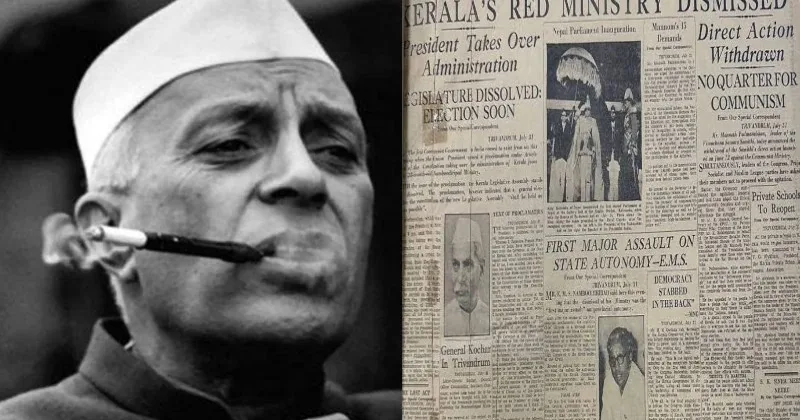
Bharatiya Janata Party (BJP) MP Dr Nishikant Dubey on July 31 described the dismissal of Keralam’s elected Communist government in 1959 as a “dark chapter” in the history of the Congress party, stating that it marked the beginning of the political misuse of Article 356 to remove governments led by ideological opponents.
In a post on X as part of his ongoing “Congress Dark History” series, Dubey said that on July 31, 1959, the government headed by E.M.S. Namboodiripad India’s first democratically elected Communist government was dismissed by the then Prime Minister Jawaharlal Nehru under Article 356.
According to Dubey, the dismissal established a precedent for using constitutional provisions to unseat elected state governments. He claimed that the practice continued for decades, with numerous state governments being dismissed until the Supreme Court’s landmark intervention in the 1994 S.R. Bommai judgment, which significantly curtailed the arbitrary use of Article 356.
In his post, the BJP MP argued that the dismissal of the Keralam government was not merely an administrative decision but the beginning of a political tradition where elected governments representing opposing ideologies were removed through central intervention.
He said that the Congress leadership used Article 356 to weaken political rivals and centralise power, calling the 1959 dismissal a defining moment in India’s constitutional and political history.
Dubey also linked the 1959 developments to the broader geopolitical context of the Cold War. He said that the United States was keen to contain the spread of Communist ideology and claimed that the then Congress president, Indira Gandhi, aligned with American interests during that period.
Dubey referred to former US Ambassador Daniel Patrick Moynihan’s memoir, claiming it contains references to CIA funding of Indian political actors.
He further mentioned that foreign influence has periodically shaped Congress politics, extending his criticism to the present leadership of the party. The dismissal of the E M S Namboodiripad government remains one of the most debated episodes in independent India’s political history.
The Communist government, elected in 1957, introduced major land and education reforms that generated both support and intense opposition. A widespread protest movement, known as the Vimochana Samaram (Liberation Struggle), emerged against the government, involving sections of the Congress, community organisations and religious groups.
Amid escalating unrest, the Union Government invoked Article 356, dismissed the state government and imposed President’s Rule on July 31, 1959. Historians and constitutional scholars continue to debate whether the decision was justified by the prevailing law-and-order situation or represented an early instance of the Centre exercising excessive power over a state government.
Article 356 empowers the President to impose President’s Rule in a state if constitutional machinery is deemed to have failed. Over subsequent decades, the provision was invoked numerous times by successive central governments of different political parties, often drawing criticism for alleged political misuse.
The Supreme Court’s S R Bommai vs Union of India (1994) judgment established important constitutional safeguards, holding that the President’s proclamation under Article 356 is subject to judicial review and cannot be exercised arbitrarily.
