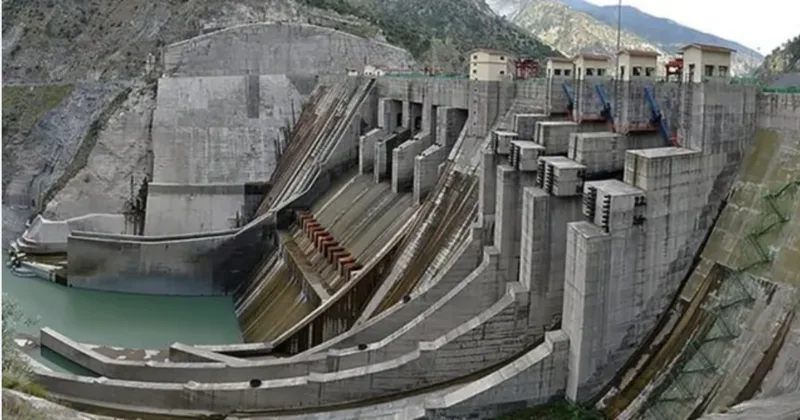
JAMMU: The district administration of Reasi has issued a public advisory warning residents to stay away from the banks of the Chenab River as reservoir silt flushing operations at the Salal and Baglihar hydroelectric projects are set to trigger a significant rise in the river’s water level over the coming days. There is considerable silt in the Salal reservoir, which has accumulated since April 1978 due to the closure of down sluice gates after an understanding was reached between then Indian Foreign Minister Atal Behari Vajpayee and Aga Shahi of Pakistan.
The Indian government was forced to take this step and lower the height of Salal dam by 10 metres as Pakistan had then threatened to escalate the issue under provisions of the Indus Waters Treaty (IWT) of September 1960. Besides, the Indian government of the day thought it prudent to resolve the issue bilaterally as it did not want to involve any third party intervention. After signing the Simla Agreement some years earlier, the Indian government wanted bilateralism to define the relationship with Pakistan.
According to the advisory issued by the Office of the District Magistrate, Reasi, the spillway gates of the Salal Dam at Jyotipuram will remain open from 9 am on July 17 to July 26 to facilitate reservoir silt flushing. The administration said the schedule was communicated by the General Manager (Technical), Salal Power Station.
De-silting Restores Eroded Capacity of Dams
There are several spillway gates in the project and a couple of them were opened partially some days ago but an official advisory of this nature was not issued at that time. The opening of these spillway gates for these 9 or 10 days will bring down the level of the reservoir significantly flushing out tonnes of fresh sand and silt that has accumulated since the last flushing. It is likely that this flushing may be done a couple of times more in the rainy season.
Most of this silt will be washed down to Marala headworks of Pakistan which is approximately 50 kilometres downstream. These headworks are a significant project on the Chenab River near Sialkot in Punjab. It was built during the British colonial period in India as part of the Triple Canals Project to irrigate vast areas of farmland in Punjab.The Triple Canals Project, initiated in 1906, was one of the largest irrigation projects in British India, aimed at providing water to arid regions of Punjab. The Upper Chenab Canal was one of the three canals constructed for the project. The canal was opened in 1912 and completed five years later in late 1917.
The Marala-Ravi Link Canal was built between 1952 and 1956 after the Indo-Pakistani water dispute of 1948. The canal was constructed to transfer water from the Chenab River to the Ravi River, which was then fed into the Balloki Headworks. It was during this period that parleys between the two nations were continuing towards the Indus Waters Treaty.
Improved Hydropower Generation in Salal, Baglihar
According to the Reasi district administration advisory, the Baglihar Dam in Ramban will also undertake drawdown flushing, with the process scheduled to begin at around 10 pm on July 16, as informed by the Deputy General Manager (Civil), JKSPDC. The district administration has warned that the flushing operations could lead to a sudden and substantial increase in the water level of the Chenab, posing a risk to people living or moving near the river.
The lake formed due to reservior of the Salal dam stretches back to around 25 kilomters behind the dam. Similarly, the lake of the Baglihar dam also stretches back several kilometers behind it going backwards from near Chanderkote in Ramban district to near Doda town and beyond.
Incidentally, as part of the Indus Waters Treaty of 1960, such de-silting operations, that too undertaken repeatedly by the Indian government, raised heckles in Pakistan. With the Treaty in abeyance at present, the constraints put on India as upper riparian no longer exist.
The advisory covers several villages located upstream and downstream of the Salal Dam. These include Dharan, Thanpal, Amas, Sai Lanjan, Narloo, Gari and Salmot upstream, and Gujjar Kohli, Sadh Baba, Bidda, Kachi Khera, Talwara, Nambla, Vijaypur, Bara Dari, Patta, Kansi Patta, Jedhi, Danessa, Badder, Chumbian, Dera Baba Banda Bahadur and Seri downstream.
In view of the potential danger, the administration has prohibited the movement of the public, vehicles, rafting activities and cattle along the riverbanks from 10 pm on July 16 until July 26. Residents have been advised not to venture near the Chenab during the flushing period to avoid any mishap.
The administration has directed officials of the Revenue Department, Police, SDRF and Rural Development Department to work in close coordination, continuously monitor the situation along the riverbanks and ensure strict enforcement of safety measures.
Potential Danger for People Living Near Banks
Field functionaries, including Lambardars, Chowkidars and GRS/Village Level Workers (VLWs), have also been asked to spread awareness among local residents. They have also been asked to educate people about the inherent risks and prevent the movement of people, livestock and vehicles along vulnerable stretches of the river during the long operation.
The advisory has been issued as a precautionary measure to ensure public safety during the annual reservoir silt flushing exercise at the two hydroelectric projects.
It needs to be noted here that the silt load of the Chenab is one of the highest in comparable rivers anywhere in the world. This is because all the Himlayan rivers, due to sharp gradient and several other factors, these rivers carry a lot of sand etc along their paths, from glaciers and mountains to plains.