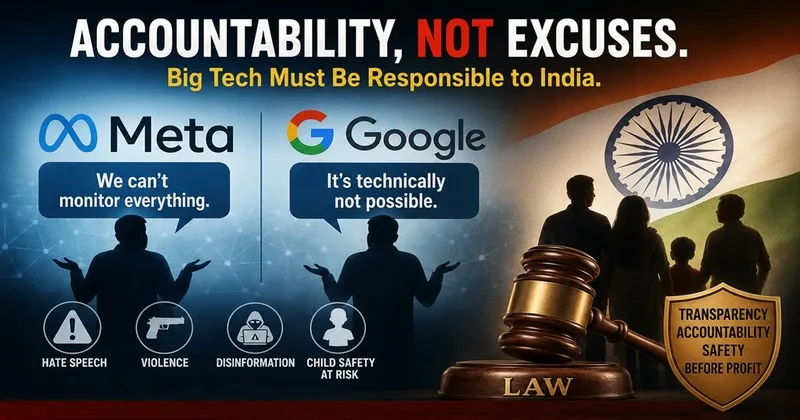
Digital platforms, which profoundly influence the daily lives, opinions, electoral discourse, mental well-being of children and social harmony of millions of Indian citizens, have become pivotal mediums in public life today. In this context, when Meta and Google claim that monitoring every piece of controversial content is impossible, the question naturally arises: is this a technical limitation or a convenient argument to evade accountability?
This is particularly pertinent given that these very companies employ highly advanced artificial intelligence and algorithms for ad targeting, analysing consumer behavior and prioritizing content. They deliver specific content to intended audiences in the blink of an eye. It is precisely for this reason, among others, that numerous countries across the globe have repeatedly imposed multi-billion dollar fines and initiated legal action against these companies.
How Credible is the Claim of ‘Impossible Monitoring’?
Meta and Google argue that billions of posts, videos and comments are uploaded to their platforms daily, making the pre-screening of every piece of content impossible. While this argument might sound plausible on the surface, it is not even partially accurate; these companies simultaneously claim to possess state-of-the-art artificial intelligence, machine learning capabilities and algorithms based on millions of data points capable of precisely analyzing user preferences, language, location and behavior.
Given this, it is natural to ask: if the same technology is capable of displaying ads tailored to individual interests, detecting copyright violations within seconds and enforcing advertising policies, why can it not be used to swiftly remove content involving violence, terrorism, child sexual exploitation, organised disinformation or hate speech? Ultimately, the repeated expression of inability regarding this issue by these companies naturally raises suspicions and points toward the shaping of a specific narrative and market dynamic within the Indian context.
Why shouldn’t these companies be held accountable to the citizens of India?
This is a significant question, given that India is one of the largest digital markets for these companies. Millions of Indian citizens use these platforms for news, education, business and social interaction. In this context, should the obligation of these companies be limited merely to profit-making, or should it extend to complying with Indian laws and protecting the fundamental rights of citizens?
If a platform’s algorithms amplify fake news, violent content or posts that incite social discord, simply because such content boosts user engagement, can this be dismissed as merely a technical issue? The question of social responsibility inevitably arises here. While freedom of expression is vital in a democratic society, it is inextricably linked to responsibility, a fact that companies like Meta and Google need to understand today.
Growing Global Scrutiny
If the claims made by these companies were entirely valid, numerous democratic nations across the world would not have found it necessary to take stringent measures against them; yet, the reality is quite the opposite. Evidence shows that the European Union has enforced the Digital Services Act (DSA) and the Digital Markets Act (DMA) to impose strict accountability on major digital platforms. Under these laws, companies like Meta and Google are mandated to remove illegal content, conduct risk assessments and enhance the transparency of their algorithms.
In 2023, Ireland’s Data Protection Commission imposed a record fine of €1.2 billion on Meta for violating user data protection regulations, one of the largest privacy-related penalties in history. Over the years, the European Commission has levied fines totaling more than €8 billion on Google for antitrust violations, covering issues related to Android, Google Shopping and its advertising business.
France, too, has imposed fines amounting to millions of euros on Google and Meta for violations concerning privacy and cookie policies. It is for these reasons that many countries around the world have, from time to time, imposed bans or implemented severe restrictive measures against these platforms. Courts in Brazil have taken action against Meta’s platforms on several occasions, and in 2024, the judiciary adopted a strict stance regarding the removal of illegal content by social media companies. Türkiye enacted social media legislation compelling these companies to appoint local representatives and comply with court orders; non-compliance entailed measures such as advertising bans and bandwidth throttling.
In 2022, Russia designated Meta an “extremist organization” and went so far as to ban Facebook and Instagram. Google, Facebook and Instagram have been banned in China for years. These examples demonstrate that various countries have imposed strict controls or bans on these companies for different reasons.
Growing Concerns Regarding Children and Adolescents
Indeed, the mental health of children and adolescents is currently one of the most serious concerns. In Australia, various US states and Europe, there is an ongoing process of scrutiny and legislation regarding the impact of social media on children. Many governments are working towards mandating age verification, controls on algorithmic recommendations for adolescents and parental safety measures.
Attorneys General from several US states have filed lawsuits against Meta. The allegation is that the company’s platforms are designed in a way that can foster addiction among adolescents and adversely affect their mental health. While Meta has contested these allegations, the lawsuits themselves signal that regulators harbor serious concerns.
What Should India Do?
In a vast democracy like India, relying solely on the voluntary assurances of companies will not suffice. There is a need for a regulatory framework that clearly mandates algorithmic transparency, swift grievance redressal, compliance with Indian laws, child safety, responsible use of artificial intelligence and strict financial penalties for repeated violations. At the same time, it must be ensured that freedom of expression and legitimate criticism are not unduly curtailed.
The prevailing understanding is that the massive fines, new laws and judicial interventions seen globally confirm that digital accountability is essential alongside digital power. In the interest of India’s millions of citizens, meeting this expectation is the need of the hour, an imperative that must be fulfilled at all costs. If a company is unwilling to accept responsibility in India, then, regardless of the magnitude of the loss, it should be permanently barred from operating in the country; ultimately, this serves the greater good.