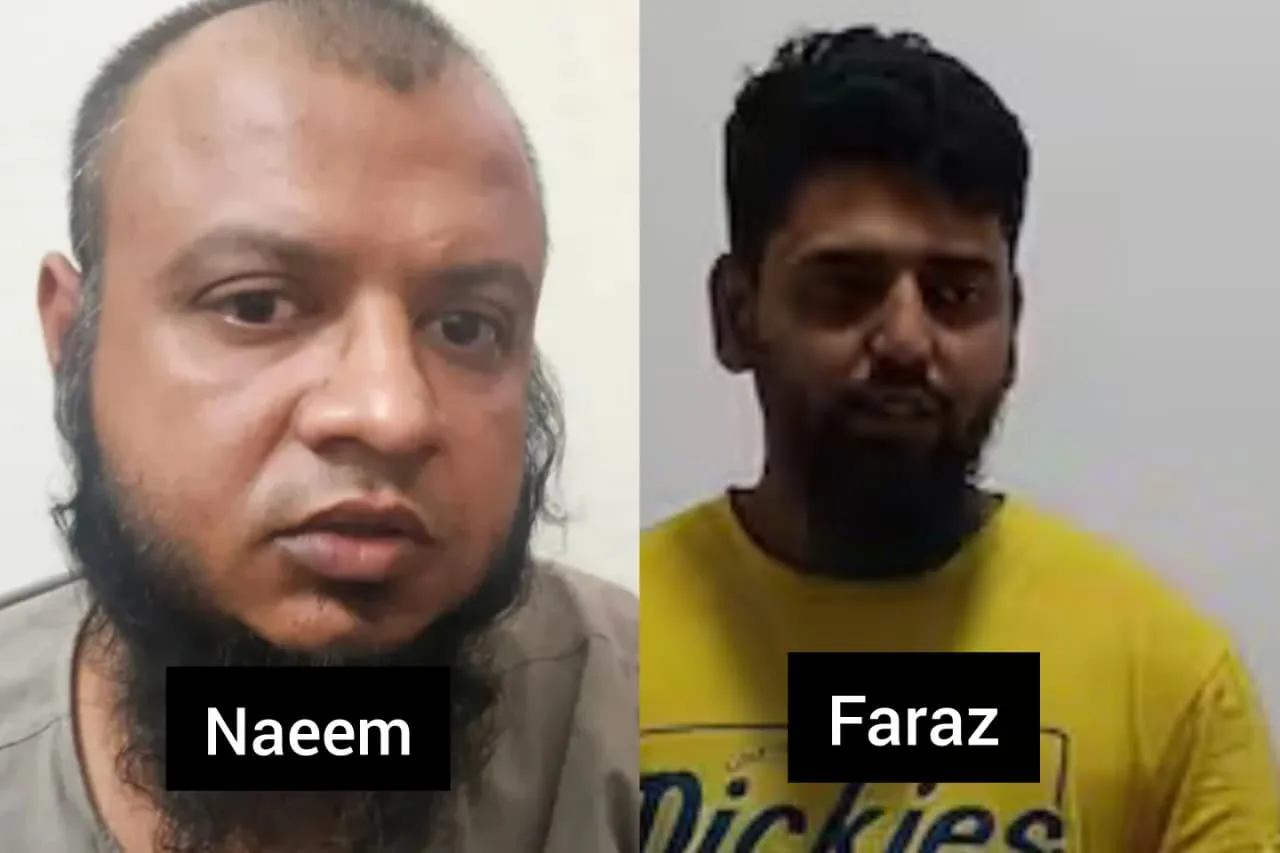
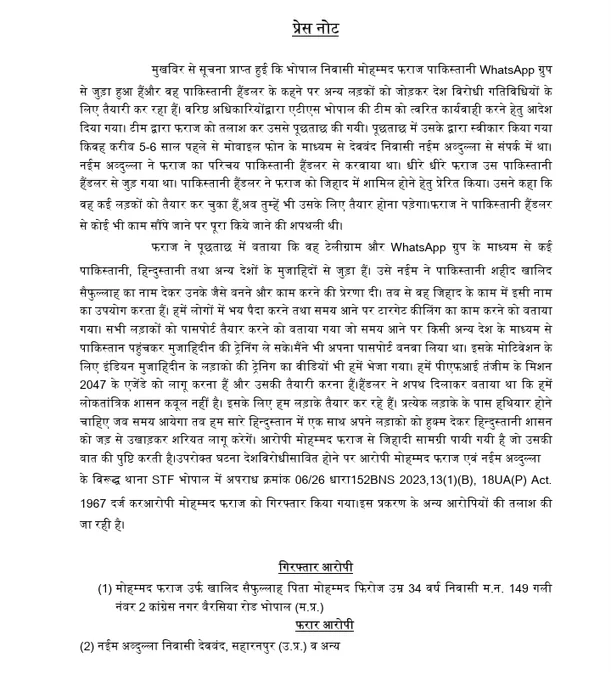
The Madhya Pradesh ATS has arrested Mohammad Faraz alias Khalid Saifullah (34), a resident of Bhopal, and named Naeem Abdullah of Deoband in Uttar Pradesh’s Saharanpur district in an alleged anti-national activities case registered under the Unlawful Activities (Prevention) Act (UAPA) and the Bharatiya Nyaya Sanhita (BNS).
According to the ATS, the investigation began after intelligence inputs indicated that Faraz was connected to a Pakistani WhatsApp group and was recruiting youths at the direction of handlers based in Pakistan. During questioning, Faraz disclosed that Naeem Abdullah had introduced him to Pakistani handlers nearly five to six years ago and played a key role in connecting him with online networks operating through Telegram and WhatsApp groups.
The ATS claims that these groups included individuals from Pakistan, India and other countries and were used to circulate radical content, establish contacts and prepare recruits for future assignments. Investigators further allege that members were encouraged to join jihad, recruit other youths and remain in regular contact with Pakistani handlers.
The digital route to radicalisation
What makes the case significant is the modus operandi described by investigators.
According to the ATS, the network did not rely on physical meetings or training camps in the initial stages. Instead, communication and recruitment took place through Telegram and WhatsApp groups.
Faraz reportedly told investigators that he became connected to Pakistani, Indian and foreign Mujahideen through these groups. The ATS claims that members regularly exchanged messages, ideological content and training material through encrypted communication channels.
Investigators found that these groups served as platforms for radicalisation, recruitment and coordination among individuals sharing extremist views.
Why Faraz became “Khalid Saifullah”
One of the more striking revelations in the investigation concerns Faraz’s adopted name.
According to the ATS, Naeem Abdullah encouraged Faraz to follow the path of a Pakistani militant known as Khalid Saifullah. Investigators say Naeem gave Faraz the same name and motivated him to emulate the individual.
Faraz reportedly began using the name “Khalid Saifullah” in his online activities and interactions within the network.
Notably, Abu Saifullah Khalid (also known as Razaullah Nizamani) was a senior commander for the designated terrorist organisation Lashkar-e-Taiba (LeT). He was fatally shot by unidentified gunmen on May 18, 2025, in Sindh province, Pakistan.
Passport, training and recruitment plans
The ATS claims that Pakistani handlers encouraged Faraz to join jihad and prepare other youths for the same objective.
According to statements recorded during interrogation, recruits were instructed to obtain passports and remain prepared to travel to Pakistan through third countries whenever directed.
Faraz told investigators that videos showing militant training were circulated among group members and that participants were encouraged to prepare for future assignments.
The ATS further claims that members were instructed to recruit more youths and expand the network.
Claims of target killings and anti-India activities
The investigation has also revealed serious allegations regarding the objectives of the network.
According to the ATS, Faraz stated that members were instructed to create fear among people and remain prepared to carry out target killings whenever ordered.
He further claimed that the handlers made participants swear loyalty to their cause and reject democratic governance.
Investigators say Faraz told them that recruits were being prepared as fighters, encouraged to acquire weapons and remain ready for future coordinated actions.
The ATS has also stated that Faraz claimed participants were instructed to work towards implementing the PFI organisation’s “Mission 2047” agenda and prepare for long-term objectives linked to the network’s ideological goals.
Recovery of Jihadi material
During the investigation, ATS officials recovered what they described as jihadi material from Faraz.
According to the agency, the recovered material corroborated several statements made during questioning and formed part of the evidence collected in the case.
Officials also seized digital evidence and communication records that are now being examined as part of the wider probe.
Based on the evidence collected so far, the ATS registered Crime No. 06/26 at STF Police Station, Bhopal.
The case has been registered against Mohammad Faraz alias Khalid Saifullah and Naeem Abdullah under Section 152 of the Bharatiya Nyaya Sanhita (BNS), 2023, along with Sections 13(1)(B) and 18 of the Unlawful Activities (Prevention) Act, 1967.
Faraz has been arrested, while Naeem Abdullah was subsequently apprehended in a joint operation conducted by the Madhya Pradesh ATS and Uttar Pradesh ATS in Saharanpur.
Security agencies are now examining the full extent of the alleged network, including its digital footprint, communication channels and possible links with foreign handlers.
Investigators are also attempting to identify other individuals who may have been associated with the Telegram and WhatsApp groups mentioned during interrogation.
The ATS has stated that efforts are continuing to trace additional accused and determine the broader scope of the alleged radicalisation and recruitment operation.