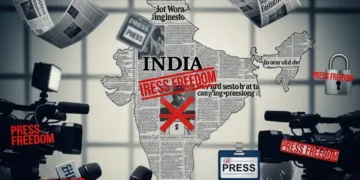
The global debate surrounding media freedom, international press rankings, and the credibility of comparative journalism assessments resurfaced sharply during Prime Minister Narendra Modi’s official visit to Norway on May 18, 2026. What began as a press interaction soon evolved into a wider international discussion after questions were raised regarding India’s position in the World Press Freedom Index prepared by Reporters Without Borders (RSF). The exchange rapidly attracted attention across diplomatic, media, and political circles, reigniting scrutiny over how global press freedom standards are measured and interpreted. The controversy emerged at a time when the 2026 World Press Freedom Index reported one of the sharpest global declines in media freedom conditions since the rankings were first introduced in 2002. With more than half of the world’s countries now classified under “difficult” or “very serious” press freedom conditions, concerns surrounding journalist safety, censorship, political pressure, violence against reporters, and the role of perception-based international evaluations have intensified worldwide. India’s ranking in the RSF index became central to the renewed debate, particularly because the country continues to maintain one of the world’s largest multilingual media ecosystems alongside a rapidly expanding digital news environment. Questions were increasingly raised over whether international ranking systems adequately account for scale, diversity, demographic realities, digital expansion, and varying geopolitical conditions while assessing media freedom across nations. Simultaneously, comparisons involving countries such as Mexico, Pakistan, Bangladesh, Türkiye, Brazil, and the Philippines further amplified discussions regarding the methodology adopted in preparing global press freedom rankings. Many pointed toward cases where nations experiencing journalist killings, cartel violence, political instability, media crackdowns, or legal harassment ranked above India, leading to wider debate over transparency, consistency, objectivity, and the possible influence of Western-centric evaluative frameworks in international media studies. The developments have transformed the World Press Freedom Index from a routine annual ranking into a broader geopolitical conversation involving democracy, media ecosystems, journalistic accountability, digital transformation, international perception, and the future of global press freedom measurement standards. During the visit of Prime Minister Narendra Modi to Norway on May 18, 2026, journalist Helle Lyng raised questions regarding press freedom in India and the Prime Minister’s approach towards media interactions. Referring to the World Press Freedom Index, the journalist pointed out that Norway holds the top position in the rankings, while India has been placed at 157 alongside Palestine, the UAE, and Cuba. The exchange drew attention after the journalist stated that questioning powerful political leaders remains an essential responsibility of the media. The remarks triggered renewed discussion around media freedom in India and intensified public scrutiny of the methodology and credibility of the World Press Freedom Index. The incident also revived wider debate over how international press freedom rankings are prepared, the criteria used in evaluating different countries, and whether political, cultural, and geopolitical factors influence global assessments of media environments. Questions Raised Over Transparency and Methodology of Global Media Rankings A report examining the World Press Freedom Index has raised questions over whether the global ranking system accurately reflects media conditions across different countries. Covering the period from 2024 to 2026, the study analyses the methodology adopted by Reporters Without Borders in preparing the index and compares India’s ranking with that of several other nations. The report states that the RSF Press Freedom Index remains structurally contested because of its reliance on perception-based assessments and scoring models, which critics argue reduce objectivity and limit consistency in cross-country comparisons. It notes that India’s repeated low ranking stands in contrast to the country’s large, multilingual, and expanding media ecosystem, raising concerns about whether the index fully captures ground realities. The study further argues that certain countries experiencing journalist killings, cartel-linked violence, or extensive state control over media continue to rank above India in the index. According to the report, these disparities reflect possible inconsistencies in the evaluation process and raise concerns regarding the influence of subjective or Western-centric frameworks in determining global press freedom standards. The report concludes that the broader decline in press freedom worldwide, reflected in the placement of more than half of the world’s countries in severe or problematic categories, indicates that the issue extends beyond individual nations and reflects wider geopolitical and structural challenges. It calls for greater transparency, balanced assessment mechanisms, and context-sensitive evaluation standards in measuring media freedom globally. How RSF’s Methodology Shapes Global Press Freedom Rankings The World Press Freedom Index prepared by Reporters Without Borders evaluates the extent to which journalists and media institutions are able to function freely within a country rather than assessing the overall quality of journalism or the total level of violence in society. Since 2022, the index has been based on five indicators: political context, legal framework, economic conditions, socio-cultural environment, and the safety of journalists. Among the most debated elements of the methodology is the “abuses score,” which assesses threats, attacks, and violence directed at journalists. Instead of relying on a direct per-capita calculation, the index applies a logarithmic population-based formula while measuring safety conditions. Critics argue that this framework can disproportionately affect highly populated countries such as India, where even a comparatively limited rise in incidents may sharply reduce the overall safety score. Many about the index further contend that the scoring model can place large democracies below smaller nations despite those countries experiencing comparable or even higher levels of violence against journalists on a per-capita basis. According to these arguments, the methodology creates inconsistencies in international comparisons and raises wider concerns regarding the objectivity, balance, and comparability of global press freedom rankings. India’s Position in the RSF Press Freedom Index and Debate Over Global Comparisons In the World Press Freedom Index prepared by Reporters Without Borders, India ranked 159th in 2024, improved to 151st in 2025, and declined to 157th in 2026, remaining within the lower tier of the global rankings during the three-year period. Several countries facing concerns related to journalist killings, cartel violence, political instability, or extensive state control over media ranked either close to or above India during the same period. According to RSF rankings, … Continue reading Methodology or Propaganda? How Pakistan, Bangladesh rank above India in global press index, sparks credibility question
