In recent years, several high-profile corporate entities have faced intense scrutiny and legal challenges following allegations by employees regarding the promotion of religious activities within the workplace.
Between 2019 and 2026, a series of complaints emerged suggesting that certain management practices were being used to foster Islamic communal environments or facilitate proselytisation efforts under the guise of diversity and inclusion. From a right-wing perspective, these developments are often viewed as a calculated attempt at institutional “soft” conversion and the marginalisation of traditional cultural values. Critics argue that such religious overtones in a secular professional setting not only violate labour ethics but also represent a broader socio-political push to normalise orthodox religious agendas within the private sector.
The following report details ten major incidents across various Indian states, highlighting alleged systematic patterns where individuals target and gather data on Hindu women in professional settings. It outlines the purported methods used to collect personal information and create roadmaps for exploitation within offices, factories, and institutions.
Systematic Targeting of Hindu Employees at TCS Nashik
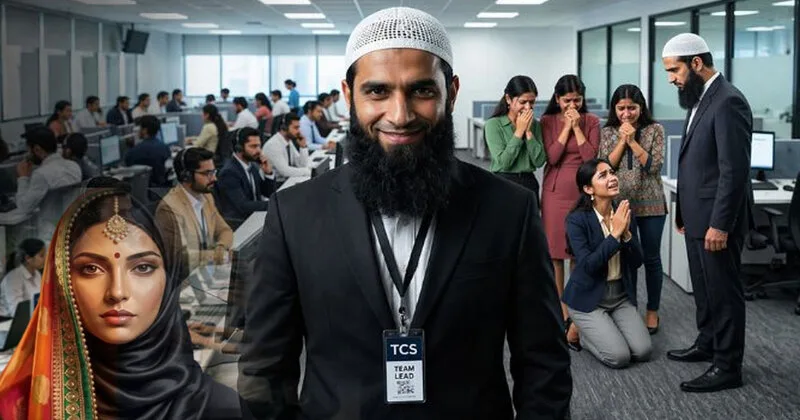
The IT sector in Nashik was rocked in April 2026, when a major scandal surfaced involving the forced religious conversion of nine employees, including eight Hindu women, at a Tata Consultancy Services (TCS) facility. Investigations revealed a disturbing roadmap where Muslim colleagues allegedly targeted young Hindu women aged 18 to 25, specifically screening for those from financially or emotionally vulnerable backgrounds during the interview process. Victims reported being pressured to perform Islamic prayers, consume beef, and wear burqas, while those who resisted were subjected to mockery of their faith and, in one instance, sexual assault. Despite internal complaints to HR, no action was taken until public outrage forced the company to suspend the accused individuals, including Asif Ansari and Shafi Sheikh, following the registration of nine FIRs detailing a co-ordinated strategy to exploit personal weaknesses shared via private WhatsApp groups.
Cultural Marginalisation and Discriminatory Grooming at Lenskart
The eyewear giant Lenskart faced significant backlash in April, 2026, after internal training documents surfaced revealing a blatant double standard that critics argue promotes Islamic attire while suppressing Hindu religious expressions. The 23-page grooming manual explicitly banned Hindu employees from wearing the sacred Kalawa (thread) and Bindi, while simultaneously permitting the Hijab, provided it was black and modestly covered the chest. Furthermore, the policy restricted the use of traditional Sindoor and religious rings, sparking allegations of a systemic anti-Hindu bias within the corporate structure. Although CEO Peyush Bansal issued an apology claiming the document was outdated, the incident has intensified concerns regarding the “soft” imposition of orthodox Islamic norms and the erasure of Hindu identity in professional retail environments.
Allegations of “Mini-Pakistan” Atmosphere at Tech Mahindra
A female employee at a Tech Mahindra BPO unit in Goregaon sparked a heated debate in April 2026 by describing her workplace as a “Mini-Pakistan” due to an overwhelming shift in demographics and cultural norms. She alleged that over 60% of the workforce in her process consists of Muslim youths, a shift she attributed to a Muslim HR official named Ghulam Ghaus, who reportedly prioritises hiring from his own community. The employee highlighted a concerning environment where Muslim women are permitted to wear religious attire like the Niqab, and extensive freedom is granted for religious activities like Iftar parties, while Hindu women are allegedly targeted for predatory relationships. This testimony has raised alarms about the creation of religious ghettos within the Indian IT industry and the resulting discomfort for Hindu staff.
Institutionalised Proselytisation at TCS Chennai
The shadow of institutional conversion efforts extended to TCS Chennai on April 14, 2026, as testimonials emerged regarding a manager named Tabrez Mohammed, formerly known as Diwakar before his conversion in 2016. Allegations suggest that Tabrez, supported by his superior Mohammad Mustafa, utilised his corporate position to coerce subordinates into adopting Islam. A former colleague recounted the immense pressure to convert, noting that the fear of professional retaliation prevented victims from speaking out earlier. This case highlights a perceived pattern where converts within management structures use their authority to further religious agendas, turning secular corporate offices into hubs for Islamic expansionism.
Disappearance of Hindu Women and Conversion Networks in Kolkata
In April 2026, reports from TCS Gitanjali in Kolkata pointed toward a more sinister dimension of the conversion crisis involving the disappearance of female employees following their religious transition. Social media accounts from local residents claimed that a Hindu woman converted to Islam and promptly vanished, a pattern allegedly mirrored in other IT firms across the city. These developments suggest the existence of an organised network active within the West Bengal IT sector that targets women for conversion and subsequent relocation. Concerns have been exacerbated by a perceived lack of administrative will to investigate these disappearances, with whistleblowers expressing fear that local authorities may penalise those who expose these predatory religious networks rather than the perpetrators themselves.
Discriminatory Uniform Mandates at Air India
Following the ownership transition of Air India to the Tata Group, new cabin crew guidelines sparked outrage for allegedly targeting Hindu religious markers. In November, 2022, a viral rulebook revealed a comprehensive ban on traditional Hindu symbols, including the Mangalsutra, Sindoor, Bindi, and wedding bangles (Chuda). The directives went as far as prohibiting sacred threads (Kalawa), toe rings, and even liquid Sindoor, labelling them as non-compliant with the uniform. Critics pointed out a glaring bias, as the document specifically itemised and restricted numerous Hindu cultural practices while remaining conspicuously silent on restrictions for Muslim religious attire. This has been interpreted by many as an attempt to sanitise the airline of its Indic heritage while maintaining a permissive stance toward other faiths.
Tanishq Ad Controversy and the Normalisation of Love Jihad
In 2020, Titan’s jewellery brand, Tanishq, faced a massive public backlash over an advertisement that was perceived as glorifying “Love Jihad.” The commercial featured a baby shower organised for a Hindu daughter-in-law by her Muslim in-laws, presenting a sanitised version of interfaith dynamics that many felt ignored the harsh realities of forced conversions and predatory relationships in India. Right-wing activists and social media users accused the brand of promoting a one-sided narrative of “secularism” at the expense of Hindu dignity. Under the weight of a national boycott campaign, Tanishq was forced to disable comments and eventually pull the advertisement from all platforms, marking a significant pushback against corporate virtue signalling.
Surf Excel’s “Colour-Phobic” Presentation of Holi
Hindustan Unilever’s brand Surf Excel drew heavy criticism in March, 2019 for a Holi-themed advertisement that many viewed as derogatory toward the Hindu festival. The ad depicted a young girl helping a Muslim boy avoid being stained by Holi colours so he could reach a mosque in “clean” clothes for Namaz. Critics slammed the narrative for subtly portraying the vibrant Hindu tradition of colours as a nuisance or something that “dirties” others, while elevating Islamic rituals as superior and deserving of protection. The hashtag #BoycottSurfExcel trended globally, as users accused the multinational corporation of using Hindu festivals to peddle an agenda of appeasement and moral superiority.
HDFC Bank’s Targeted Attack on the Bindi during Navratri
HDFC Bank found itself at the centre of a controversy in October 2023, for a marketing campaign that was widely condemned as anti-Hindu. During the sacred festival of Navratri, the bank released an advertisement featuring a woman where her Bindi was replaced by a “universal prohibition” or “no entry” sign as part of its “Vigil Aunty” campaign. This “No Bindi” imagery was viewed as a direct insult to the symbol of the third eye and feminine divinity. The outrage intensified when users compared this ad to the bank’s promotional material for Eid, which featured reverent messages about prayers and the fulfilment of wishes. The stark contrast between the mockery of Hindu symbols and the glorification of Islamic ones led to accusations of deep-seated ideological bias within the bank’s marketing division.
FabIndia and the Linguistic Erasure of Deepawali
In October, 2021, the clothing brand FabIndia faced severe backlash for attempting to rename the Hindu festival of Deepawali as “Jashn-e-Riwaaz.” The use of Urdu terminology for an ancient Vedic festival was seen as a deliberate attempt to de-Hinduize Deepawali and impose an Islamic linguistic veneer on Indian traditions. Investigations by social media users highlighted the role of the brand’s digital partner, Zeno Group India, and its leadership, which has strong ties to Urdu literary circles. Critics argued that this was not merely a creative choice but a calculated effort at cultural subversion. Following intense pressure and allegations of cultural appropriation, FabIndia withdrew the campaign and the controversial title.
The recurring pattern across these corporate controversies suggests a systemic effort to dilute the traditional cultural identity of the majority while providing institutional space for the assertive expression of Islamic norms. Whether through discriminatory grooming policies that target Hindu symbols or marketing narratives that subtly devalue Indic traditions, these developments point toward a growing “soft” institutionalisation of communal agendas within the private sector. From a right-wing perspective, this trend reflects a co-ordinated strategy by certain segments of the Islamic community and their corporate facilitators to reshape India’s professional landscape, turning secular workplaces into sites of religious friction and cultural subversion. Ultimately, these incidents serve as a stark reminder of the need for corporate accountability to ensure that the professional sphere remains a space that respects, rather than erases, the civilisational roots of the land.