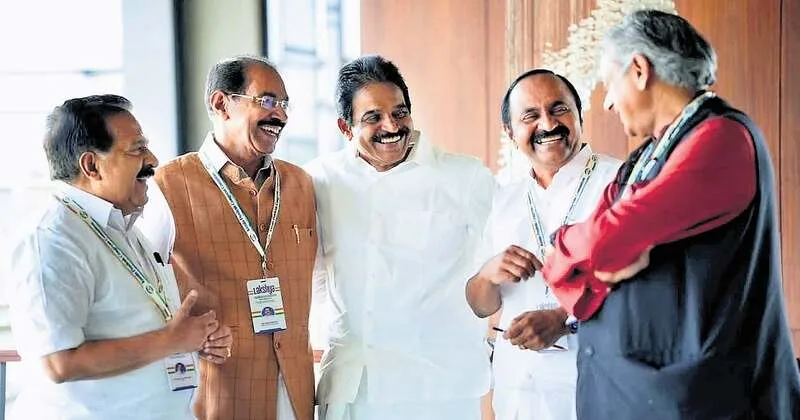
Senior Congress leaders Ramesh Chennithala, Sunny Joseph, K. C. Venugopal, V. D. Satheesan, and Shashi Tharoor, all seen as potential Chief Ministerial contenders, interact during the KPCC Leaders’ Summit in Sultan Bathery, January 2026
Thiruvananthapuram: With the assembly elections fast approaching, the Congress party in Kerala is facing increasing difficulty in finalising its list of candidates. Internal disagreements have intensified after several Members of Parliament (MPs) expressed their willingness to contest the assembly elections. The development has placed the party’s high command in a difficult position as it attempts to balance electoral prospects with organisational discipline.
Within the party, a section believes that fielding MPs could improve the Congress’s chances of winning in certain constituencies where the party needs strong candidates. However, the move has not found favour with some senior leaders in the state leadership, including Opposition Leader V. D. Satheesan, who are wary of the complications it could create. As a result, attention has now shifted to whether the party high command will eventually grant permission for MPs to contest the state elections.
The debate intensified after reports emerged that senior Congress leader and AICC general secretary K. C. Venugopal might consider contesting the assembly elections. If Venugopal enters the fray, several other MPs are also likely to seek tickets.
Among those who have already expressed interest in contesting are K. Sudhakaran and Adoor Prakash. Sudhakaran, a former Kerala Pradesh Congress Committee (KPCC) president, is reportedly firm in his demand for a seat and is determined to contest the election. Party insiders say there is growing concern that denying him a ticket could trigger serious internal tensions within the party.
Other MPs, including M. K. Raghavan, are also believed to be exploring their chances. Names such as Kodikunnil Suresh and Shafi Parambil have also surfaced in discussions regarding potential candidates. The possibility of multiple MPs seeking assembly seats has therefore become a major issue for the party leadership.
This situation has led to dissatisfaction among many leaders in the state unit. A significant section of the leadership believes that MPs should not be fielded in the assembly elections and that priority should instead be given to leaders who are already active in state politics. The issue is expected to be discussed at the Congress election committee meeting scheduled to be held in Delhi later in the evening. The committee will deliberate on the candidate selection process and attempt to arrive at a consensus on the first phase of the candidate list.
Party sources indicate that the Congress plans to announce a maximum of 60 candidates in its first list. The final list will be prepared only after discussions with senior leaders of the high command in Delhi.
The high command is also expected to take a final decision on whether sitting MPs should be allowed to contest the assembly elections. According to the state leadership, sitting MLAs should be retained in key constituencies such as Perumbavoor Ernakulam district and Sultan Bathery in Wayanad district, where the party believes continuity could help maintain its electoral strength.
A final decision will be taken on several pending issues, including whether MPs will be permitted to contest. KPCC President Sunny Joseph recently clarified that no leader should publicly declare their candidacy before the party finalises the official list.
The first phase of the candidate list is expected to include sitting MLAs, candidates from reserved constituencies, and seats where the party has only a single potential candidate. Sources indicate that the party leadership has already reached a consensus on candidates for around 40 seats, including about 20 constituencies currently represented by Congress MLAs.
These 40 seats are understood to include reserved constituencies and seats where the party leadership has little disagreement over the choice of candidates. Discussions are still ongoing regarding the remaining 20 seats that may be included in the first list.
Within the party, there is also a growing view that candidates should ideally be announced only after the official announcement of the election schedule. Many leaders believe that premature announcements could trigger internal disputes and complicate the campaign strategy.
Despite the high command’s apparent reluctance to allow MPs to contest assembly elections, the party is facing considerable pressure from some senior leaders. The central leadership believes that repeatedly giving tickets to the same leaders may send the wrong message to party workers and deny opportunities to younger and more deserving candidates. Another concern being raised within the party is the possibility of by-elections if sitting MPs win assembly seats. Such by-elections would impose both financial and political burdens on the party. In addition, if MPs shift to state politics and lose their Lok Sabha seats in subsequent elections, it could reduce the party’s strength in Parliament.
The move by some MPs is also seen as contradicting the High Command’s directive to increase representation for youth and women in the party’s candidate lists.
However, several senior leaders argue that their strong influence in local constituencies could significantly improve the Congress’s chances of victory. They believe that experienced leaders should not be sidelined at a crucial time when the party is trying to regain political ground in the state.
The state leadership fears that this situation could lead to factional tensions and disputes over seat allocation. Party insiders say the final shape of the candidate list will largely depend on how the high command handles the pressure from MPs and senior leaders seeking tickets.
The high command is also reportedly unhappy with the individual moves of some leaders who announced their interest in contesting even before internal discussions were completed. Rahul Gandhi had earlier publicly criticised such tendencies after noticing that some party workers raised slogans and displayed pictures of certain leaders during the closing ceremony of the ‘Puthu Yuga Yatra’.The situation became more tense after KPCC President Sunny Joseph made remarks that were interpreted by some as indirectly rejecting former KPCC president K. Sudhakaran’s claim to a ticket. The statement angered Sudhakaran’s supporters, who began mobilising protests against the party leadership.
According to party sources, some supporters planned to stage a demonstration at the KPCC headquarters and burn an effigy of Sunny Joseph. However, Sudhakaran personally intervened and persuaded his supporters to withdraw the protest after senior leaders spoke to him.
Reports indicate that Sunny Joseph and senior Congress leader Ramesh Chennithala contacted Sudhakaran in Delhi to defuse the situation. They reportedly requested him to ensure that no public controversy arises before the party takes a final decision regarding the Kannur seat.
Sudhakaran subsequently asked his supporters to disperse, including those who had gathered wearing shirts printed with his photograph. Despite these developments, party sources say there has been no formal communication yet regarding the Kannur constituency, which is considered one of the seats where the Congress has a strong chance of victory. Some leaders believe that if Sudhakaran is given an exception among MPs and allowed to contest, it may open the door for other MPs to demand similar concessions. At the same time, there are indications that if Sudhakaran himself does not contest, the party might consider a candidate recommended by him. However, the fact that Sudhakaran publicly announced his intention to contest before the party completed its internal discussions has created confusion within the leadership. As the Congress moves closer to finalising its candidate list, the party leadership now faces the delicate task of maintaining unity while also responding to the competing demands of its senior leaders.
