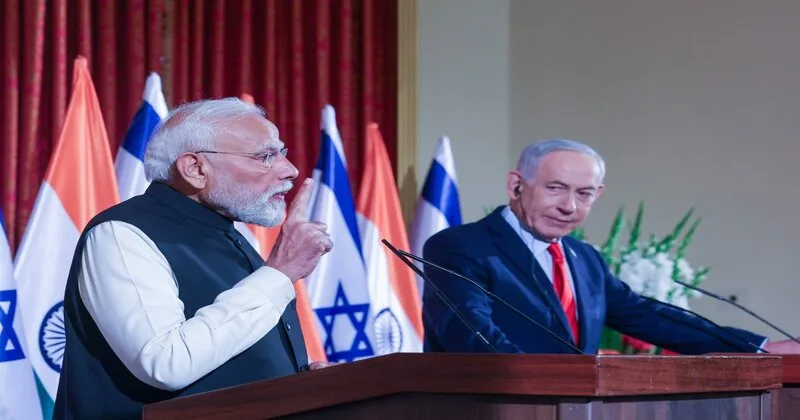
Jerusalem: India and Israel on February 26, Thursday signed multiple agreements and Memoranda of Understanding(MoUs) across multiple sectors covering Artificial Intelligence, cybersecurity, education, agriculture etc. during Prime Minister Narendra Modi’s two-day state visit to the country, reflecting the growing strategic, technological and economic partnership between the two countries. The agreements cover areas including innovation, agriculture, geophysical exploration, maritime heritage, fisheries, aquaculture, artificial intelligence, education, commerce and cybersecurity. The agreements were signed in the presence of Prime Minister Modi and his Israeli counterpart, Benjamin Netanyahu, ahead of their press statements in Jerusalem.
A cultural exchange MoU and an MoU establishing the India-Israel Innovation Centre for Agriculture were signed. An MoU in geophysical exploration was also signed by while another agreement was inked for the development of the National Maritime Heritage Complex in Lothal. A Declaration of Intent in the field of horizon scanning was also inked and an MoU on fisheries and aquaculture was signed in the presence of PM Modi and Prime Minister Netanyahu. Alongside, an agreement on advancing education through the use of artificial intelligence was also signed.
Today’s discussions with PM Netanyahu were very fruitful. We’ve taken a historic decision to elevate our time-tested partnership to a Special Strategic Partnership. This decision reflects the aspirations of the people of both countries.@netanyahu pic.twitter.com/zXJr2re3Mb
— Narendra Modi (@narendramodi) February 26, 2026
Additionally, a Letter of Intent on the establishment of a Cyber Centre of Excellence and an MoU linking UPI systems between India’s NPCI and Israel’s Masav were signed. Other agreements included a commercial arbitration pact, an MoU between the International Financial Services Centres Authority (IFSCA) and the International Securities Authority, and a separate MoU on Artificial Intelligence to strengthen collaboration in emerging technologies. Officials said these new agreements and MoUs are expected to yield significant outcomes in research, trade and high-tech collaboration, further consolidating the India-Israel strategic partnership.
Addressing the joint press meet with PM Netanyahu.@netanyahu https://t.co/4BUYaXc8G7
— Narendra Modi (@narendramodi) February 26, 2026
India-Israel elevate bilateral relations to Special Strategic Partnership
Prime Minister Narendra Modi announced that India and Israel have decided to elevate their bilateral ties to the level of Special Strategic partnership. He further noted that the elevation of the status of partnership between India and Israel was focussed on giving a new direction and speed to the ties. Addressing a joint press briefing with Israeli Prime Minister Benjamin Netanyahu, Prime Minister Narendra Modi thanked Netanyahu for the warm welcome extended to him and his delegation. Referring to being conferred the Speaker of the Knesset Medal, PM Modi said he dedicates the honour to 140 crore Indians and to the enduring friendship between India and Israel.
PM Modi said, “Our relationship is based on a strong foundation of deep trust, shared democratic values. Our ties have stood the test of times. Today, we have taken the historic decision to elevate our time-tested partnership to the status of a Special Strategic Partnership. This decision reflects the vision of both countries”. PM Modi further noted how the meeting today saw discussions to give the cooperation a new direction and accelerate momentum.
List of Outcomes (27 in total) 🇮🇳 🇮🇱
State Visit of PM @narendramodi to Israel ⬇️ pic.twitter.com/nkzRRQ2xME
— Randhir Jaiswal (@MEAIndia) February 26, 2026
Renewed momentum for IMEC and I2U2; Coordinated fight against terrorism
Underscoring the renewed momentum between India and Israel during his bilateal discussions with Israeli Prime Minister Benjamin Netanyahu on the India-Middle East-Europe Economic Corridor (IMEC) and the India-Israel-UAE-USA (I2U2) initiative, Prime Minister Narendra Modi emphasised that “peace and stability in West Asia are directly linked to India’s security”. PM Modi also reiterated India’s firm stance on terrorism, noting that New Delhi and Jerusalem share the position on the issue. “Today we also had extensive discussions on regional and global issues. While promoting regional connectivity, we will move forward with new momentum on the India-Middle East-Europe Economic Corridor (IMEC) and India-Israel-UAE-USA, i.e., I2U2”. PM Modi said.
“India and Israel are completely clear that there is no place for terrorism in the world. Terrorism in any form, in any expression, cannot be accepted. We have been standing shoulder to shoulder opposing terrorism and its supporters and will continue to do so. Peace and stability in West Asia are directly linked to India’s security”, he said The IMEC initiative is positioned as a transformative framework through which global trade, connectivity and cooperation across three continents, with robust infrastructure development, seamless logistics and sustainable growth, are being promoted under its design and a more interconnected future is being advanced through the collective commitment of partner nations.
Meanwhile, the I2U2 initiative brings together India, Israel, the United Arab Emirates and the United States to collaborate on joint investments and strategic projects in areas such as food security, clean energy and technology. Prime Minister Modi added that India has consistently supported dialogue and peaceful solutions in West Asia while referring to ongoing efforts to de-escalate tensions in the region.
A strategic push to Free Trade Agreement(FTA) & critical mineral partnership
Prime Minister Narendra Modi said that India and Israel will soon finalise a mutually beneficial Free Trade Agreement (FTA) and announced the establishment of a “Critical and Emerging Technology Partnership” to deepen cooperation in the tech and innovation sectors. Speaking during the joint statement with his Israeli counterpart Benjamin Netanyahu PM Modi said the two leaders discussed imparting a new direction and faster pace to bilateral cooperation.
“In today’s meeting, we discussed giving a new direction and a faster pace to our cooperation. Our economic cooperation is the engine of growth, innovation and shared prosperity. To encourage mutual investment, we entered into a bilateral investment agreement last year. We will also soon finalise a mutually beneficial Free Trade Agreement”, he said. Highlighting the growing focus on technology-driven collaboration, the Prime Minister said technology will form the core of the future partnership between the two nations. “Technology is the core of our future partnership. Today, we have decided to establish a ‘Critical and Emerging Technology Partnership. This will give new momentum to cooperation in areas like AI, quantum and critical minerals”, PM Modi added.
The first round of negotiations for the India-Israel FTA commenced in New Delhi on February 23, Monday and is scheduled to take place until February 26. Union Minister for Commerce and Industry Piyush Goyal met a delegation from Israel in India for the first round of FTA negotiations. During Piyush Goyal’s visit in November 2025, the Terms of Reference (ToR) for the launch of Free Trade Agreement (FTA) negotiations between India and Israel were signed.
India’s digital revolution tool UPI to be unveiled in Israel
PM Modi also welcomed the agreement on the use of India’s Unified Payments Interface (UPI) in Israel, calling it a significant step in advancing digital cooperation, adding that both countries are committed to leveraging digital health innovations to improve the lives of their citizens through shared experiences and best practices. “In the field of digital health as well, we are committed to improving people’s lives by sharing our experiences”, he added.
In the defence sector, the Prime Minister noted that India and Israel share decades-old, reliable cooperation, which is set to expand further.
Big push to skilled labour force mobility
Breifing about PM Modi visit to Israel and the strtaegic outcomes, Foreign Secretary Vikram Misri asserted, “In recent years, mobility has been a sunrise sector of cooperation between the two countries, and considerable progress has been made. Nearly 42,000 Indian skilled workers have travelled to Israel in recent years. Today, the signing of the implementation protocol on commerce and services, manufacturing and the restaurant sectors will open up these sectors for mobility cooperation and facilitate the safe and secure movement of Indian nationals and Indian workers in these sectors in Israel. There is also a broad consensus that up to 50,000 Indian workers may arrive in Israel within the next five years to work in these sectors”.
Accelerating cooperation in agricultural sector
On the back of the success of the Centres of Excellence established with Israeli cooperation across India for strengthening the agricultural sector, Prime Minister Narendra Modi announced the creation of “Villages of Excellence” to further deepen agricultural cooperation between the two countries. Speaking during joint press statement with his Israeli counterpart Benjamin Netanyahu, PM Modi said agricultural cooperation has been one of the most successful pillars of the bilateral relationship and will now be given a futuristic direction.
“There has been a long and successful history of agricultural cooperation between the two countries. Today, we have resolved to give this cooperation a futuristic direction. The Centres of Excellence established in India with the cooperation of Israel are excellent examples of our friendship. Seeing their success, we have set a target to increase their number to 100”, he said. Moving a step further, the Prime Minister announced the development of “Villages of Excellence”, aimed at expanding the benefits of Israeli agricultural technology to the grassroots level.
“With this, Israeli technology will reach every village in India and will greatly increase the income and productivity of lakhs of farmers. Together, we will also develop future-ready farming solutions. The establishment of the India-Israel Innovation Centre for Agriculture in India will provide a strong base for this cooperation”, PM Modi added. The Indo-Israel Centres of Excellence (CoE) are high-tech, intensive agricultural hubs established to facilitate the transfer of Israeli agri-technologies adapted to local conditions. These centres are designed to support farmers by focusing on select priority crops. Each CoE includes components such as advanced nursery management, improved cultivation practices and efficient irrigation and fertigation systems.
PM Modi visit to Israel is thus deemed as a major strategic victory in India’s diplomatic playbook and geopolitical calculus. The visit saw the signing of 27 agreements spanning innovation, cultural exchange, manufacturing, artificial intelligence, agriculture, education, mobility of skilled labour, quantum computing, critical mineral cooperation etc. that culuminated in the elevation of the partnership to “Special Strategic Relations”, which has indeed rendered a new momentum to one of the vital partnerships of 21st century.
(With Inputs from ANI)