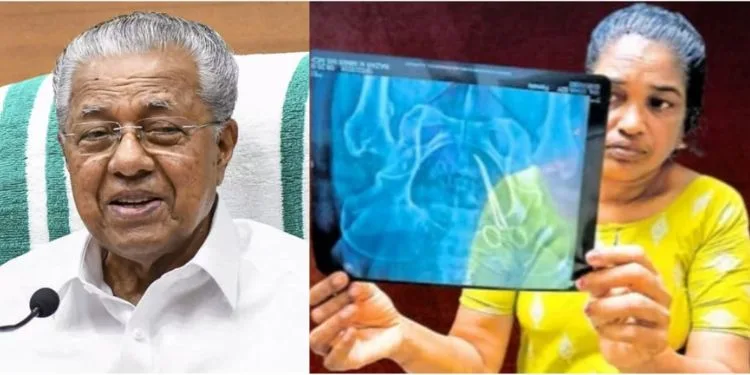
Alappuzha: At a time when Kerala’s ruling Left government is engaged in a massive public relations exercise projecting the state as “Kerala No. 1 in India” ahead of the Assembly elections, a shocking case of alleged medical negligence has surfaced in Alappuzha district.
For nearly five years, Usha Joseph (51), a resident of Punnapra in Alappuzha district, lived in unbearable pain with a pair of surgical scissors left inside her abdomen during a hysterectomy performed in 2021 at Alappuzha Government Medical College Hospital.
“It was so painful that I couldn’t even sit. After urinating, the pain would become unbearable. I would bend forward and fall on my knees,” Usha said, struggling to speak through tears. “I have been living with this agony for five years.”
According to Usha, she began experiencing severe abdominal pain almost immediately after returning home from surgery. Over the years, she consulted several hospitals and doctors, but none could identify the real cause. She was repeatedly told it was a urinary stone and was prescribed painkillers and injections. “I travelled everywhere with tablets in my bag,” she said. “I cannot even control my urine now. I have to wear diapers when I go out. The pain is so intense that even a single drop of urine causes unbearable burning.”
Once a worker under the Mahatma Gandhi National Rural Employment Guarantee Scheme, Usha has been forced to give up her job. “After working for a while, I would suddenly lose control of my bladder. I couldn’t stand or sit. That’s when I stopped going for work.”
Her family currently lives in a rented house after their own home collapsed. Her husband Joseph is a daily-wage labourer. Over the past five years, they say they have spent huge sums of money seeking treatment, pushing the already-poor family deeper into financial distress.
Five Years of Pain, One X-Ray Revelation
The turning point came last week, when Usha began bleeding while passing urine. Alarmed, she consulted a retired urologist, who advised an X-ray. The scan revealed a shocking truth that a 10-centimetre-long surgical scissors was lodged inside her abdomen. “I couldn’t believe it,” said a relative. “All these years, she was suffering because doctors forgot a metal instrument inside her body.”
Usha had undergone the removal of her uterus on May 3, 2021, after a tumour was detected. Due to COVID-19 restrictions, none of her family members was allowed to accompany her during the procedure.
After receiving the X-ray report, Usha approached the gynaecology department of the medical college on Wednesday. However, she alleges that she was given painkillers and asked to return on Monday for surgery. Family members claim that doctors informally advised her not to disclose the incident publicly, triggering allegations of an attempted cover-up. It is also reported that she was not admitted immediately due to an ongoing doctors’ strike. “They told her to come back on the 23rd and that the scissors would be removed then,” said a family member. “But how can she trust the same hospital again?” Fearing further treatment at the government facility, Usha was shifted to a private hospital in Kochi late Wednesday night. Local representatives were informed about the incident, demanded that the government bear the full cost of surgery and post-operative care, and provided adequate compensation to the family.
Relatives confirmed that they plan to file a police complaint against those responsible for the negligence. Local residents are also preparing to submit a complaint to the Health Minister, demanding a thorough investigation and strict action. “This is not just about one woman,” said a neighbour. “If this can happen in a government medical college, what safety do ordinary people have?”
Hospital Superintendent Dr A. Harikumar acknowledged awareness of the incident but said no formal complaint had been received so far.
Medical experts note that leaving surgical instruments inside a patient, known as a “retained foreign body”, is considered a serious and preventable medical error, often resulting from failures in operating theatre protocols.
For Usha Joseph, however, the terminology offers little comfort. “I trusted the hospital. I trusted the doctors,” she said quietly. “For five years, I lived thinking the pain was my fate.”
As Kerala’s political establishment projects glossy development narratives and election-time slogans, Usha’s story stands in stark contrast, raising uncomfortable questions about accountability, patient safety, and the lived realities of the poor. This is not just a case of negligence. It is a devastating reminder that, beneath the banners proclaiming “Kerala No. 1,” ordinary citizens can still be left to suffer in silence, sometimes with scissors forgotten inside their bodies.