February 4, 2026 — Today marks the Punya Tithi of Satyendra Nath Bose, the man who proved that you don’t need a Nobel Prize to have half the particles in the universe named after you. If the cosmos were a high-school party, the “Fermions” would be the moody kids sitting in far-off corners, while the “Bosons” (named after our man) are the ones huddled together in a giant, chilly mosh pit known as the Bose-Einstein Condensate.
S.N. Bose passed away on this day in 1974, leaving behind a legacy that is equal parts high-level quantum mechanics and deep-rooted Bhadralok culture.
The “Dhoti-Savant” Energy
Bose was a product of the Bengal Renaissance, a period where people were simultaneously mastering the Upanishads and Triple Integrals. Born in 1894, he was a student at Hindu School—the same one Rabindranath Tagore attended, though Tagore famously ditched it because he hated the walls.
Bose, however, loved the walls—specifically the ones he could cover in equations. As a student, he once secured 110 out of 100 in a mathematics paper. His teacher, Upendra Bakshi, gave him the extra ten marks because Satyen had solved every problem in the paper using multiple different methods. The logic was simple: he’d earned a bonus for being too smart for the syllabus.
Einstein: The World’s Most Famous Translator
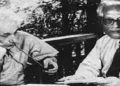
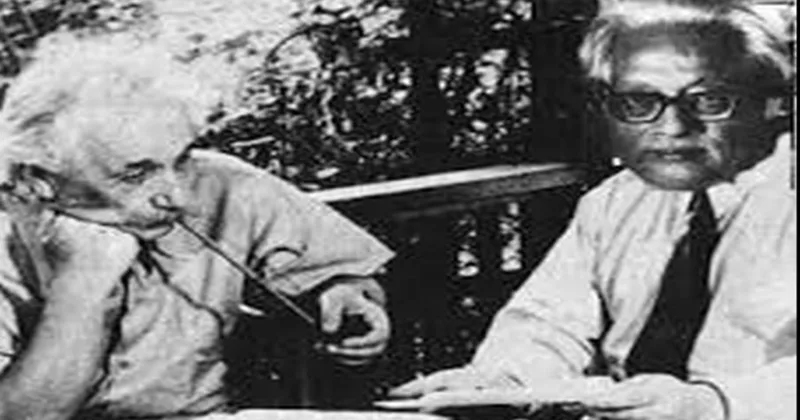
In 1924, Bose was a young Reader at Dhaka University. He wrote a paper on light quanta that the mainstream scientific journals ignored. Instead of sulking, he did the ultimate “power move”: he mailed it directly to Albert Einstein with a note essentially saying, “I have ventured to send you the typewritten paper… I do not know whether you still remember that somebody from Calcutta asked your permission to translate your papers.”
Einstein didn’t just remember; he was so impressed by the “elegant” derivation of Planck’s Law that he translated the paper into German himself and got it published. Imagine being so good at physics that the guy who invented Relativity becomes your freelance translator. That is peak Bose energy.
A Man of Strings and Sanatana Roots
While the world knows him for the “God Particle” (the Higgs Boson), Bose’s soul was deeply connected to his Indian roots. He wasn’t just a lab-coat-wearing calculator; he was a true polymath:
The Esraj Maestro: Bose was a master of the Esraj, a stringed instrument with a soulful, haunting sound. His friends often found him playing it in the dark, lost in Ragas, proving that the harmony of the spheres isn’t just a mathematical concept.
Vernacular Vanguard: He was a fierce advocate for teaching science in the mother tongue. He founded Gyan O Bigyan, a science magazine in Bengali, famously stating: “Those who say science cannot be taught in the vernacular either do not know science or do not know the language.”
The Tagore Connection: Rabindranath Tagore was so fond of him that he dedicated his only book on science, Visva-Parichay, to Bose. They shared a bond that bridged the gap between the poetic and the planetary.
Verifiable Trivia to Drop at Dinner
The Nobel Snub: Despite seven Nobel Prizes being awarded to scientists working on concepts he pioneered (like Bosons and Bose-Einstein Condensates), Bose himself never won one. His response was legendary in its chill: “I have received all the recognition I deserve.”
The “Sleeping” Genius: Bose was famous for closing his eyes during high-level seminars. People often thought he’d nodded off. Then, at the end, he’d open his eyes and point out a specific flaw in an equation on the fifth slide. He wasn’t napping; he was calculating in 4D.
The Dirac Naming: It was the legendary physicist Paul Dirac who coined the term “Boson” in 1945 to ensure Bose’s name would be literally built into the fabric of reality.
The Final Equation
Bose’s philosophy was a blend of scientific rigor and the Sanatana concept of the “Integral Man.” He didn’t see a conflict between his Sanskrit shlokas and his quantum statistics; to him, they were just different ways of describing the same cosmic dance.
So today, as we remember the “Father of the God Particle,” let’s take a cue from him: master your craft, play your music, and never be afraid to send your “drafts” to the biggest experts in the room. You might just end up naming half the universe after yourself.