Thiruvananthapuram: Budget 2026 has emerged as a crucial stabilising force for Kerala’s internally weakened economy, cutting through what the state’s ruling Left Democratic Front (LDF) and opposition United Democratic Front (UDF) have projected as a narrative of central neglect. Since the Union Budget announcements, both fronts have jointly projected a narrative that Kerala was “ignored” by the Centre, alleging that the state received nothing substantial and was denied long-pending demands such as AIIMS and high-speed rail. The Left government has amplified this charge of total neglect with an evident eye on the approaching elections.
Political Row: State govt criticises, BJP pushback and industry endorse budget
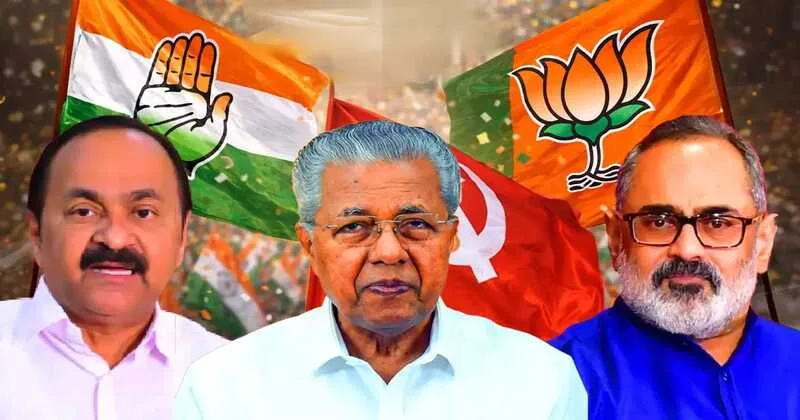
Kerala Finance Minister K. N. Balagopal said the Union Budget reflects an overall economic slowdown, with only a marginal increase in revenue. He argued that both the states and the Centre have suffered significant revenue losses following the restructuring of the tax system, and alleged that the Budget offers no concrete roadmap to address this shortfall. Balagopal further criticised the Budget for failing to allocate even a single rupee for Anganwadi workers and for ignoring the Vizhinjam port project. He also pointed out that there have been substantial cuts in key allocations, including the Revenue Deficit Grant, which he said would further strain the state’s finances. Meanwhile, Chief Minister Pinarayi Vijayan mocked the Union Finance Minister, remarking that she appeared to have forgotten that a state called Kerala even exists on the country’s map. He also demanded that Union ministers from Kerala respond, alleging that the Union Budget had completely ignored the state.
Congress Opposition Leader V. D. Satheesan made what was widely criticised as a sectional remark, saying that after listening to the Union Budget, he was left wondering whether Kerala was even part of India. Referring to repeated assurances made by Union ministers from the state, he said he had at least expected an announcement on AIIMS, but noted that there was no mention of AIIMS or high-speed rail, which he described as deeply disappointing. Satheesan pointed out that during the local body elections and even afterwards, BJP leaders and the Prime Minister had portrayed Kerala as a developed state. “If this is the manner in which Kerala is being ‘developed’, the Budget itself is a clear indication,” he said, alleging a deliberate attempt to neglect the state. He claimed there was growing protest against what he described as a conscious policy of sidelining Kerala. He also mocked the “turtle trails programme,” alleging that it was merely meant to symbolically acknowledge Kerala’s existence without offering any substantive support. Additionally, Satheesan alleged that the inter-state mineral policy announcement was part of an effort to hand over Kerala’s mineral wealth to corporate interests.
Responding to the state government’s criticism, BJP state president Rajeev Chandrasekhar accused the LDF government of deliberately spreading false propaganda against the Union Budget by failing to implement key central government schemes. He said flagship initiatives such as the Pradhan Mantri Awas Yojana, Jal Jeevan Mission and Ayushman Bharat were all designed with significant benefits for Kerala, but their implementation had been consistently undermined by the state government. Chandrasekhar pointed out that in 2017, both Madurai in Tamil Nadu and Kerala were selected for the establishment of AIIMS. While Tamil Nadu proceeded swiftly, Kerala has yet to hand over the required land even after several years. He noted that land acquisition in Kozhikode remains incomplete, making it impossible to move forward with the project. Questioning the state government’s intent, he asked whether Kerala was unwilling to allocate funds or assume responsibility to facilitate major infrastructure projects such as high-speed rail, national highways, or AIIMS, arguing that allegations of neglect were being used to mask administrative inaction and shift blame onto the Centre.
Adding an industry perspective, M. A. Yusuff Ali, Chairman of the LuLu Group, said the Union Budget reflects India’s strong growth momentum and its commitment to long-term economic stability. He noted that the Budget seeks to create a sustainable development environment by simplifying tax rules and opening new avenues for large-scale investment. Yusuff Ali said measures such as expanding the Portfolio Investment Scheme, raising the individual investment limit from 5 per cent to 10 per cent, increasing the overall investment ceiling for all PIOs from 10 per cent to 24 per cent, and reviewing FEMA regulations would provide a strong boost to NRI investors. He added that the allocation of over Rs 10,000 crore for small and medium industries would accelerate India’s transformation into a global manufacturing hub.
Kerala’s central tax share rises from Rs 24,500 cr to Rs 36,355 cr
However, the revised Finance Commission award, which increases Kerala’s share of the Centre’s tax revenues, has emerged as a significant setback to the state government’s narrative of neglect. Since states are entitled to 41 per cent of the Centre’s tax collections, the higher allocation to Kerala is expected to substantially strengthen its fiscal capacity and support development activities across sectors in the coming years.
The Union Government’s decisions, based on the recommendations of the 16th Finance Commission, point to a significant strengthening of Kerala’s fiscal position. As per the Commission’s formula, 41 per cent of the Centre’s tax revenues will be devolved to the states. Under this arrangement, states will collectively receive around Rs 1.4 lakh crore as Finance Commission grants. This allocation includes funds earmarked for local self-government institutions, gram panchayats and municipalities, as well as disaster management. The Centre has fully accepted the Finance Commission report submitted in November 2025, lending statutory and financial certainty to these transfers.
Most importantly for Kerala, a long-standing grievance regarding its shrinking share in central taxes has been decisively addressed. The state’s share of the divisible pool has been raised from 1.925 per cent to 2.382 per cent. Under the revised formula, Kerala will receive Rs 36,355 crore during the current financial year. In comparison, the state received only about Rs 24,500 crore last year. This translates into an annual increase of over Rs 10,000 crore for Kerala, a gain that will continue for the next five years. Expectations expressed by the state’s Finance Minister after the presentation of the Kerala budget have thus been realised in concrete fiscal terms.
Higher central transfers ease borrowing, revive stalled KIIFB and mega infrastructure projects
Higher and more predictable central transfers will also allow Kerala to moderate its borrowing requirements. Reduced dependence on loans will, in turn, lower future interest liabilities and improve the state’s overall debt profile. Analysts note that this fiscal correction could have a positive impact on Kerala’s credit rating, improving investor confidence and lowering the cost of future borrowings. Several road and bridge projects, both under and outside the ambit of the Kerala Infrastructure Investment Fund Board (KIIFB), have been delayed due to persistent fund constraints. The additional resources from enhanced tax devolution can be deployed to complete these stalled projects. Mega initiatives such as the hilly highway and coastal highway projects are expected to benefit significantly from the improved fiscal space.
Social welfare spending stands to gain as well. Welfare pensions, which form a critical lifeline for lakhs of economically vulnerable residents, have often been delayed for months because of cash-flow pressures. The increased and assured tax revenue from the Centre is likely to enable the state to disburse pensions on time, reducing hardship among beneficiaries. At the macroeconomic level, Union Finance Minister Nirmala Sitharaman has reiterated the Centre’s commitment to fiscal consolidation. The Union Budget has kept the fiscal deficit at 4.4 per cent for 2025–26 and aims to reduce it further to 4.3 per cent in 2026–27. This calibrated approach is intended to strengthen India’s economic fundamentals while sustaining growth momentum. In sum, Budget 2026 underscores an effort to reinforce the Indian economy by keeping states fiscally empowered and aligned with national development goals. Far from marginalising Kerala, the enhanced tax devolution offers the state a concrete opportunity to stabilise its finances, revive stalled development projects, and restore economic confidence, well beyond the political narratives of neglect advanced by both the LDF and the UDF.