The first question is-when the Government of Bharat says that the problem of Goa will be solved by international pressure, the countrymen would like to know how many more countries are there in the International arena at the moment which seem to be ready to put pressure on Portugal in favour of India? We know that even when non-violent and unarmed Indian Satyagrahis were massacred in Goa in broad daylight, no so called giant nation of the world said any word against them. The Goa movement has been going on for so long, but none of the ‘four elders’ have said anything in favour of Bharat. Burma, Hindesia, Peking have reacted a little in favour of Bharat, but it is unlikely to have any impact on Portugal.
The second question related to this is that India is called the ‘honourable’ member of the Commonwealth, but on the other hand, we see that the British response to the Question of Goa has appeared against India instead of in the favour. Some British letters have stabbed Bharat in the back instead of doing justice to Bharat on the Goa question, and otherwise it seems that the response to these anti-India letters reflects the British government’s unrevealed response.
That is to say, the British press has spitted poison against India on the question of Goa more than the US, and the funny part is what India is getting it against remaining in the British Commonwealth. Not only that, even when it’s just rights are hijacked in Goa, the British Government remains mischievously silent and its newspapers venomously continue to speak against India and advocate the mischievous acts of Bharat’s enemies.
Shouldn’t we learn some lesson in this situation? Does India not need to seriously reconsider the question of not having relations with the British Commonwealth?
Suhrawardy, a prominent Pakistani politician, has advised Prime Minister Nehru to stop the Goa Satyagraha because he argues that colonialism cannot be ‘eradicated from external aggression.’ Not only that, he even said that ‘if the Nehru government considers the entry of Bharatiya Satyagrahis in to Goa appropriate for the liberation of Goa, will it allow Pakistanis to enter Kashmir for Kashmir liberation? Here, considering Suhrawardy’s above suggestions completely baseless and unnatural, we want to state that the Nehru Government should not ignore the mischief of the Pak press and politicians and the anti-India talk and give them the befitting reply. (Panchjanya, August 29, 1955)
Prime Minister Nehru’s laxity: Jan Sangh’s stand
Another aspect to the problem which needs to be considered is what the Government of India is doing for the comprehensive and stormy propaganda that is essential to create world opinion in favour of Bharat quickly and accurately. We think our propaganda system is, in this sense, very relaxed, disorganized and unorganized.
Even after the Portuguese resorted to arbitrary firing and many other atrocities on unarmed and peaceful Satyagrahis who participated in the Goa liberation movement, the attitude of the Government of Bharat to continue rattling the song of peace and non-violence is indicative of what? Readers should think themselves. Either it has to be said that the Nehru Government does not consider it a national insult and therefore does not take any action to avenge it or say that it does not accept its duty and responsibility at all.
On the other hand, it can be said that the government is taking undue advantage of the generosity and tolerance of the Bharatiya people. We can confidently say that if a problem like Goa had been faced by the British nation today and the government there, had a lax faith and weak attitude like the Nehru Government, government could not last even two days. It must have collapsed, but it is only as a result of the generosity of the Indian people or lack of political consciousness that the Nehru Government is stable despite its weak policy on Goa. (Panchjanya, August 29, 1955)
Impact of Jan Sangh’s Satyagraha
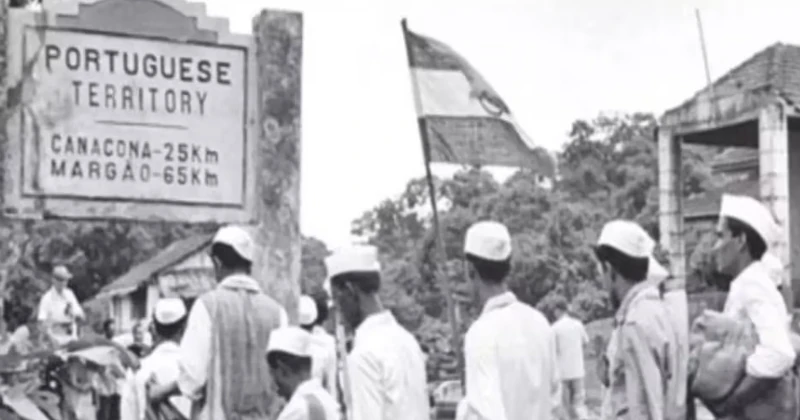
- On December 19, 1961, the Indian Army unfurled the tricolour in Goa, Daman and Diu.
- It was named Operation Vijay which lasted for 36 hours.
- Portugal’s Governor General Vasalo E. Silva surrendered before Indian Army Chief PN Thapar.
- Thus Goa became the part of the Republic of India through Jan Sangh, RSS and Indian Army.
- Goa was granted statehood on May 30, 1987 while Daman and Diu remained Union Territories.
International Situation and India
Jan Sangh’s stand on the International situation:
The first question is: when the Government of Bharat says that the problem of Goa will be solved by international pressure, the countrymen would like to know how many more countries are there in the International arena at the moment that seem ready to put pressure on Portugal in favour of India? We know that even when non-violent and unarmed Indian Satyagrahis were massacred in Goa in broad daylight, no so-called giant nation of the world said a word against them. The Goa movement has been going on for so long, but none of the ‘four elders’ have said anything in favour of Bharat. Burma, Hindisia, and Peking have reacted a little in favour of Bharat, but it is unlikely to have any impact on Portugal.
The second question is that India is called the ‘honourable’ member of the Commonwealth, but, on the other hand, we see that the British response to the Question of Goa has appeared against India rather than in favour. Some British letters have stabbed Bharat in the back instead of doing justice to Bharat on the Goa question; otherwise, the response to these anti-India letters seems to reflect the British government’s unrevealed response.
That is to say, the British press has spewed poison against India on the question of Goa more than the US has, and the funny part is that India is getting it for remaining in the British Commonwealth. Not only that, even when its rights are hijacked in Goa, the British Government remains mischievously silent, and its newspapers venomously continue to speak against India and advocate the mischievous acts of Bharat’s enemies.
Shouldn’t we learn some lesson in this situation? Does India not need to seriously reconsider the question of not having relations with the British Commonwealth?
Suhrawardy, a prominent Pakistani politician, has advised Prime Minister Nehru to stop the Goa Satyagraha because he argues that colonialism cannot be ‘eradicated from external aggression.’ Not only that, he even said that ‘if the Nehru government considers the entry of Bharatiya Satyagrahis in to Goa appropriate for the liberation of Goa, will it allow Pakistanis to enter Kashmir for Kashmir liberation? Here, considering Suhrawardy’s above suggestions completely baseless and unnatural, we want to state that the Nehru Government should not ignore the mischief of the Pak press and politicians and the anti-India talk and give them the befitting reply. (Panchjanya, August 29, 1955)
All India House of Representatives (RSS) 1964: Merger of Goa etc. into affiliated provinces
It was natural that various Indian territories, freed from slavery of Portugal and France, were merged into nearby provinces. It was necessary, the general expectations of the people there, their feeling of complete freedom and identification with Indian life and administrative facilities and development in the present political structure of India. But it is sad that the Government of India has not yet taken this step. By reasserting a specific culture of these regions and the false principle of protecting it which is inconsistent with the basic principles of Bharat’s emotional unity and national unity and which may have serious consequences in the future, government of Bharat has done a wrong thing. The House demands that arrangements be made immediately to merge these areas into the adjoining regions. (Archives of RSS)
The resistance of Portugal was the intuition of the RSS outcome and the Merger of Goa into India (Praveen Gugnani)
The nature and geographical boundaries that we are currently able to see in Bharat are the result of an untiring struggle and campaign of integration that has lasted long after independence. Even after independence, there were many areas that must have been ruled naturally by the Republic of Bharat. It goes without saying that the meaning of the Indian freedom struggle and freedom that Indian historians interpreted and the way power was transferred to India was nothing less than a conspiracy and more than a vicious cycle.
Whenever we discuss the Indian freedom struggle, we clearly and declared impression of the Rashtriya Swayamsevak Sangh on some parts of the present Indian geography. The live wounds of divided Bharat into the hearts of the RSS and millions of nationalists of this nation resulted in a continued struggle. even after the departure of the British, for some time, the Colonial territories which were occupied by France and Portugal. And one after the other areas became part of the Republic of India and Indian good governance with end of foreign rule in these areas.
A vivid example of the Sangh’s campaign was in Dadra and Nagar Haveli in 1954, 7 years after Bharat became independent. With the departure of the British, France gave Puducherry, etc., to the Government of India under an agreement, but the Portuguese, who came before the British, kept their rule intact in many areas of Bharat. The Portuguese decided to crush the ongoing Satyagraha led by Dr. Ram Manohar Lohia in their territory and a large number of soldiers and weapons were deployed for this purpose. The hope of an independent Goa, Diu, and Dadra and Nagar Haveli was beginning to fade. Even after independence, part of our motherland was under subjugation, and everyone was aggrieved about it.
At that time, activists of some nationalist organisations tried to work in this direction by establishing the Azad Gomantak Dal. The then Central Government was keeping itself separate from the scheme of these patriots. The Gomantak Army did not give up even because of Delhi’s indifference and as part of this operation, a part of the Dadra Nagar Haveli bordering Maharashtra-Gujarat was fixed as a target. Shivshahir Baba Saheb Purandare, composer Sudhir Phadke, sports broadcaster Rajabhau Wakankar, dictionary creator Vishwanath Narwane, Nana Kajrekar, who became police officer of Dadra Nagar Haveli after liberation, Krishna Bhide , Member of Pune Municipal Corporation, Major Prabhakar Kulkarni of Bhonsle Military School, Nashik, Bindu Madhav Joshi of Grahak Panchayat, Sreedhar Gupte, former Vice Chancellor of Pune University, etc all were the youths.
This team met Sangh’s Maharashtra chief Babarao Bhide and Vinayak Rao Apte with the sense of pain of the portuguese subjugation in mind and told them about the plan for armed revolution. This was followed by a systematic, secret, armed struggle planned under the leadership of the RSS.To complete and succeed this campaign to liberate Dadra Nagar Haveli was the fund was naturally needed for which Sudhir Phadke took the lead. Phadke contacted Vocal Empress Lata ji and requested her to hold an event stating the whole issue which Lataji immediately accepted. Lata Didi’s concert took place at Hiralal Maidan in Pune which collected a lot of money but that too fell short, so citizens and committees etc. were used locally for this purpose.
On July 31, 1954, a group of about 200 youths headed to Silvassa, the capital of Dadra Nagar Haveli, in torrential rains to transform to the scheme in to reality after collecting money, resources, resources. No one knew where this armed group was going, why, for what. Only one sentence in this regard heard by this group that was what came out of the mouth of Babarao Bhide and Apte “Go with Wakankar ji”.
Surprisingly, assuming this sentence as an order, the hundreds of youths marched towards Dadra Nagar Haveli like a disciplined soldier. Vishnu Bhople, Dhanaji Burungule, Pilaji Jadhav, Manohar Nirgude, Shantaram Vaidya, Prabhakar Sinari, Balkoba Sane, Nana Soman, Govind Malesh, Vasant Prasad, Vasudev Bhide and their fellow courageous youths followed their leader and sacrificed their lives but hoisted the Indian flag on this Portuguese territory.
No one told their loved ones where they were going and when would they come back. Some people went straight to the station fearing that they would not be allowed to go if go home. No one knew how to carry out the armed movement, yet they succeeded in their campaign. Rajabhau Wakankar, Sudhir Phadke, Baba Saheb Purandare, Vishwanath Narwane, Nana Kajrekar, etc. were leading fighters of this movement, who had stayed in that area and had obtained all the information about the site of the war. Vishwanath Narwane could speak Gujrati very well. He had secretly obtained a lot of information from the local public. Rajabhau Wakankar had collected some pistols and other weapons.
Thus, after collecting small information from the battlefield, weapons and money Shri Babarao Bhide administered a pledge to the soldiers of the group being prepared from Pune. He gave clear notices and sang the song “Mera Rang De Basanti Chola”. A group of patriots, cultured by the Sangh Sanskar, left with indomitable courage.
On the night of July 31, when they reached Silvassa, they began to move carefully in all the dark and torrential rain, and as soon as they entered the premises of the Portuguese headquarters, they burst crackers as planned; the Portuguese soldiers assumed it as the sound of guns and overwhelmed by the suddenly emerged frightening atmosphere. What followed became the course of the fall of the Portuguese. Several groups of youth entered the place with the slogan of “Azad Gomantak Dal Zindabad, Bharat Mata Ki Jai”. In the meantime, Vishnu Bhople cut off the hand of a Portuguese soldier, and the rest of the Portuguese soldiers got scared and sought refuge.
The heroes ended the challenge of Portuguese soldiers from police posts and other places, and on the morning of August 2, a group of patriotic youth led by the Rashtriya Swayamsevak Sangh went to Dadra Nagar Haveli and hoisted the Tricolour of Bharat by taking down the Flag of Portuguese rule. The group of patriotic volunteers did not go back from the region even after the merger of Dadra Nagar Haveli with the Republic of India, but returned after 15th August after hoisting the tricolour flag and carrying out the Independence Day parade ,thus completing the chapter of the merger of Dadra Nagar Haveli with the Republic of India. Today, on the anniversary of that incident, the grateful nation remembers all the soldiers of the Gomantak Army proudly and it will be a true tribute to such heroes who were born again on this earth and enhance the prestige of this Land of Bharat. Re-remembrance and 100000 salutations