



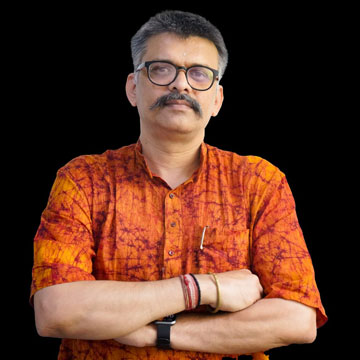


As Bharat marks 150 years of Vande Mataram – the song that once electrified the Swadeshi movement and turned the streets of Bengal and Bharat into a living battlefield of patriotism – the debate around its meaning, politics and legacy has returned with renewed force. Is Vande Mataram merely a patriotic song, or is it, as Shri Aurobindo said, a mantra that embodies Bharat Mata herself? A special ten-hour debate on Vande Mataram was initiated in Lok Sabha by Prime Minister Narendra Modi on December 8 to mark the historic occasion. In this wide-ranging conversation, eminent author and National Convenor of Prajna Pravah, J Nandakumar, speaks to Organiser Editor Prafulla Ketkar on why the 150th anniversary is not just a commemorative exercise but a civilisational necessity. Excerpts:
How do you see the importance and significance of Vande Mataram in the intellectual space? Why should we celebrate 150 years as an important occasion?
It is absolutely necessary that we do so. In the life of a nation, there are a few sacred moments that energise its very spirit and organise society to resist oppression. Vande Mataram is one such moment, crystallised in a song.
It infused Bharat with immense energy and a deep sense of attachment to the motherland. I often call it not just patriotism but “matriotism” – devotion to the mother as Bhoomi and Rashtra. From Kanyakumari to Kashmir, that energy flowed across Bharat and lifted the entire country to a higher emotional and spiritual plane. This happened because Vande Mataram is not a mere song; it is a power-packed mantra.
“The partition of Bengal in 1905 was the dress rehearsal for 1947. Vande Mataram defeated the first partition, but appeasement politics later betrayed its spirit”
It arose at a critical time in history when we were forced to sing praises of the British monarch – the Chakravarti of England – as part of the colonial “national song”. In that environment, Bankim Chandra Chattopadhyay composed Vande Mataram. I do not think it was “composed” in a routine poetic sense. It was a manifestation of something already present within him – that matru-kalpana, the vision of the Mother. In many ways, it is a poetic interpretation of the Vedic idea “Mata bhoomih putro’ham pruthivyah” – “The earth is my mother, and I am her son.”
This idea of the motherland, or what you call “matriotism”, has existed since ancient times. So why did this particular poem, written around 1875, gain national significance only later?
Because it was both civilisationally eternal and historically timely. It was very much the need of that hour. I would say Bharat Mata herself needed it. Out of the inner urge of the nation, the song emerged through a Rishi– a true seer-poet. The medium was Bankim Chandra Chattopadhyay.
He beheld the serene beauty of Bharat – flowering trees, flowing rivers, gentle winds – and at a certain moment that landscape appeared to him not just as land, but as his own mother, standing before him in divine splendour. It is said that he rose from his seat and bowed; Bharat Mata had manifested before him. That was the moment of Vande Mataram.
If you look at the historical context, after 1857 there was a deep depression in the national psyche. People had hoped that 1857 would end British rule, but those hopes were shattered. A sense of helplessness spread: perhaps the British could never be defeated. In that situation, I believe Bharat Mata worked through Bankim Chandra, and Vande Mataram came in 1875 as a response to that civilisational crisis.
About seven years later, in 1882, he incorporated it into his novel Anandamath. That novel gave the song a much wider platform. In one sense, Anandamath was written also to carry Vande Mataram into the public mind. It is a remarkable literary work, narrating the sannyasi rebellion, and within that narrative the song is sung – this is how it spread and became popular.
Though the language is Bengali, it is highly Sanskritised and symbolically rich. The imagery, the kalpana, is such that even a non-Bengali Bharatiya with love for the nation can feel and understand its spirit.
“I don’t think Vande Mataram was ‘composed’ in a routine poetic sense. It was a manifestation of something already present within Bankim Chandra – that Matru-kalpana. At a certain moment, the land appeared before him
as the Mother herself”
How do you view Vande Mataram as poetry, as philosophy, and as a mission?
As poetry, Vande Mataram is a profound symbolic representation of Bharat. It first describes the physical beauty and fertility of the land – the rivers, fields, breezes, greenery. Then it reveals Bharat Mata as Saraswati and Lakshmi – the embodiment of knowledge, prosperity and abundance. It also invokes her as the valiant, protective mother whose fighting spirit and dynamic power defeat forces of adharma.
This layered depiction stirs and challenges every Bharatiya to rise. That is why the poem has such enduring poetic strength; it is still alive and vibrant even after 150 years. As philosophy, through its symbols and images, Vande Mataram awakens an inner sense of devotion, duty and identification with Bharat as a sacred mother, not just as a political territory.
As a mission, its call is unambiguous: unite, resist oppression, and awaken a national consciousness that is rooted in our civilisational self-understanding.
Even today, any Bharatiya who truly loves this country will find their heart stirred and their sense of duty sharpened when they hear Vande Mataram.
You mentioned that after the 1880s, various revolutionary movements and secret societies were active. But you say the decisive moment that turned Vande Mataram into a national mantra was 1905, with the partition of Bengal. How did that happen? How did it become a unifying slogan for both Hindus and Muslims, compelling the British to reverse their decision?
The spirit behind it was very clear. Bankim Chandra was not just a poet; he was a Rishi-kavi, one who tunes into the inner voice of the nation. Through him, this power-packed mantra emerged. It had an extraordinary capacity to organise people and instil in them a sense of nationhood, which was exactly what was needed then. The partition of Bengal in 1905 was not a random administrative act. It was a deliberate move by the British. They clearly understood that Bengal was the nerve-centre of revolutionary activity and intellectual awakening in Bharat. Their logic was straightforward: if Bengal could be fractured, British rule could be extended indefinitely. They initially tried to win over Muslim elites in East Bengal by suggesting that a separate province would give them something like a mini-sultanate: more power, more prestige. But when the partition formally took effect on October 16, 1905, Hindus and Muslims began to grasp the real danger.
Under leaders like Surendranath Banerjee, Rabindranath Tagore, Dwijendranath Basu and others, people gathered in Kolkata. They tied rakhis to one another, symbolising a shared bond, and sang Vande Mataram together. It became a living oath of unity – a declaration that dividing Bengal was the same as wounding Bharat Mata.
From 1905 to 1911, that spirit of resistance and unity persisted. For six long years this movement continued – it is hard to find a parallel in Bharatiya history for such a sustained, mass upsurge that finally forced an imperial power to withdraw a major decision. The British ultimately annulled the partition of Bengal in 1911. So yes, Vande Mataram became the national mantra of that struggle, connecting Hindus and many patriotic Muslims in a shared fight to protect the motherland.
That was a great victory. But you’ve also said that within that victory lay the seeds of future failure. Could you explain that?
Every victory must be examined carefully. The wise ask: Is there a hidden possibility of future defeat in this success? The British did exactly that. They recognised that they had been defeated in Bengal, but they immediately started working on how to prevent such a united upsurge in future.
On the one hand, they nurtured and encouraged Muslim separatism. The Muslim League, formed in 1906, did not arise only from Muslim initiatives; British officials played a key role in its design and orientation. From 1909 onwards, elements within the League and among fundamentalist leaders began to propagate the idea that Vande Mataram and Bharat Mata were “Hindu” constructs, not acceptable to Muslims. On the other hand, inside the nationalist camp, a section of the leadership became more inclined towards constitutionalism and gradual reforms, rather than mass-based revolutionary mobilisation rooted in civilisational symbols.
A telling moment came in 1923 at the Kakinada Congress session. It was by then a long tradition to sing Vande Mataram at Congress meetings. When the great singer Pandit Vishnu Digambar Paluskar rose to sing it, Maulana Mohammad Ali, who was presiding, objected that it was a Hindu bhajan and therefore not appropriate. He even walked out while the song was being sung, and returned to occupy the presidential chair after it ended.
The real tragedy was that none of the senior Congress leaders stood up and said: “If you insult Vande Mataram, if you walk out on the national song, you have no moral right to preside over this session.” That silence was the beginning of a long decline.
From that period, the full song was increasingly avoided in Congress forums. Slowly, the narrative that Vande Mataram was “communal” and “divisive” began to take hold in sections of the political class.












Comments