






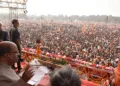
For decades, the sprawling Brigade Parade Ground in Kolkata has been synonymous with mass political rallies, combative speeches, and the loud rhetoric of parties vying for public imagination. But on last Sunday (7 December), the ground seemed to shed that old identity and take on a completely different aura. It was not party flags but saffron-clad monks, families, students, and devotees who filled the field. It was not political slogans but the sacred vibration of a timeless verse that rolled across the air. More than five lakh devotees, by some estimates, gathered to recite the Bhagavad Gita in unison, a spectacle that turned the Brigade into an ocean of voices chanting:
“Dharmakshetre Kurukshetre samaveta yuyutsavaḥ,
Māmakaḥ Pāṇḍavāśchaiva kimakurvata Sañjaya.”
For the sceptics who had questioned the feasibility of such a mammoth event, the congregation itself became an emphatic answer. Far exceeding expectations, the count of voices rose to nearly 650,000 chanting participants, while lakhs more stood in silent reverence. The moment they began their collective recitation; it felt as though the city had paused to witness something both ancient and new at once, a reassertion of cultural identity that came not from political coercion but from spontaneous civilizational pride.
The Bengal that assembled that day was not the Bengal of electoral maps or political speeches. This was a cross-section of society rarely seen together in public life; monks and householders, young students and elderly devotees, women with children, and persons with special needs. Their presence filled the historic ground to its brim, giving it a warmth and vitality that political rallies, with all their noise, seldom produce. From the dais, instead of fiery political speeches, reverberated the blessings of revered Shankaracharya and saints. For a state that prides itself on cultural sophistication, this was not a demonstration of power but a declaration of spiritual continuity.
Rabindranath Tagore, in his Bengali essay Sahityer Matra, had written: “The Gita has not aged; perhaps it never will.” The Brigade gathering seemed a living testament to the poet’s words.
The event also invited reflection on the intertwined destinies of Bharat and Sanatan Dharma, a relationship articulated with prophetic clarity by Sri Aurobindo. In his famous Uttarpara Speech, he declared: “When therefore it is said that India shall rise, it is the Sanatan Dharma that shall be great. When it is said that India shall expand and extend herself, it is the Sanatan Dharma that shall expand and extend itself over the world. It is for the Dharma and by the Dharma that India exists. To magnify the religion means to magnify the country.”
If India’s resurgence is inseparable from the resurgence of Sanatan values, then what unfolded at the Brigade may well be read as the laying of a cultural foundation stone for that renewal. In the pre-independence era, when successive revolutionary attempts seemed to falter, Aurobindo turned to the Bhagavad Gita to articulate what he called spiritual nationalism, the idea that true liberation must be rooted in a deeper, moral, and spiritual awakening.
A century later, as India prepares to mark 100 years of independence in 2047 and speak of a “Viksit Bharat,” the Gita once again returns as a guiding text. The overwhelming turnout at the Brigade suggests that the people of Bengal, historically a crucible of national awakening, still recognise the Gita’s relevance in a modern India that seeks both development and dharma.
In 1893, standing before the Parliament of World Religions in Chicago, Swami Vivekananda began his address with a pride that resonated across continents. Representing the “most ancient order of monks,” he declared himself a voice of Sanatan Dharma, a tradition he described as the mother of all religions.
One could sense something of that same civilizational confidence at the Brigade. The chants, the saffron robes, the congregational devotion together they echoed a heritage that refuses to be confined to the past. Atul Prasad Sen had written, “Bharat abar jagat sabhāy shreshṭha āsan lobe.” Today, that line feels less like poetic aspiration and more like a national mission.
No cultural resurgence, however organic, escapes criticism. Some argued that mass chanting of the Gita was unnecessary in a modern society. Others went a step further, selectively quoting Swami Vivekananda to claim that he preferred football to Gita recitation. This half-quotation, now frequently weaponised, conveniently omits the full context. Vivekananda had said that playing football might bring a young person “closer to heaven” than merely reciting the Gita, because physical strength was essential to understand the Gita’s profound message, not because the scripture was dispensable. His point was simple: weak minds cannot grasp powerful truths. Once a young person becomes strong and confident, he said that, then you will understand the Upanishads and the glory of the Atman better.
The Brigade event embodied precisely this synthesis strength of spirit merging with strength of conviction. India’s story has never been merely political. Her unity, resilience, and identity have been nurtured for thousands of years by the philosophical and cultural streams of Sanatan Dharma. The idea that the land itself is a mother, not a territory but a divine presence is an inheritance that only this tradition has carried with such emotional integrity.
Bankimchandra Chattopadhyay captured this in Anandamath when Bhavananda says, “We do not accept any other mother; Janani Janmabhumishcha Swargadapi Gariyasi.” This spiritual nationalism did not divide; it elevated. It allowed Indians to see themselves not merely as a political people but as a civilizational family. And that civilizational family diverse yet united by its spiritual core was unmistakable at the Brigade.
Now the question is why the Gita? And why now? Because the challenges of the 21st century; technological, geopolitical, cultural demand not only innovation but inner strength. India’s aspiration to become a global leader must rest on more than economic growth; it must stand on moral clarity, discipline, and a sense of collective purpose. The Gita, with its insistence on righteous action and equanimity, remains one of the most powerful texts to shape such a purpose.
Sri Aurobindo once wrote that the Gita offers truths “not merely for intellectual discussion,” but for yogic vision, truths that help build an inner life capable of transforming society. The Brigade’s event was not a ritual; it was a reminder of this transformative potential.
It may be tempting to see the chanting event as a one-day spectacle, a cultural gathering that came, inspired, and passed. But its deeper significance lies elsewhere. It represents the beginning of a new cultural confidence in Bengal, a state that has often been painted as detached from its spiritual roots due to decades of ideological conditioning.
The sheer diversity of those who attended, from monks to mothers to millennials demonstrates that the call of Sanatan Dharma still resonates deeply. It reaffirms that cultural revival need not be orchestrated from above; it can arise naturally from the hearts of people who feel connected to their civilizational inheritance. If Bharat is indeed to reclaim a place of honour in the world, it will not do so by abandoning its roots but by rediscovering them. And in that journey, gatherings like the Brigade Gita chanting become milestones, markers of a nation remembering itself.
As the final syllables of the Gita recitation dissolved into the Kolkata afternoon, many felt they had witnessed not just an event but a moment of historical symmetry. The same Bengal that once produced Bankim, Vivekananda, Aurobindo, and Subhas, who shaped India’s soul, had once again shown that cultural awakening is written into its character. India rises when Sanatan Dharma rises. And Sanatan Dharma rises when ordinary people, in extraordinary numbers, gather to affirm its values. At the Brigade Parade Ground, five lakh voices seemed to say not only a verse from a scripture but a promise to the future, that the eternal wisdom of the Gita will continue to guide India as she marches toward new horizons.














Comments