






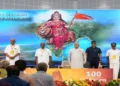
CHENNAI: Dr Mohan Bhagwat, in a Q&A session, answered the questions posed by the youth in the programme that was held in Chennai marking the centenary celebrations of the Rashtriya Swayamsevak Sangh
How are we progressing in decolonising Bharat from the lens of the RSS; what is the way forward?
Sangh and many other great leaders and thinkers have given a fundamental discourse of thought that is totally free from colonisation. We have to absorb it as it is. When I say that Rashtra is not a “nation” in the Western sense, the Rashtra is Sanskriti, Bharat Mata and our Purvaja Parampara. Questions arise because we try to understand these concepts through Western frameworks instead of the viewpoint of Bharat. In the Sangh, from the early entry of a Swayamsevak, we change his mindset through programmes, bauddhiks, geet and even casual conversation. Wherever our Shakhas function, people begin to see and think differently; this is a gradual process. Everything is inculcated so that we develop the habit of thinking through the eyes of Hindustan. It is slow work. Among some sixty lakh Swayamsevaks, some have learned this fully and some are yet to start, but the culmination is that we naturally think like Bharatiyas, not like Americanised or Europeanised Bharatiyas.
The maximum number of Hindus are in Bharat, yet we still do not call our nation a Hindu Rashtra in our Constitution. Why?
The identity “Hindu” arose from inclusivity and continues today. The entity that existed before the Constitution is the same entity that shaped the Preamble—freedom of worship, liberty, equality, fraternity and justice. When diverse Hindus realise that irrespective of worship form they are Hindu, Hindustani, constitutional recognition may follow, but for the existence and prosperity of Hindu Rashtra this is not necessary. If all Hindus say we are Hindus, that is enough.
The Bible is a universal scripture for Christians and the Quran for Muslims. What is the stand of the RSS regarding a universal scripture for Hindus, and why?
The Sangh’s position flows from the inclusive nature of our civilisation: there have been many paths and teachers, and the unity is in recognising that the goal is one, though methods differ. Hinduness is not mere information; it is a principle which can be expressed only through practice. Hindutva is principle, RSS is practice. This is not a technical claim about a single universal text but an affirmation of an inclusive spiritual civilisation.
What have we done to protect Bharat’s 175 unique Gomata breeds, including around 45 breeds from Tamil Nadu?
We have separate ‘Go Samvardhan’ departments. Their duty is to save Bharatiya cow breeds, encourage people to rear them and promote local breeds. People bring Gir cows from Gujarat to Tamil Nadu, but cows serve agricultural purposes. Gir suits Gujarat agriculture, Kangayam suits Tamil Nadu. To save cows, farmers should keep cows, and for that, cows must be agriculturally useful. Go Samvardhan trains farmers for this. The work is ongoing; it has not yet reached 100 per cent, but in 10–15 years we can expect results. We are working towards that end.
What are the core values of the RSS that youth in Tamil Nadu misunderstand most, and how can perceptions be transformed?
Reach out and tell them; let them see our life and intentions. When they see purity of intention they start believing us. There is no special misunderstanding, only temporary reservations that are overcome by reaching out and having dialogue. Logic makes people receptive, and living examples dispel misconceptions. Our All-India camp in Nagpur invites people; reservations evaporate when they see us from within. National feeling in Tamil Nadu is not lacking; the feeling is as strong as elsewhere. What is lacking is the atmosphere for full expression. Artificial barriers have been created; they cannot be sustained because national feeling, when expressed fully, breaks them. That environment is slowly taking hold.
Many neutral-minded Bharatiyas avoid politics because it has become identity battles. Will RSS or BJP champion a new form of politics away from identity?
Neutrality should not mean watching injustice happen. Hold others’ right to opinion sacred and have dialogue. Secularism as conceived in Europe is not entirely relevant to Bharat’s tradition; the state in Bharat has been secular in practice. Sangh prepares men for public life, asking them to be honest and often recommending a period of focused political activity without demands. Sangh neither compels nor forbids political participation; it prepares those who choose to serve.
What is the Sangh’s roadmap as the nation transforms?
Many live the Sangh ethos without formal contact; the essence is life and example. We have faith in society and are large enough for house-to-house contact; we aim to change the habit of seeing only for self and family and create citizens who think of Bharat as a whole. Five planned initiatives and pilot projects have shown desired change; we will extend them to society at large.





Comments