






The visit of the Russian President Vladimir Putin to India from December 4 to 5 is easily the most high-profile visit of a head of state in the current year 2025. The visit in many ways sums up the rise of India as a global power and triumph of India as a military power. The economic cooperation and business details of the visit have been highlighted in the media but the defence and strategic issues have received lesser attention. A lot of this has do with the media hype around S-500 air defence system, SU-57 fighter aircraft and other military hardware. But the strategic substance of this important visit goes far beyond the acquisition of military hardware from Russia.
The most important takeaway of the visit in military terms obviously is strengthening of Indo-Russia defence cooperation. Russia still accounts for the supply of 38 per cent of military hardware to India. Russia has faced problems in maintaining defence supply chain to India because of the ongoing war with Ukraine. Yet Russia has ensured that India does not suffer from any major deficiency of military hardware. Russia has continued to take on the combined might of American and NATO military hardware supplied to Ukraine for the last four years. That proves the resilience of Russian defence industry. India too has to establish and rejuvenate the indigenous defence industry to continue with the supplies during wars and conflict situations. India as a whole has made major strides to be self-sufficient in defence manufacturing.
India would need active support of Russia to develop the comprehensive air defence cover called ‘Sudarshan Chakra’ by PM Modi, which has been planned by the year 2030. Given the type of air threat faced by India from Pakistan and China, India needs a multi-layer air defence system. Russia has also developed a plethora of UAVs and combat drones that have played a critical role in the war against Ukraine. India needs collaboration with Russia to develop low-cost combat drones. BrahMos missiles built under Indo-Russia collaboration is already a world class product and many more defence systems can be built in India. India has to quickly seek transfer of technology from Russia, something that is extremely difficult to obtain from the western military powers.
India is already emerging as a major global hub of MRO (Maintenance, Repair and Overhaul) for the military hardware. Unlike any other equipment, military hardware requires in-situ repairs and maintenance to ensure maximum serviceability at all times. As regards overhaul, major equipment like tanks and artillery guns need to be overhauled after a particular life cycle. During Operation Sindoor, many of the overhauled equipment which was modified to meet wartime requirement paid handsome dividends. In fact, the importance of MRO in our context is no less than the indigenous defence production. In a prolonged conflict, both the defence industry and the MRO hubs have to work in unison to ensure uninterrupted supply of military hardware to the fighting troops.
India also has to team up more closely with Russia in the space and cyber domain. Space is going to be next frontier and Russian expertise would be very handy to India. China has already made rapid strides in the space warfare domain and India has to counter that with the Russian assistance. Russia is also a major player in the cyber warfare and has developed capability to cripple the IT network of adversaries. India has already faced several cyber-attacks in the recent times. In times of conflict, India has to further refine its ability to thwart cyber-attacks, particularly on the railways, banking, airlines and defence networks.
As regards the military hardware to India from Russia, the talks certainly would have taken place. In fact, the Russian defence minister had a long meeting with Rajnath Singh, Raksha Mantri, a day prior to the arrival of Putin. India and Russia follow a system of regular interaction as far as defence cooperation is concerned. Therefore, the defence deals are finalised over a period of time after detailed discussion. Given the uncertain security situation, at times it is appropriate to maintain a level of secrecy around such defence deals. But one thing is certain; Russia would continue to be the major defence partner of India for a foreseeable future.
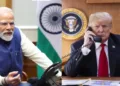
The visit of Putin to India had a strategic signal for the US, major European powers and China. Russia needs the economic and moral support of India, as another attempt is being made by President Trump to end its four-year long war with Ukraine. The recent events have also revealed the friction between America and the European powers. PM Modi once again stressed the need to end the conflict during his meeting with President Putin. President Trump had a long tele conversation with PM Modi and Russia-Ukraine war would certainly have figured in that. The peace proposal of President Trump is workable to enforce at least a ceasefire between Russia and Ukraine. Surprisingly, European powers have sided with Ukraine, most probably to prolong the war for the benefit of their defence industry.
Essentially, India has been diplomatically successful to negate the bogey of India prolonging Russia-Ukraine war through its oil imports from Russia. It is increasingly evident that it is the major defence manufacturers from the US and the West that have prolonged the war for their vested interests. President Putin is also concerned about growing domination of China in the Russian markets. Therefore, his focus during the visit was also to counter China by encouraging more and more Indian products in the Russian markets. It is good that China has welcomed the visit of President Putin to India.
The most significant outcome of this visit in strategic terms is to shape a new multi-polar world order. The world has already suffered from the domination of US as the lone superpower for the last 30 years or so. China’s rise and aspiration to be the next superpower takes us back to the conflict scenario of USA-USSR era. For a peaceful and stable world order, rise of responsible powers like India is critical. Russia realises that both India and China are going to be key players to check western hegemony. Indo-Russian bonhomie is also vital for our growth journey towards Viksit Bharat@2047. Modi and Putin share a personal chemistry and both of them are going to be around for a considerable period to shape the destiny of these two major nations in their own way.







Comments