





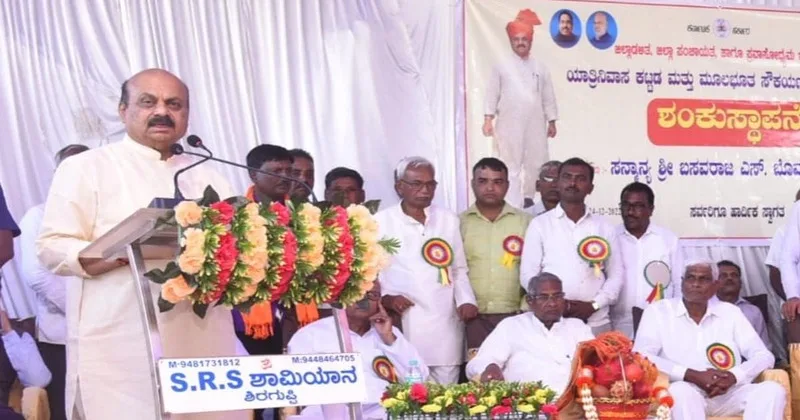
Bengaluru: Former Chief Minister Basavaraj Bommai has launched a stringent attack on the Siddaramaiah-led Karnataka government, calling the newly introduced hate-speech law “unconstitutional, undemocratic, and dangerously punitive.” The former CM argued that the state already has sufficient legal provisions to deal with hate speech and public disorder, making the new legislation unnecessary and politically motivated.
Bommai stated that the law, which proposes a sentence of up to ten years and makes offences non-bailable, is designed not to curb hate speech but to silence individuals who speak against the government or the Congress party. According to him, the legislation is a direct assault on democratic rights, individual freedoms, and the principles of free expression enshrined in the Constitution. Calling it a “dark day for Karnataka,” he said the state was witnessing the onset of what felt like an emergency.
ಕರ್ನಾಟಕ ರಾಜ್ಯ ಸರ್ಕಾರ ಇವತ್ತು ದ್ವೇಷ ಭಾಷಣದ ವಿರುದ್ದ ಕಾನೂನು ತಂದಿರುವುದು ಸಂವಿಧಾನ ವಿರುದ್ದ ಇದೆ. ನಮ್ಮ ವಾಕ್ ಸ್ವಾತಂತ್ರ್ಯ, ವ್ಯಕ್ತಿ ಸ್ವಾತಂತ್ರ್ಯ ಮೊಟಕುಗೊಳಿಸುವ ಕಾನೂನು ಈಗಾಗಲೇ ದ್ವೇಷದ ಭಾಷಣ ತಡೆಯಲು ಸಾಕಷ್ಟು ಕಾನೂನುಗಳಿವೆ. ಆ ಕಾನೂನು ಬಳಸಬಹುದು, ಆದರೆ, ಹತ್ತು ವರ್ಷದ ಶಿಕ್ಷೆ ಕಾನೂನು ತಂದು ಸರ್ಕಾರದ ವಿರುದ್ದ, ಅವರ ಪಕ್ಷದ…
— Basavaraj S Bommai (@BSBommai) December 11, 2025
The BJP leader accused the Congress government of using the law as a shield to hide its failures. He alleged that the administration has failed to deliver any meaningful development and is instead “neck-deep in corruption across sectors.” Bommai reiterated the BJP’s charge that funds meant for Dalit welfare were misappropriated by the government and claimed that the new law is being weaponised to suppress voices that expose such wrongdoing. He described it as a “black spot on Siddaramaiah’s political legacy,” especially coming from a CM who claims to champion individual liberty and constitutional values. Bommai declared that the BJP would fight the law politically and legally.
Congress has history of restricting freedom of speech
The criticism intensified as party leaders and commentators drew attention to what they described as the Congress party’s long history of restricting freedoms. Citing examples from the past, critics noted that under the guise of liberalism, the Congress has repeatedly curbed liberty, imposed unreasonable restrictions on dissenters, and targeted writers, journalists, and filmmakers.
References were made to the First Amendment of 1951 often described by critics as draconian which introduced limitations on free speech. Several books, including Satanic Verses and Red Sari, were banned, and writers like poet Madhura Sultanpuri faced arrest for their work. Even cinema was not spared: legendary actor Dilip Kumar’s film Ganga Jamuna reportedly faced nearly 250 cuts from the censor board.
Cases of ordinary citizens being slapped with sedition charges were also highlighted. One example often cited is that of Ram Nandan, who was jailed for three years for expressing dissent. According to BJP leaders, this pattern demonstrates that restrictions on freedom of expression are ingrained in the Congress’s political DNA.
Political observers arguing against the new law say that existing penal provisions—covering hate speech, incitement, defamation, and public disorder—are more than adequate. The creation of fresh offences, they contend, opens undefined “gray areas” that can be misused to punish critics. Media professionals too have expressed apprehension, fearing the law could become a tool to arrest journalists and suppress uncomfortable reportage.
Some analysts even linked the move to global trends, especially in parts of Europe where new regulations governing online speech have raised concerns about overreach. They argued that Congress, being aligned with what they term the “international liberal framework,” is drawing inspiration from such global efforts to regulate speech. A few critics speculated that influential global actors, including philanthropic networks, may be encouraging the clampdown—though such claims remain unverified.













Comments