





Punjab’s modern political history cannot be understood without acknowledging a simple and enduring truth: Hindu–Sikh unity has been the backbone of Punjab’s strength for centuries. Every period of progress in Punjab has emerged from cooperation between the two communities, and every era of instability has been the product of deliberate attempts—domestic and foreign—to divide them. From British colonial strategy to the conspiracies of the Muslim League, from political miscalculations of the 20th century to foreign interference in recent decades, the history of Punjab is, in essence, the history of unity versus division.
The earliest record of this strategy appears in 1845, on the eve of the Anglo-Sikh Wars. Colonel Steinbach, reporting to the British authorities, wrote that the Khalsa Raj could not be defeated by military action alone. To break the Sikh Empire, Hindus and Sikhs—who stood shoulder to shoulder—would have to be divided politically and socially. He further noted that the Muslims of the region would be inclined to support British rule. The report, preserved in colonial archives, confirms that communal division in Punjab was not an accidental development but a deliberate instrument of British imperial policy. Punjab could not be conquered so long as its two major communities remained united.
A century later, on the eve of Independence, the same strategy resurfaced through the propaganda of the Muslim League. As Punjab descended into murderous violence in 1947, rumours were spread that Sikhs would be safe in Pakistan and that their real enemies were Hindus. These lies were designed to weaken the historical bond between the two communities. But the trains of refugees arriving in East Punjab revealed the truth: Hindus and Sikhs were being massacred together, without distinction.
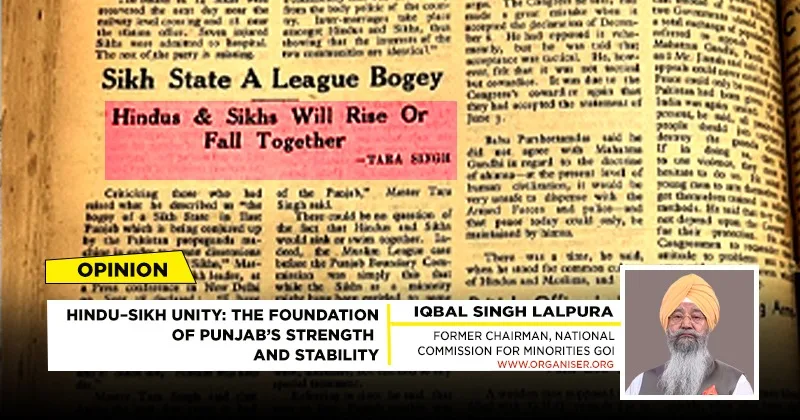
At this critical moment, on September 18, 1947, Master Tara Singh made one of the most significant pronouncements in Punjab’s history. Speaking to the press in New Delhi, he said, “I have always said—and I repeat again—that Hindus and Sikhs will rise and fall together. Their fates are inextricably linked. If Hindus die, Sikhs will not survive; and if Sikhs die, Hindus will also vanish.” His words, emerging from the heart of Partition’s tragedy, reaffirmed a civilisational truth that had guided Punjab for centuries: the destiny of both communities is one and the same. He also warned against the false propaganda of the Muslim League, which was responsible for disarming Hindus and Sikhs in West Punjab and enabling their massacre.
India’s national thinkers also recognised this truth. Pandit Madan Mohan Malaviya described Sikhs as the “shield of India” and suggested that every Hindu family should encourage one son to join the Sikh Panth to strengthen the nation’s defence. Swami Vivekananda declared that the spiritual strength and martial discipline of the Sikhs would protect India in the future. Neither Malaviya nor Vivekananda saw Hindus and Sikhs as separate communities; they saw them as a single civilisational family.
After Independence, despite the wounds of Partition, Punjab attempted to rebuild harmony. In 1967, when Justice Gurnam Singh led a non-Congress government, political partners drafted an 11-Point Common Programme emphasising communal peace, fair governance, and development rooted in Hindu–Sikh cooperation. Though short-lived, it was an honest effort to restore Punjab’s historical unity.
On March 27, 1970, a young Parkash Singh Badal, then Chief Minister, reaffirmed the same truth. Publicly declaring that Hindu–Sikh amity was his central agenda. He warned people not to fall victim to the any propaganda again. His words aligned completely with Master Tara Singh’s warning of 1947 and echoed Steinbach’s 1845 analysis: Punjab can rise only when its people remain united.
But even as some leaders sought unity, others undermined it for political gain. By the late 1970s, Punjab became the ground for a dangerous political experiment. Former intelligence officers—especially GBS Sidhu, IPS (R&AW)—along with journalists and researchers have documented how certain Congress leaders encouraged the early rise of Jarnail Singh Bhindranwale to weaken the Akali Dal. What began as political manoeuvring soon turned into radicalisation. Pakistan’s ISI and foreign networks quickly exploited the situation. As Sidhu and others noted, the early Khalistan conspiracy was not rooted among ordinary Punjabis but emerged from domestic political manipulation and foreign interference.
The cost was devastating. Punjab was pushed into a decade of violence that scarred generations. Militant groups targeted not only the Indian state but also the shared cultural fabric of Hindus and Sikhs—the very bond that had protected Punjab for centuries. Their goal was exactly what Steinbach had described in 1845: break Punjab by breaking its unity.
Yet the deepest layers of Punjab’s society never accepted this division. Hindu and Sikh families continued to protect one another. Social life, rooted in a shared language, culture and history, remained interwoven. The bond of Roti-Beti di Sanjh—sharing food and matrimonial ties—survived the darkest nights. Punjab endured because its people refused to abandon their unity.
As militancy receded in the 1990s, India entered a new political era. Atal Bihari Vajpayee became the first national leader to openly restore Hindu–Sikh unity as an essential civilisational principle. He supported Parkash Singh Badal, who had advocated this unity since 1970, and worked sincerely to apply balm to the wounds of the 1984 tragedy. Vajpayee strengthened the global Sikh community, promoted preservation of Sikh heritage, and sanctioned funds for the celebration of the 300th Khalsa Sirjna in 1999.
This legacy has continued with even greater determination under Prime Minister Narendra Modi since 2014. The last decade has seen unprecedented efforts to honour Sikh identity, correct historical injustices, and celebrate the Sikh contribution to India. The Kartarpur Corridor became a reality; the 550th Prakash Purab of Guru Nanak Dev Ji and the sacrifices of the Sahibzade were commemorated at the highest level; forgotten Sikh heroes received long-overdue recognition; and the 350th martyrdom anniversary of Guru Tegh Bahadur Ji was honoured globally. The Modi Government has consistently rejected the politics of division and emphasised unity rooted in mutual respect.
As far as Sikh identity as an independent Panth is concerned, it was clearly defined by Guru Arjan Dev Ji and Bhai Gurdas Ji, and the Constitution of India also recognises Sikhs as a distinct community. Unnecessary controversies created by foreign or separatist elements are aimed at creating differences between Hindus and Sikhs to weaken Punjab and India.
Today, Punjab again stands at a crossroads. Economic stress, rising debt, social tensions and political instability are creating a fragile environment. Foreign agencies are attempting to exploit grievances. Divisive voices abroad are trying to revive separatist narratives. The lesson of history, however, is unmistakable. From 1845 to 1947, from 1967 to 1970, and through the tragic events of the 1980s, one message remains unchanged: Punjab rises when its people are united and falls when they are divided.
The way forward is therefore not new. It is the same path that protected Punjab for centuries. Hindu–Sikh unity is not a political slogan—it is a civilisational truth, a historical necessity, and the only foundation on which Punjab’s prosperity, security and dignity can be rebuilt. National leadership today has once again reaffirmed this unity. It is now the responsibility of Punjab’s political class, intellectuals and civil society to rise above temporary politics and strengthen the principles of Ekta, Saanjh te Bharosa—unity, shared heritage and mutual trust.
Only then can Punjab regain the peace, progress and pride that its history has always promised.
Punjabi je kar ik hon,
Sadi tarakki roku kaun!
Let us begin this journey again.








Comments