





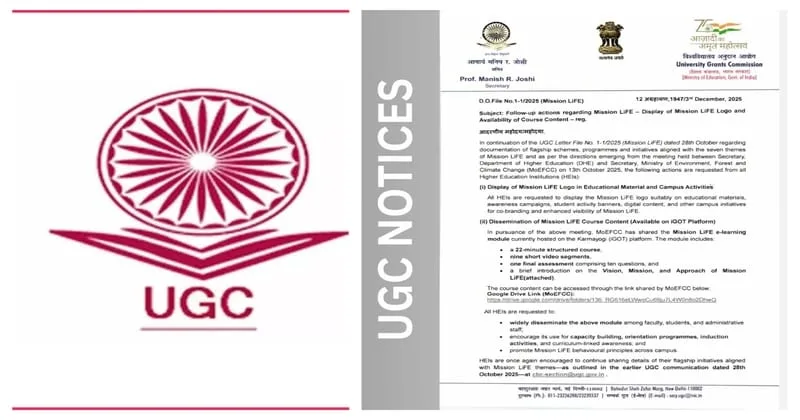
The University Grants Commission (UGC) has issued a fresh directive urging all Higher Education Institutions (HEIs) across the country to step up follow-up actions under Mission LiFE (Lifestyle for Environment), a national movement that encourages sustainable living and climate-conscious behavior. The latest circular, signed by UGC Secretary Prof. Manish R. Joshi on December 3, 2025, emphasizes that universities and colleges must integrate the Mission LiFE logo and course content into their campus activities and educational programs.
The notice titled “Follow-up actions regarding Mission LiFE, Display of Mission LiFE Logo and Availability of Course Content” aims to promote environmental awareness and sustainable living in education. It shows India’s larger effort to turn climate-friendly living into a shared social movement, not just a government plan.
📢 UGC Updates
HEIs are requested to take follow-up actions on Mission LiFE, including:
🔹 Displaying the Mission LiFE logo on educational and awareness materials.
🔹 Sharing the Mission LiFE e-learning module (iGOT) widely with students, faculty, and staff.Read the UGC… pic.twitter.com/lTTDYaW2Ga
— UGC INDIA (@ugc_india) December 4, 2025
According to the circular, all higher education institutions are required to display the Mission LiFE logo on educational, promotional, and awareness materials used on campuses. The logo must appear on banners, posters, brochures, and digital content related to environment-focused activities and initiatives. This, the UGC says, will enhance Mission LiFE’s visibility and align campus-level programs with the national sustainability mission.
Beyond visual representation, the UGC has also directed institutions to disseminate the Mission LiFE e-learning course, developed by the Ministry of Environment, Forest and Climate Change (MoEFCC) in collaboration with the Department of Higher Education (DHE). The module, hosted on the government’s iGOT Karmayogi platform, aims to promote environmental awareness and encourage behavioral change among students and academic staff.
The structured course includes a 22-minute video, a series of short informative segments, a ten-question final assessment, and an overview of Mission LiFE’s vision, mission, and approach. The UGC has made the course link available to all HEIs, encouraging them to integrate it into faculty training, orientation programs, and student activities.
Mission LiFE, launched by Prime Minister Narendra Modi at the United Nations in 2022, promotes an eco-friendly lifestyle that reduces waste, saves resources, and lives in balance with nature. It encourages people to take the lead in climate action instead of relying only on government efforts. Through its latest directive, the UGC supports this idea in higher education. The goal is to help students not just learn about sustainability but also practice it in their everyday lives. By involving both students and teachers, Mission LiFE aims to make colleges and universities active centers of environmental change.
The Commission has urged universities and colleges to widely share the Mission LiFE module among students, teachers, and administrative staff. It has also advised HEIs to include it in capacity-building programs, training workshops, and curriculum-linked activities. Institutions have been encouraged to organize campus drives, competitions, and outreach events aligned with Mission LiFE themes.
This directive is not just an administrative task—it aims to turn national environmental goals into real action on campuses. The success of Mission LiFE will depend on how well universities follow these guidelines, not just by finishing courses. By doing this, educational institutions can help create “pro-planet citizens,” which is a key idea of the Mission LiFE movement.
India has pledged to achieve net-zero carbon emissions by 2070, a target that requires both technological innovation and widespread behavioral change. Mission LiFE is designed to bridge this gap by combining scientific knowledge with public participation. Through education, it connects environmental awareness with lifestyle practices, turning climate responsibility into a shared national culture.
By incorporating LiFE into the education sector, the UGC aligns the country’s universities with global sustainability frameworks, including the UN Sustainable Development Goals (SDGs), notably SDG 12 (Responsible Consumption and Production) and SDG 13 (Climate Action).
The success of this initiative will depend on active participation, institutional leadership, and creative communication. While the UGC has set the direction, universities must ensure that the message of Mission LiFE resonates deeply within their academic communities.
Rather than viewing the directive as a compliance requirement, HEIs have an opportunity to redefine their role in national climate action. By nurturing informed, responsible, and environmentally aware graduates, they can make Mission LiFE not just a campaign, but a way of life.
The Commission has also invited institutions to share their innovative practices and success stories that align with Mission LiFE themes. If followed sincerely, this initiative can make Indian campuses centers of sustainable ideas and inspire change in nearby communities. In short, Mission LiFE is not just about learning to protect the environment; it is about living responsibly, learning with awareness, and setting an example for others.














Comments