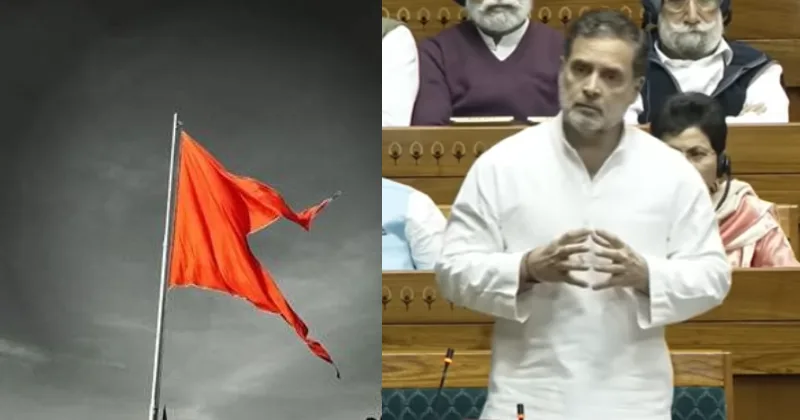
Safron Flag (L ) - Rahul Gandhi (R)
Rahul Gandhi’s Parliament speech on the occasion of 150 years of Vande mataram, is only the latest reminder of a Congress party that has repeatedly damaged Bharat’s institutions, undermined its civilisational identity, and drowned the country in decades of corruption and manipulation. To understand the intensity of Congress’s attacks on the RSS and nationalist forces today, one must revisit the party’s long, documented history, not opinions, but events, scandals and decisions that shaped the nation’s past and continue to influence its present.
Congress was initially a platform for nationalist forces fighting against the colonial British, even though it was originally conceptualised by the British to prevent another 1857-style military uprising and to contain the growing anger of Indians. Yet the resentment among ordinary people was so strong that the organisation naturally split between genuine nationalists and those loyal to British interests. Despite these internal divisions, the overall priority of securing Independence meant that almost every strand of political opinion eventually connected itself with Congress, which functioned more as a broad platform than as a political party before 1947.
The fears of Congress’s Western-leaning leadership became a reality when the country was partitioned on religious lines, and the British-aligned faction within Congress gradually transformed itself into an extended, invisible arm of former colonial and emerging global forces. India moved from a colonial state to a neo-colonial framework without openly acknowledging the shift.
During this period, some Congress leaders genuinely dedicated themselves to rebuilding the nation, but another section—particularly under the leadership of Nehru—consolidated complete control over the system. As both Prime Minister and party president, he held unparalleled influence for decades without institutional checks. This centralised hold has long been evident to nationalist groups and a vigilant society, which continued to voice their concerns without compromise, regardless of their size or strength.
Today, that long-standing fight against neo-colonial influences—carried out through backdoor designs and systemic manipulation—is finally being cornered, exposed, and challenged with evidence.
From the very moment Bharat attained Independence, Congress began shaping an unmistakable anti-Bharat pattern. Instead of embracing the nation’s civilisational character, the leadership under Nehru pushed a Western-influenced, deracinated template that rejected the cultural foundations which had sustained Dharma for centuries. Hindu civilisational symbols, language revival efforts, temple reforms and traditional institutions were sidelined under what came to be known as Nehruvian “modernity”.
At the same time, while RSS swayamsevaks were in action rehabilitating refugees during Partition and protecting vulnerable communities during riots, the Congress leadership not only refused to acknowledge this nation-building work but actively targeted the organisation. Jawaharlal Nehru imposed ban on the RSS after assisination of Gandhi in 1948, treating it as an enemy rather than a social force committed to strengthening the nation. This hostility laid the foundation for the long-standing Congress versus RSS conflict. Alongside this cultural and ideological distortion, Congress also began a parallel process of institutional capture and corruption, creating a framework that would define its governance style for decades.
Corruption within Congress did not emerge as isolated incidents; it became an institutionalised way of functioning. From the licence-permit raj to political extortion rackets, scandal after scandal shook the country. Policies existed only on paper, never on the ground, because the entire administrative system was controlled by Congress leadership. When Indira Gandhi rose to power, her personal ambition overshadowed any sense of national interest. Her desire to control every arm of the state ensured that anyone who questioned or criticised her authority faced consequences.
The declaration of the Emergency became the clearest example of how far Congress was willing to go. During those dark years, the party captured Parliament, bureaucracy, media, sections of the judiciary and even the electoral process. Popular slogans replaced genuine welfare action, and unchecked political power was concentrated in the hands of a single individual. The 1975 Emergency, along with the tampering of the Constitution’s Preamble by inserting the words “Secular” and “Socialist”, represented only the visible tip of the iceberg. Beneath it lay decades of Congress manipulation designed to control and run the country through fear, censorship and political coercion.
It was the RSS that stood firmly against this authoritarianism. While Congress attempted to crush dissent, RSS and its Swayamsevaks held the democratic spirit together and resisted dictatorship through constitutional and social mobilisation. Many volunteers paid a heavy personal price to restore democracy and revive a vibrant political system. That struggle has never been forgotten, and it remains a chapter Congress refuses to either digest or acknowledge, because it exposes the party’s blunders and its willingness to push citizens into silence and submission.
This courageous resistance by the RSS left a deep mark on Congress leadership. From that point onwards, Congress grew increasingly hostile towards the RSS and its inspired organisations—precisely because they had withstood both the system and the times with public support and a nationalist vision. That enduring influence continues to haunt the Congress even today.
The people’s resistance to Indira Gandhi’s Emergency was nothing less than India’s second political freedom struggle. Democracy was suspended, the press was censored, the RSS was banned, and opponents were thrown into jail. The nation rose once again, this time not against a foreign ruler, but against the authoritarianism of the Congress itself.
The Congress soon discovered that Indian Communists were reliable, all-weather allies, and together they created an ideological space where violence was romanticised and armed struggle was justified. What began as Communist agitation soon mutated into Maoist extremism—a movement that threatened the very foundations of India’s democracy. Yet, instead of confronting this danger, Congress and the Communist networks often operated like partners in crisis, each supporting the other whenever needed. Through influence over academia, bureaucracy and cultural bodies, this nexus controlled the levers of these extremist currents.
As a result, Naxalism, armed rebellion and Maoist ideology penetrated deep into universities and intellectual spaces, hijacking the education system and normalising divisive narratives. Identity politics was encouraged. Caste hostilities were sharpened. Dravidian separatist ideas were amplified. Regional chauvinism and language wars were nurtured. Islamic fundamentalist groups were given political space. Many splinter groups that broke away from Congress acted less like independent entities and more like its ideological extensions, constantly shaping turbulent politics while shielding Congress from direct responsibility.
The death of Indira Gandhi set off a tragic chain of events—beginning with the anti-Sikh riots and the intensification of the Khalistani movement. Terrorism in Kashmir escalated rapidly, culminating in the forced exodus of Hindus from their ancestral homeland in the Valley, all while Congress governments remained largely indifferent. Basic Hindu rights were denied, temples remained under state control, and the Ram Mandir movement was mocked, delayed and delegitimised.
Rajiv Gandhi’s tenure revealed the cost of this manipulation. Congress leaders orchestrated mobs that killed thousands of Sikhs in the aftermath of Indira Gandhi’s assassination. The Prime Minister justified the massacre with the chilling statement: “When a big tree falls, the earth shakes.” Instead of remorse, there was rationalisation. Shortly afterwards, the Congress government overturned the Supreme Court’s Shah Bano judgement solely to appease Muslim clerics, sacrificing the dignity and rights of Muslim women for vote-bank politics.
Then came the Bofors scandal, one of the largest defence scams in Indian history. Rajiv Gandhi’s close circle received kickbacks, compromising national security for personal gain. It became the defining symbol of how Congress repeatedly prioritised political survival and vote-bank arithmetic over Bharat’s constitutional values and national interests.
The political chaos that followed, decades of unstable coalition governments, was often driven by splinter groups born out of Congress itself. These parties allowed the Congress leadership, from Rajiv Gandhi to Sonia Gandhi, to exert influence from behind the scenes even when the party was not in power.
During the UPA years, the most dangerous development was the creation of the National Advisory Council—an unelected, extra-constitutional body headed by Sonia Gandhi, functioning as a parallel cabinet. Ministries implemented NAC directives as if they were law. Congress set up Minority Corporations to cultivate permanent vote banks, ignored the radicalisation of extremist groups, and maintained silence when Islamic terrorists carried out attacks across Mumbai, Delhi, Coimbatore, Ahmedabad, Hyderabad, Bengaluru and other cities. This was institutional subversion in its purest form. Congress also captured or influenced the Election Commission, judiciary, bureaucracy, enforcement agencies, media organisations, NGOs, and foreign-funded think tanks. This ecosystem was designed not for governance but for dynasty preservation.
Today, that carefully engineered system is collapsing. Institutions are asserting independence. The Election Commission refuses dynastic pressure. Enforcement agencies pursue corruption cases without partisan loyalty. Sections of the judiciary resist political signalling. Bureaucrats do not fear the “High Command.” NGOs and foreign-funded outfits face scrutiny. Media and academic echo chambers no longer control public discourse. For the first time in decades, institutions serve Bharat rather than a political family.
This is happening alongside a massive cultural awakening. From the memory of Vanga-bhanga in Bengal, when Vande Mataram united an entire civilisation, to the revolutionary soldiers of Madras who died with that chant on their lips, the spirit of Bharat has repeatedly risen when attacked. Today’s revival—symbolised most powerfully by the Ram Mandir in Ayodhya—marks a civilisational turning point. Bharat is embracing a worldview rooted in Vasudhaiva Kutumbakam, asserting its identity without seeking Western validation.
In this new landscape, particularly after 2024, the RSS and nationalist forces have become the backbone of a vigilant society—aware, assertive, self-confident, and unwilling to be manipulated by deracinated Congress, shaped by Nehru, Indira, Rajiv, Sonia Gandhi, Rahul Gandhi and Priyanka Vadra, who thrived for decades on corruption, minority appeasement, divisive politics, institutional capture, and intellectual patronage of Maoists. Those pillars are under challenge and slowing they are crumbling to its natural death of this eco-system.
That is the real reason behind the growing frustration in Rahul Gandhi’s speeches: not ideological conviction, but the collapse of a dynasty’s unquestioned privilege.

Leave a Comment