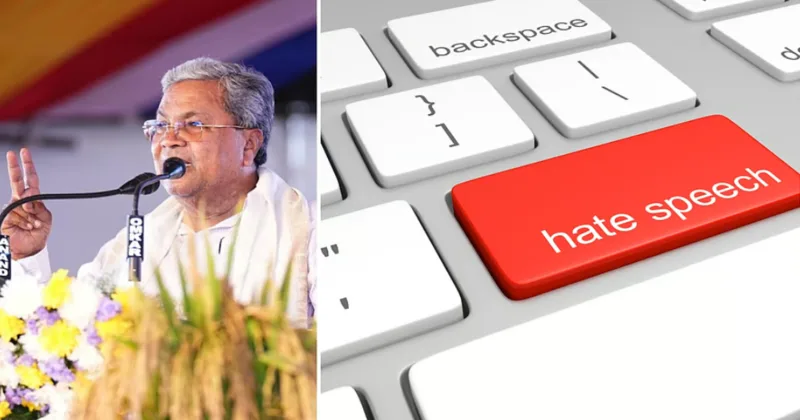
Karnataka CM Siddaramaiah LED Congress government introduces Hate Speech Bill
Belagavi: A major political storm erupted in the Karnataka Assembly on December 9after the Congress government tabled the Karnataka Hate Speech and Hate Crimes Prevention Bill 2025, drawing fierce resistance from the opposition BJP. The bill, introduced by Home Minister Dr G Parameshwara, aims to curb hate speech and hate-motivated offences across the state. However, the BJP alleged that the legislation is a political weapon designed to silence critics of the government.
The bill was introduced immediately after the Question Hour, and Speaker UT Khader sought the consent of the House through a voice vote. The moment Khader called for approval, BJP members aggressively opposed the move, shouting “no” in unison. Several BJP legislators, including V Sunil Kumar, demanded a division of votes, arguing that the government was pushing through a sensitive bill without consensus. Despite the objections, the Speaker proceeded with the introduction process, further fuelling opposition anger.
The proposed law provides for stringent penalties, including imprisonment ranging from one to seven years for first-time offences and up to ten years for repeat offenders. It also prescribes fines of up to one lakh rupees. Approved by the state cabinet on December 4, the bill seeks to regulate the dissemination, publication and broadcast of content that may incite hatred or ill will against individuals or communities.
According to the draft, hate speech is defined widely to include any expression intended to provoke hatred based on religion, caste, gender, sexual orientation, race, tribe, language, disability, place of birth or residence. The legislation further extends its reach to all forms of digital communication, including texts, images, audio, software, databases and signals transmitted through electronic systems.
The bill also brings a broad network of service providers under its purview. Channels, telecom providers, internet service providers, web-hosting platforms, social media companies, search engines, online marketplaces, online payment platforms and even cyber cafés could be held accountable for allowing the circulation of hate content. Non-compliance or negligence may expose these entities to legal consequences.
Any case filed under the proposed law will be non-bailable, and trials shall be conducted by a Judicial Magistrate First Class. Additionally, the bill empowers senior police officers — not below the rank of Deputy Superintendent of Police or an Executive Magistrate — to initiate investigations upon receiving credible information. This sweeping power, according to the opposition, is ripe for misuse.
BJP leaders launched a scathing attack on the government both inside and outside the Assembly. They accused the Congress administration of introducing a draconian law that could be selectively enforced against opposition leaders, activists and citizens critical of government policies. Several BJP MLAs alleged that the bill’s ambiguous definitions could criminalise legitimate political speech and dissent.
The opposition also questioned the timing of the bill, arguing that the Congress was attempting to project itself as a champion of social harmony while simultaneously targeting its political opponents. Many BJP leaders suggested that the legislation was rushed without adequate consultations, public opinion or cross-party scrutiny. They insisted that laws curbing speech must be framed with extreme caution, especially in a democracy.
Outside the House, BJP leaders reiterated that the bill threatens fundamental freedoms and could lead to excessive policing of online spaces. They demanded that the bill be referred to a joint select committee for detailed examination. Some leaders alleged that the Congress government was trying to divert attention from governance failures by creating the perception of moral reform.

Leave a Comment