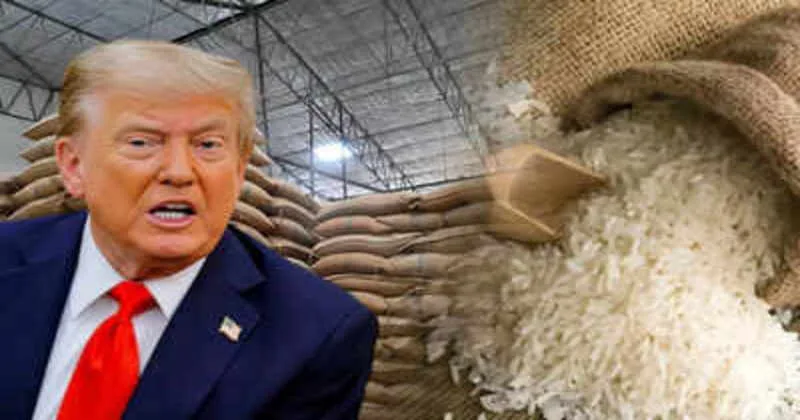
US President Donald Trump
Rice exporters in India have downplayed US President Donald Trump’s threat to impose heavy tariffs on Indian rice, saying the move will not have a meaningful impact on India’s rice trade. Trump, speaking on the issue recently, accused India of dumping cheap rice in the US market and warned that steep tariffs could be imposed to curb imports. He added that once tariffs are enforced, the issue would be “over in just two minutes.” However, the Indian Rice Exporters Federation has argued that any fresh tariff hike would hurt American consumers more than Indian exporters. According to exporters, a similar situation unfolded earlier when Trump raised tariffs on Indian rice from 10 per cent to 50 per cent. That increase, they say, did not reduce demand for Indian rice in the US; instead, it resulted in higher retail prices, with the burden ultimately falling on consumers.
Exporters pointed out that before the tariff hike, a 10-pound bag of rice in the US typically cost between $13 and $14. Following the increase, prices have risen to around $18–19 per bag. They stressed that Indian rice, particularly basmati, has a strong and loyal consumer base in the US, largely among people of Indian, Pakistani, Bangladeshi origin and immigrants from Gulf countries. These consumers prefer Indian rice for its quality and taste, which, exporters claim, American-grown rice does not match. India is the world’s largest rice producer and accounts for around 28 per cent of global rice exports. In terms of basmati rice, the US is India’s fourth-largest export destination. When basmati and non-basmati rice are combined, the US ranks tenth. In 2024, India exported rice worth approximately $386 million to the US. Despite this, only about 5.2 per cent of India’s total rice exports are destined for the American market.
If non-basmati rice alone is considered, the US slips to the 24th position among India’s export destinations. Saudi Arabia remains the largest buyer of Indian rice, followed by Iraq. Exporters argue that these figures clearly show India’s limited dependence on the US market and suggest that even an aggressive tariff hike would not materially damage India’s rice exports.
Nevertheless, Trump’s comments triggered an immediate reaction in Indian equity markets. Shares of rice-exporting companies came under pressure following the threat, falling by as much as 8 per cent in intraday trade. Stocks of major players such as KRBL, LT Foods and GRM Overseas all registered notable declines, reflecting investor anxiety over the possibility of trade disruptions. Market sentiment has also been affected by the US Federal Reserve’s key monetary policy announcement, scheduled later today in Indian time. There is a wide expectation that the Fed will cut its benchmark interest rate by 25 basis points, bringing it into the 3.5–3.75 per cent range. If this happens, it will mark the third consecutive rate cut.
However, investors are more focused on the Fed’s “dot plot,” which outlines policymakers’ expectations for economic performance and interest rate movements over the next year. Market participants fear that even if rates are cut today, the revised dot plot may signal no further rate reductions in 2026. According to analysts, the Fed believes sufficient monetary easing has already been provided and that additional cuts could risk reigniting inflation. This uncertainty has added to global market volatility. In the US, the S&P 500 declined 0.09 per cent, while the Dow Jones Industrial Average fell 0.38 per cent. Asian markets also traded lower, with Japan’s Nikkei down 0.41 per cent, China’s Shanghai Composite slipping 0.59 per cent, and Hong Kong’s Hang Seng index easing 0.38 per cent. European markets were largely flat to negative, with the UK’s FTSE index down 0.03 per cent. Concerns over renewed inflationary pressures in China have further unsettled investors. China’s industrial profits fell to a negative 5.5 per cent in October, highlighting persistent weaknesses in the manufacturing sector. At the same time, inflation in November climbed to 0.7 per cent, the highest level since February, compared with 0.2 per cent in October, raising fears of uneven economic recovery.
Trump-linked business group to invest Rs 1 lakh crore in India
Amid these global developments, a major investment announcement involving Trump-linked businesses drew attention in India. Trump’s business group revealed plans to invest Rs 1 lakh crore in India over the next 10 years, including in projects such as a proposed ‘Future City’ in Telangana. The announcement was made by Eric Swider, CEO of Trump Media and Technology Group Corporation and founding CEO of Trump’s social media platform, Truth Social, during the Telangana Rising Global Summit. Swider praised India’s technological progress, saying the country is increasingly emerging as a global leader in technology. He noted that two decades ago, India was largely seen as a “call centre,” but since then, it has made remarkable advances. According to him, India’s transformation is evident in the number of Indians now leading major global technology companies, reinforcing the country’s growing role in shaping the future of the global tech industry.
The investment announcement marks a notable shift from Donald Trump’s earlier remarks in which he had described the Indian economy as “dead,” a comment that drew sharp reactions at the time. The proposed Rs 1 lakh crore investment now signals a clear vote of confidence in India’s economic momentum and long-term growth potential. By committing capital to large-scale projects such as Telangana’s proposed ‘Future City,’ Trump-linked businesses appear to be acknowledging India’s resilience, expanding technology ecosystem and emerging global leadership, underscoring a contrast between past rhetoric and present economic engagement.

Leave a Comment