





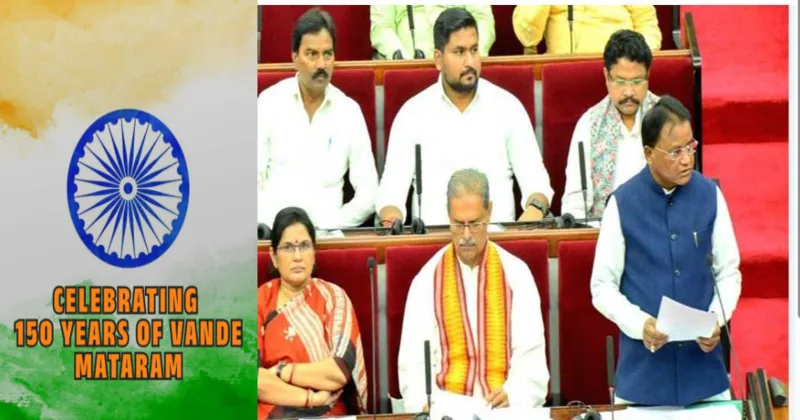
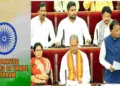
Bhubaneswar: On December 9, the Odisha Legislative Assembly unanimously adopted a resolution authorizing the state government to conduct a year-long celebration marking the 150th anniversary of Vande Mataram, the national song that played a defining role in India’s freedom struggle. The resolution, moved by Odia Language, Literature and Culture Minister Suryabanshi Suraj, garnered support from both the Biju Janata Dal (BJD) and the Congress following a brief discussion in the House.
Introducing the resolution, Minister Suraj stated that the objective of the statewide observance is to instill patriotism among children, youth, and students while also highlighting the cultural and historical legacy of Vande Mataram. He noted that Odisha has a special connection to Bankim Chandra Chattopadhyay—the author of Vande Mataram—as the state served as his “karma bhoomi” during his tenure as a government officer in Jajpur district.
During the discussion, Chief Minister Mohan Charan Majhi delivered an impassioned speech, describing Vande Mataram as “not merely a song, but the soul of Bharat,” a chant that has united generations of Indians through sacrifice, struggle, and shared national identity. He emphasized that commemorating the iconic composition is an opportunity to revive the values of patriotism, duty, and unity at a time when India is emerging as a global power.
Majhi hailed Bankim Chandra Chattopadhyay’s creation as a literary and cultural turning point in India’s freedom movement. “This song resonates with the rhythm of our breath and the passion in our blood,” he stated, adding that Bankim Chandra was not only a literary genius but also a visionary whose words “ignited a fire in every Indian heart.”
Historical references cited in the Assembly noted that Vande Mataram was composed on November 7, 1875, on the auspicious day of Akshaya Navami, and later featured in Chattopadhyay’s 1882 novel Anand Math. The song gained nationwide prominence after Rabindranath Tagore rendered it publicly for the first time in 1896. Its powerful invocation of the motherland as a divine figure deeply inspired freedom fighters, who turned it into a rallying cry against British rule.
The Chief Minister emphasized that the colonial government feared the song’s mobilizing power so intensely that it was banned at various points during the independence movement. “The image of the motherland as ‘Maa’ was a spiritual and emotional force that no amount of repression could suppress,” he remarked.
Majhi criticized attempts made in post-Independence India to diminish the stature of Vande Mataram by giving it a religious connotation. “To view Vande Mataram through the lens of religion is an injustice to history. It represents national unity and Indian identity beyond caste, religion, or region,” he argued.
Welcoming Prime Minister Narendra Modi’s decision to observe the 150th anniversary year of Vande Mataram until 7 November 2026, Majhi announced that Odisha would organize special events across districts, schools, universities, and cultural institutions as part of this national initiative. He noted that this year also coincides with several significant national milestones: the 75th anniversary of the Constitution, the 150th birth anniversaries of Sardar Vallabhbhai Patel and Bhagwan Birsa Munda, and the 350th martyrdom year of Guru Tegh Bahadur. All of these events reinforce the spirit of unity reflected in Vande Mataram.
The Chief Minister further emphasized that music and song played a transformative role during the freedom struggle, mobilizing people across regions. “Just as revolutionaries embraced martyrdom with ‘Mera Rang De Basanti Chola’ on their lips, Vande Mataram inspired millions to join the movement for liberation,” he stated.
Calling for bipartisan support, Majhi told the House that discussions surrounding Vande Mataram transcend politics and serve as a tribute to the sacrifices of freedom fighters. “Vande Mataram is a mantra that binds the nation together—a force of unity, not division,” he asserted.
He added that the unanimous passage of the resolution reflects a collective pledge towards nation-building. “This is not merely the anniversary of a song,” he said, “but a reaffirmation of India’s eternal cultural spirit and our shared commitment to building a stronger, united, and developed nation.” He expressed confidence that Vande Mataram would continue to serve as a symbol of national consciousness for generations to come.
Following the discussion, the Assembly passed the resolution by voice vote. As the proceedings concluded, the House stood as Vande Mataram was played over the sound system. All legislators joined in singing the first two stanzas, which were formally adopted by the Constituent Assembly as the national song. However, after the approved stanzas ended, Congress and BJD members staged a walkout, while the remaining portions of the song continued to play. BJP MLAs remained standing in respect until the rendition concluded.









Comments